
Plate Heat Exchangers for the Sugar Industry: Juice Heating, Cooling and Heat Recovery. Plate Heat Exchangers for the Sugar Industry Sugar production is both thermally intensive and operationally demanding. Large volumes of raw juice, limed juice, clarified juice, syrup, molasses, vapour and condensate move through the plant under changing temperatures, concentrations and fouling conditions. Efficient heat transfer affects steam consumption, evaporation capacity, product quality, uptime and the economics of the complete sugar season.
Plate heat exchangers for the sugar industry can provide compact, efficient heating, cooling, heat recovery, evaporation and condensation solutions when the plate type and channel geometry match the process stream. A fibrous raw-juice duty requires a different design from a cleaner clarified-juice or utility-water duty. High-viscosity syrup and molasses also require careful thermal and hydraulic evaluation.
Surya Sankara Trading Pvt. Ltd. is an Authorised Distributor for Alfa Laval products. Based in Hyderabad, the company supports sugar mills, refineries, distilleries and process plants evaluating Alfa Laval heat-transfer equipment, genuine spares and service requirements across India.
Why Heat Transfer Matters in Sugar Production
Sugar mills use heat repeatedly from juice preparation through evaporation, crystallisation and final product handling. Poor heat-transfer performance can increase vapour demand, restrict throughput, raise pressure drop and shorten operating time between cleaning cycles.
A properly engineered system can help a plant:
- heat raw, mixed or limed juice;
- preheat clarified juice before evaporation;
- recover energy from condensate or low-grade vapour;
- heat or cool syrup, remelt and molasses;
- increase or debottleneck evaporation capacity;
- condense vapour while keeping condensate and cooling water separated;
- reduce equipment footprint in retrofit projects;
- simplify inspection, cleaning and capacity modification.
The result depends on the complete process design. Equipment selection should be based on representative stream properties, expected fouling, utility conditions, allowable pressure drop and cleaning strategy—not only on flow rate or connection size.
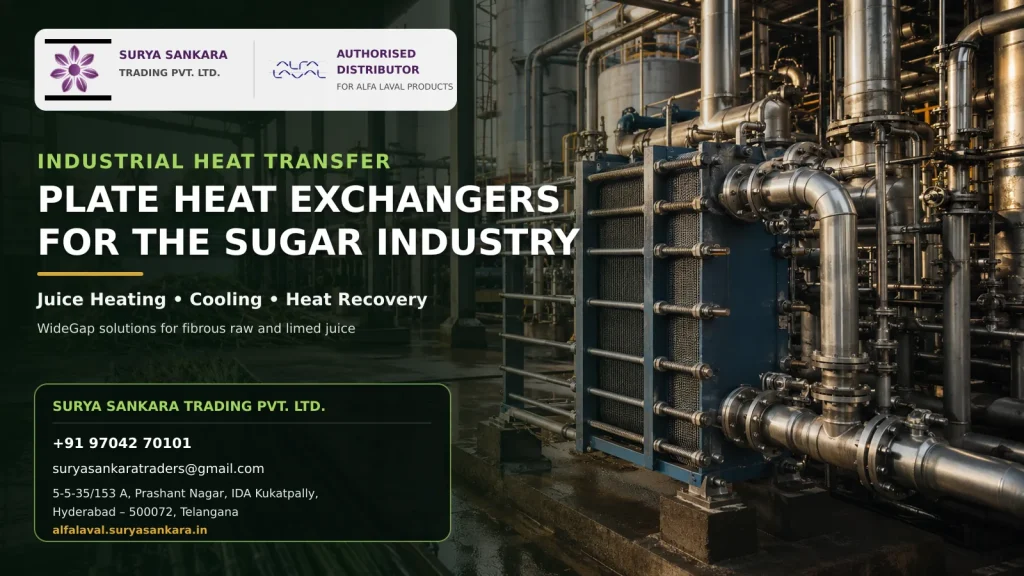
How a Plate Heat Exchanger Works
A gasketed plate-and-frame heat exchanger contains a series of corrugated plates compressed between a fixed frame plate and a movable pressure plate. Ports and gaskets direct the hot and cold media through alternate channels. Heat passes through the plates while the fluids remain separated under normal operating conditions.
Counter-current flow can produce a close temperature approach and effective heat recovery. Corrugations create turbulence, which improves heat transfer, but also contribute to pressure drop. The number of plates, plate pattern, channel gap, number of passes and connection arrangement must therefore be calculated together.
Sugar streams are not uniform. Fibre, suspended solids, crystals, viscosity and concentration can change substantially across the process. This is why a standard narrow-channel plate exchanger should not automatically be used for a fibrous or heavily contaminated stream.
Applications in Cane Sugar Mills and Refineries
1. Raw and Mixed Juice Heating
Raw or mixed cane juice can contain bagacillo, fibres and suspended matter. Conventional narrow passages may clog or foul quickly under these conditions. A wide-channel plate design can provide more space for solids and fibres to pass while retaining the thermal advantages of plate technology.
Alfa Laval identifies WideGap plate heat exchangers as a suitable option for heating fibrous sugar streams such as raw juice and limed juice. Depending on the engineered configuration, the heating medium may be liquid, steam or low-pressure vapour.
2. Limed Juice and Pre-Liming Heating
Heating during liming and clarification preparation affects downstream treatment. These streams may remain fibrous and fouling. The exchanger must tolerate the solids load while providing the required outlet temperature and manageable pressure drop.
WideGap units can be configured with wide channels on both sides or with a wide channel for the dirty process stream and a narrower channel for the cleaner heating medium. The correct choice depends on whether one or both fluids contain solids.
3. Clarified Juice Heating
After clarification, the cleaner juice can often be heated in a standard gasketed plate heat exchanger, subject to actual solids content and fouling behaviour. Heating clarified juice before the evaporator can increase the heat available for evaporation and may relieve an evaporation bottleneck.
Condensate or vapour bleed-offs may serve as heat sources where the plant heat balance permits. The benefit must be calculated using real flow, temperature and seasonal operating data.
4. Syrup Heating and Cooling
As water is removed, syrup becomes more concentrated and viscous. Viscosity affects heat transfer, pressure drop and product distribution. Selection requires concentration or Brix data at the relevant temperatures, not merely the nominal flow rate.
Plate heat exchangers may be considered for appropriate syrup heating or cooling duties. The plate pattern, gap, passes and velocity should balance thermal performance, product handling, fouling and pump capability.
5. Molasses Heating and Cooling
Molasses is highly viscous, particularly at lower temperatures. Its viscosity changes sharply with temperature and composition. An exchanger selected using water-like properties will be unreliable.
For molasses duties, provide viscosity-versus-temperature information, concentration, suspended solids, crystals, required temperature change and maximum permissible pressure drop. The engineering review must also consider start-up, shutdown and cleaning conditions.
6. Remelt and Refinery Sugar Liquids
Sugar refineries handle remelt liquor and other comparatively clean sugar liquids. Standard plate heat exchangers may provide efficient heating or cooling where stream cleanliness, viscosity and operating limits are suitable.
The product side must still be assessed for scaling, crystallisation and contamination risk. Plate and gasket materials should match the fluid chemistry, temperature and cleaning programme.
7. Process-Water and Utility Duties
Plate heat exchangers can also isolate or recover heat between utility circuits, including hot water, cooling water, condensate and other plant services. These cleaner duties often suit conventional gasketed plate-and-frame units.
A utility exchanger and a process-juice exchanger are not interchangeable merely because their heat loads are similar. Solids, viscosity, hygiene, corrosion and cleaning conditions remain different.
WideGap Plate Heat Exchangers for Fibrous Juice
Alfa Laval WideGap plate heat exchangers are developed for fibrous fluids and fluids containing coarse particles. Wider plate passages and suitable port geometry allow material to pass with less risk of blockage than in a conventional narrow-channel exchanger.
Potential advantages for a properly selected sugar duty include:
- handling of raw and limed juice containing fibres;
- use of low-grade vapour or condensate where thermally feasible;
- compact installation compared with many tubular alternatives;
- access for mechanical inspection and cleaning;
- capacity adjustment by modifying the plate pack where the frame permits;
- CIP or backflushing options when compatible with the deposit and plant procedure.
WideGap is not clog-proof. Excessive solids, foreign objects, unstable flow, unsuitable velocity or inadequate cleaning can still reduce performance. Straining, upstream process control and a planned cleaning procedure may be required.
Heat Recovery and Steam Economy
Sugar mills often have multiple heat sources at different temperature levels. A high-temperature source should not be consumed unnecessarily when a lower-grade source can perform the duty. Plate heat exchangers can help recover energy from condensate, pan vapour or later evaporator effects where temperature levels and process integration permit.
For example, low-grade heat may be used to preheat a cold juice stream before final heating. This can preserve more valuable steam for evaporation, power generation or other process requirements.
The achievable recovery depends on:
- hot- and cold-stream flow rates;
- inlet and target temperatures;
- temperature variation during the season;
- fouling allowances;
- pressure-drop limits;
- available heat-transfer area;
- control and bypass philosophy;
- condensate recovery requirements;
- the overall steam and vapour balance.
No fixed saving should be promised without a heat and mass balance. A case study from one mill cannot be applied as a guaranteed result for another plant.
Evaporation with AlfaVap
Evaporation concentrates clarified juice by removing water. Alfa Laval states that AlfaVap plate evaporators can be used as stand-alone effects, complete engineered evaporation arrangements or boosters to existing evaporators, depending on the plant design.
Potential engineering advantages include compactness, low liquid hold-up and short residence time. These characteristics can matter where space, product exposure time or expansion of existing evaporation capacity is important.
An evaporation project requires more than selecting a heat-transfer surface. Feed concentration, target concentration, vapour conditions, boiling-point elevation, circulation, entrainment, control, cleaning and mechanical design must all be evaluated.
Vacuum Condensation with AlfaCond
Sugar plants and refineries may need to condense vapour under vacuum. AlfaCond is designed as a plate surface condenser for vacuum duties. Its welded vapour channels and gasketed cooling-water channels keep condensate separated from the cooling medium under normal operation.
This can be valuable when clean condensate is to be recovered rather than mixed with cooling water. The suitability of AlfaCond depends on vapour load, vacuum level, non-condensable gases, cooling-water temperatures, permitted pressure drop, condensate subcooling and water quality.
Fouling, Scaling and Crystallisation
Fouling is one of the main selection and operating concerns in sugar processing. Deposits may arise from fibres, suspended solids, scale-forming minerals, organic matter, caramelised product or sugar crystallisation.
Warning signs include:
- failure to reach the target outlet temperature;
- increasing steam or utility consumption;
- rising pressure drop;
- reduced process flow;
- unstable control-valve position;
- shorter production runs between cleanings;
- visible leakage or contamination.
An oversized unit is not automatically the solution. Very low channel velocity may worsen distribution and cleaning. The plate pattern, channel gap, velocity, wall temperature and cleaning method should be selected as one system.
Cleaning and Backflushing
The cleaning method should match the deposit, exchanger materials and plant safety procedures. Options may include water flushing, backflushing, chemical cleaning-in-place or opening the plate pack for mechanical cleaning.
Before using a chemical cleaner, confirm:
- deposit composition;
- chemical type and concentration;
- cleaning temperature;
- exposure duration;
- compatibility with plates and gaskets;
- neutralisation, rinsing and disposal procedure.
Do not use metal tools or aggressive methods that scratch or deform heat-transfer plates. After opening, restore the plate order and tighten the pack only to the manufacturer’s specified dimension.
Plate and Gasket Material Selection
Material selection depends on both process and utility fluids. Stainless steel may suit many sugar duties, but chlorides, cleaning chemicals, pH, temperature and contaminants can alter corrosion risk.
Gasket compatibility must be checked against:
- process medium and concentration;
- temperature and pressure;
- steam or vapour exposure;
- cleaning chemicals;
- start-stop cycling;
- required food-contact compliance where applicable.
An unsuitable elastomer can harden, swell, crack or lose sealing force. Always identify the current plate and gasket specifications before ordering spares.
Plate Heat Exchanger vs Shell-and-Tube for Sugar Plants
Both technologies have valid applications. Plate heat exchangers can offer high thermal efficiency, close temperature approach, compact footprint and accessible heat-transfer surfaces. Shell-and-tube units may suit certain high-pressure, high-temperature, severe-fouling or mechanically demanding services.
For fibrous juice, a WideGap plate exchanger—not an ordinary narrow-channel PHE—is the relevant comparison. The decision should consider:
- solids and fibre size;
- viscosity and concentration;
- design pressure and temperature;
- fouling and cleaning frequency;
- pressure-drop allowance;
- plot space and retrofit constraints;
- seasonal operating pattern;
- lifecycle service requirements.
Data Required for Equipment Selection
For each operating case, provide:
- Stream name: raw juice, limed juice, clarified juice, syrup, molasses, condensate or utility
- Normal, minimum and maximum flow rates
- Hot- and cold-side inlet and target outlet temperatures
- Brix or solids concentration
- Density, viscosity and specific heat at operating temperature
- Fibre, suspended-solids and crystal content, including particle size where available
- Maximum allowable pressure drop on both sides
- Operating and design pressures and temperatures
- Steam, vapour or condensate conditions
- Plate and gasket material requirements
- Fouling history and existing cleaning procedure
- Available connections, footprint and maintenance clearance
- Seasonal run length and planned shutdown windows
- Existing equipment drawings and performance data for retrofit enquiries
Accurate data prevents both undersizing and unnecessary oversizing.
Maintenance During the Crushing Season
A planned inspection programme can reduce unplanned downtime. Operators should trend flow, inlet and outlet temperatures, pressure drop and utility consumption from a clean baseline.
Recommended practices include:
- checking strainers and upstream separation equipment;
- investigating gradual pressure-drop increases;
- inspecting for external leakage;
- verifying control valves and instruments;
- recording each cleaning cycle and its result;
- checking gaskets for hardening, cracking or displacement;
- inspecting plates for deposits, corrosion, deformation or cracks;
- performing integrity testing when appropriate;
- keeping correctly identified genuine spares available before the season.
If plant capacity, Brix, temperatures or utility conditions change, the exchanger should be re-rated rather than assumed to remain suitable.
Support for Sugar Mills and Refineries in India
India’s sugar industry spans Maharashtra, Uttar Pradesh, Karnataka, Tamil Nadu, Telangana, Andhra Pradesh, Gujarat and other cane-producing regions. Each plant has a different steam balance, crushing rate, cane quality, water chemistry and seasonal operating strategy.
Surya Sankara Trading Pvt. Ltd. supports enquiries for:
- WideGap exchangers for fibrous raw or limed juice;
- clarified-juice heating;
- syrup, remelt and molasses duties;
- heat-recovery and retrofit evaluation;
- AlfaVap evaporation applications;
- AlfaCond vacuum-condensation duties;
- standard gasketed plate heat exchangers for utilities;
- genuine Alfa Laval plates and gaskets;
- cleaning, inspection and maintenance requirements.
Frequently Asked Questions
Which heat exchanger is suitable for raw sugarcane juice?
A wide-channel plate heat exchanger may suit raw or limed juice containing fibres. Alfa Laval WideGap is designed for fibrous fluids and coarse particles, but the final configuration must be selected from actual solids, flow, temperature and pressure-drop data.
Can a standard plate heat exchanger handle clarified juice?
Often yes, because clarified juice is cleaner than raw juice. Residual solids, fouling, concentration, temperature and pressure drop must still be evaluated before selection.
Can plate heat exchangers heat or cool molasses?
They may suit certain molasses duties, but viscosity changes strongly with temperature. Reliable selection requires viscosity, Brix, solids, flow and allowable pressure-drop data.
How can a sugar mill recover waste heat?
Where the heat balance permits, a plate heat exchanger can transfer energy from condensate, low-pressure vapour or another warm stream to incoming juice or water. The opportunity must be confirmed through a thermal study.
Are WideGap heat exchangers easy to clean?
They can be cleaned by appropriate CIP, backflushing or mechanical methods depending on the deposit and installation. No exchanger is maintenance-free, and cleaning procedures must be compatible with its materials.
Can a plate heat exchanger increase sugar-plant capacity?
It may help remove a heating or evaporation bottleneck, and certain gasketed units can be expanded by adding plates if the frame allows. The complete process must be reviewed before predicting a capacity increase.
Where can sugar mills obtain Alfa Laval heat exchangers in India?
Surya Sankara Trading Pvt. Ltd. is an Authorised Distributor for Alfa Laval products and supports sugar-industry heat-transfer enquiries from Hyderabad and customers across India.
Request a Technical Discussion
Planning raw-juice heating, clarified-juice preheating, syrup cooling, heat recovery, evaporation or vacuum condensation? Share your process data with Surya Sankara Trading Pvt. Ltd. for a technical discussion.
Surya Sankara Trading Pvt. Ltd.
Authorised Distributor for Alfa Laval products
Office: 5-5-35/153 A, Prashant Nagar, IDA Kukatpally, Hyderabad – 500072, Telangana
Phone: +91 97042 70101
Email: suryasankaratraders@gmail.com
Website: https://suryasankara.in/
Suggested Readings and further information on:
- What Is a Plate Heat Exchanger?
- How to Select a Plate Heat Exchanger
- Plate Heat Exchanger vs Shell & Tube Heat Exchanger
- Energy Saving Using Plate Heat Exchangers
- Plate Heat Exchanger Cleaning Guide
- Plate Heat Exchanger Maintenance Guide
- Decanter Centrifuge Applications
Please check more technical information on Alfa Laval website
Use one or two naturally within the published article. nofollow is not necessary for authoritative informational sources.
Disclaimer
This microsite is operated by Surya Sankara Trading Pvt. Ltd., an Authorised Distributor for Alfa Laval products. It is not Alfa Laval’s corporate website. Alfa Laval product names and trademarks belong to their respective owner.