
m line
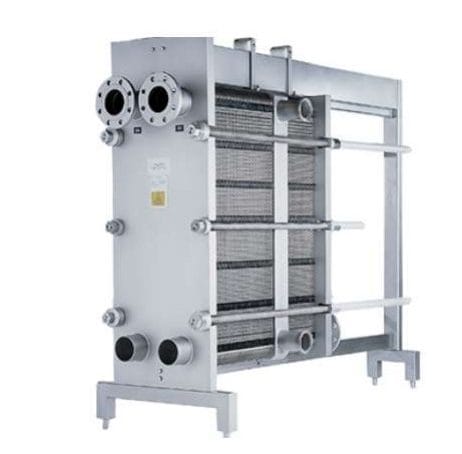
benefits
- High energy efficiency – low operating cost
- Flexible configuration – heat transfer area can be modified
- Easy to install – compact design
- High serviceability – easy to open for inspection and cleaning and easy to clean by CIP
- Access to Alfa Laval’s global service network
Alfa Laval M line of gasketed plate-and-frame heat exchangers are used for high design pressure (>10 bar/145 psi), such as in carbonated beverages. The large range of plate and gasket types comply with Food Contact Materials (FCM) requirements for pasteurization and other heating and cooling duties in hygienic and utility applications in the dairy, food, beverage and pharmaceutical industries.
Gasketed plate-and-frame heat exchangers are highly efficient devices used for transferring heat between two fluids. Comprising a series of metal plates sealed with gaskets, these exchangers facilitate the exchange of thermal energy through their large surface area. The plates create alternating channels for the hot and cold fluids, ensuring maximum contact and heat transfer.
The gaskets, typically made of elastomers, contribute to a tight seal, preventing fluid mixing and ensuring operational integrity. This design allows for easy disassembly and maintenance, as individual plates can be removed for cleaning or replacement without dismantling the entire unit.
The efficiency of gasketed plate-and-frame heat exchangers stems from their ability to handle high temperatures and pressures while maintaining a compact footprint. Their modular construction makes them suitable for a wide range of applications, including HVAC systems, industrial processes, and renewable energy systems.
These heat exchangers are favored for their energy efficiency, cost-effectiveness, and adaptability to varying thermal loads. With their robust design and versatility, gasketed plate-and-frame heat exchangers play a crucial role in optimizing heat transfer processes across diverse industries, contributing to enhanced energy conservation and system performance.
Alfa Laval M Line Gasketed Plate Heat Exchangers
Alfa Laval M Line plate heat exchangers are gasketed plate-and-frame units designed for a broad range of industrial heating, cooling and heat-recovery duties.
Their compact construction, efficient heat-transfer surface and accessible plate pack make M Line heat exchangers suitable for applications requiring dependable thermal performance and service flexibility.
Surya Sankara Trading Pvt. Ltd. supports customers in Hyderabad, Telangana and other South Indian locations with Alfa Laval M Line product enquiries, preliminary selection discussions, genuine spare-parts requirements and service coordination.
Surya Sankara Trading Pvt. Ltd. is an Authorised Distributor for Alfa Laval products.
What Is an Alfa Laval M Line Heat Exchanger?
The Alfa Laval M Line is a range of gasketed plate-and-frame heat exchangers. Each unit contains a pack of corrugated metal plates mounted between a fixed frame plate and a movable pressure plate.
Elastomeric gaskets fitted between the plates:
Direct the fluids through alternating channels
Keep the hot and cold fluids separated
Seal the plate pack from the surroundings
Heat passes across the thin metal plates from the warmer medium to the colder medium without the two fluids mixing during normal operation.
The required M Line model and configuration depend on the process duty, flow rates, temperatures, pressures and material requirements.
How Does an M Line Plate Heat Exchanger Work?
In a typical liquid-to-liquid application, the hot and cold fluids flow through alternate channels, commonly in a counter-current arrangement.
The corrugated plate pattern:
Creates turbulence
Supports effective fluid distribution
Provides mechanical strength to the plate pack
Produces a large heat-transfer surface
Helps achieve efficient thermal performance
Counter-current flow can support close temperature approaches and effective heat recovery where the process conditions permit.
Benefits of M Line Plate Heat Exchangers
Efficient Heat Transfer
Thin plates and turbulent flow create favourable conditions for transferring heat between fluids. The exact performance depends on the thermal design and operating conditions.
Compact Footprint
Compared with certain conventional exchanger designs, a gasketed plate heat exchanger can provide the required heat-transfer area within a compact installation.
Accessible Plate Pack
The unit can be opened for inspection and mechanical cleaning after it has been correctly isolated, depressurised, drained and cooled.
Flexible Capacity
Depending on the selected model and available frame capacity, plates may sometimes be added or removed to accommodate revised thermal requirements.
Material Options
Different plate and gasket materials may be available for various fluids and temperatures. Final compatibility must be confirmed for the complete operating conditions.
Multiple Connection and Pass Arrangements
M Line units can be configured for different connection positions and flow arrangements, subject to the selected model and thermal design.
Heat-Recovery Potential
Close temperature approaches can make gasketed plate heat exchangers suitable for recovering usable heat from compatible process streams.
M Line Applications
Alfa Laval M Line plate heat exchangers may be considered for:
Process-water heating and cooling
Cooling-water systems
Closed-loop cooling
Heat recovery
Lube-oil cooling
Hydraulic-oil cooling
Boiler-water separation
Hot-water generation
Glycol and brine cooling
HVAC heating and cooling
District heating
Industrial refrigeration
Marine cooling
Utility-water applications
General industrial processes
Application suitability must be determined using actual process information.
Industrial Heating Applications
An M Line heat exchanger can transfer energy from steam, hot water or another compatible heating medium to a process stream.
Potential duties include:
Process-water heating
Cleaning-water preparation
Hot-water circulation
Boiler-loop separation
Tank-heating circulation
Utility-water heating
Low-temperature process heating
For steam applications, condensate handling, control-valve arrangement, pressure, temperature and start-up conditions must be included in the design.
Industrial Cooling Applications
M Line heat exchangers may be used to cool process water, oils, glycol solutions and other compatible liquids.
Cooling sources can include:
Cooling-tower water
Chilled water
Closed cooling water
Seawater, with suitable materials
Glycol or brine
Another available process stream
Fluid composition and water quality must be reviewed to select suitable plate and gasket materials.
Heat-Recovery Applications
Waste heat from a hot process stream may sometimes be transferred to a colder stream that requires heating.
Potential benefits can include:
Lower fuel or steam demand
Reduced cooling load
Better use of available process energy
Reduced utility consumption
Improved overall thermal integration
Savings depend on the flow rates, temperature difference, operating hours, pressure drop and utility costs. No fixed energy-saving percentage should be promised without an application-specific calculation.
M Line for HVAC Applications
Gasketed plate heat exchangers may be used in HVAC systems for:
Chilled-water circuit isolation
Cooling-tower isolation
Boiler-loop separation
District cooling
Free cooling
Heat-pump systems
Thermal-storage circuits
Pressure-zone separation
The selected exchanger must meet the required capacity, temperatures, pressure drop and water-quality conditions.
M Line for Oil Cooling
M Line plate heat exchangers can be evaluated for cooling lubricating oil, hydraulic oil and other compatible oils.
Oil viscosity varies with temperature and can influence channel selection and pressure drop. Please provide the oil grade, flow rate, inlet and required outlet temperatures, pressure and cooling-medium details.
M Line for Marine Applications
With appropriate plate and gasket materials, gasketed plate heat exchangers may be used for selected marine cooling duties such as:
Central cooling
Engine jacket-water cooling
Lubricating-oil cooling
Freshwater generation support
Auxiliary-system cooling
Seawater composition, temperature, fouling and material compatibility require careful evaluation.
Plate Material Selection
Plate material should be selected according to the process and utility fluids, temperature and corrosion risk.
Depending on model and application, possible materials may include stainless-steel grades, titanium or specialised alloys.
Selection must consider:
Chloride concentration
Fluid pH
Operating temperature
Chemical concentration
Cleaning chemicals
Dissolved gases
Possible contaminants
Erosion risk
Do not select plate material solely by industry name or general corrosion charts.
Gasket Material Selection
Gasket compatibility is influenced by:
Fluid composition
Temperature
Pressure
Oils and hydrocarbons
Cleaning chemicals
Steam exposure
Operating cycle
Required service life
The correct gasket should be verified against the actual process conditions and heat exchanger model. Visual appearance or colour alone is insufficient for gasket identification.
Information Required to Select an M Line Heat Exchanger
Please provide:
Hot and cold fluid names
Fluid compositions
Flow rates
Inlet temperatures
Required outlet temperatures
Operating pressures
Design pressures and temperatures
Allowable pressure drop
Density and viscosity
Solids or fibre content
Fouling tendency
Material restrictions
Connection requirements
Available installation space
Applicable standards
Plant location
Complete process information helps avoid excessive pressure drop, unsuitable materials or inadequate thermal capacity.
Maintenance of M Line Heat Exchangers
Maintenance requirements depend on the fluids, temperatures, gasket material, operating hours and fouling tendency.
Routine checks may include:
Monitoring inlet and outlet temperatures
Monitoring pressure drop
Checking for external leakage
Inspecting the plate-pack alignment
Checking the specified tightening dimension
Examining the frame and tightening bolts
Reviewing gasket condition
Following an appropriate cleaning schedule
Maintaining suitable replacement plates and gaskets
Do not repeatedly tighten a leaking plate pack without identifying the cause and checking the manufacturer’s specified compression dimension.
Cleaning M Line Plate Heat Exchangers
Cleaning may be completed through an approved cleaning-in-place process or by safely opening the unit and cleaning individual plates.
The cleaning method must be compatible with:
The deposit
Plate material
Gasket material
Adhesive, where applicable
Process hygiene requirements
Waste-disposal requirements
Aggressive chemicals, metal tools or abrasive methods can damage the heat-transfer surfaces and should not be used without approval.
M Line Spare Plates and Gaskets
When requesting spare parts, provide:
Heat exchanger model
Serial number
Clear nameplate photograph
Plate material
Gasket material, if known
Existing plate quantity
Process and utility fluids
Required quantity
Plant location
Surya Sankara Trading can support enquiries for genuine Alfa Laval M Line plates, gaskets and applicable service components. Compatibility and availability must be confirmed against the exact equipment identification.
M Line Versus Brazed Plate Heat Exchangers
An M Line unit can be opened for appropriate inspection, cleaning and gasket replacement. Its capacity may also be adjustable in certain configurations.
A brazed plate heat exchanger is permanently joined and normally cannot be opened. It is often selected for compact duties with compatible fluids.
The appropriate choice depends on:
Fluid compatibility
Required capacity
Temperature and pressure
Cleaning requirements
Service accessibility
Available footprint
Lifecycle considerations
M Line Versus Semi-Welded Plate Heat Exchangers
M Line gasketed units use gaskets between individual plates. Semi-welded units use welded plate pairs or cassettes, reducing gasket exposure on one side.
Semi-welded construction may be preferable for refrigerants or selected aggressive fluids. Fully gasketed M Line construction may be preferable where both fluids are gasket-compatible and access to individual plates is important.
M Line Heat Exchangers in Hyderabad and South India
Surya Sankara Trading supports industrial customers in Hyderabad, Telangana and other South Indian locations with Alfa Laval M Line heat exchanger enquiries.
Customers can contact us regarding:
New heating and cooling duties
Existing heat exchanger replacement
Heat-recovery applications
Capacity-expansion enquiries
Plate and gasket requirements
Performance problems
Cleaning and maintenance requirements
Application-based model selection
The appropriate M Line model must be determined from verified process data rather than connection size or external dimensions alone.
Why Contact Surya Sankara Trading?
Authorised Distributor for Alfa Laval products
Hyderabad-based industrial contact point
Application-focused product enquiries
Support with preliminary process-data collection
Genuine Alfa Laval spare-parts enquiries
Maintenance and service coordination
Support across Telangana and South India
Frequently Asked Questions
What is the Alfa Laval M Line?
The M Line is a range of gasketed plate-and-frame heat exchangers used for industrial heating, cooling and heat-recovery duties.
What does the “M” in Alfa Laval M Line mean?
M Line is Alfa Laval’s range designation for particular gasketed plate heat exchanger models. The exact model must be selected according to the application and required capacity.
What fluids can an M Line heat exchanger handle?
It can handle various compatible liquids, including water, glycol, brine and selected oils or process fluids. Plate and gasket materials must be selected for the actual media.
Can M Line heat exchangers handle steam?
Selected models and configurations may be used for steam-heating duties. Steam pressure, condensate arrangement, temperature and control conditions must be evaluated.
Can an M Line heat exchanger be opened?
Yes. After safe isolation and depressurisation, the frame can be opened according to the manufacturer’s instructions to access the plate pack.
Can additional plates be installed?
Additional plates may be possible where the model, frame capacity, connection size and thermal design permit. A technical review is required.
How is the correct M Line model selected?
Selection requires fluid properties, flow rates, temperatures, pressures, allowable pressure drop, material requirements and thermal duty.
What causes pressure drop to increase?
Fouling, blocked channels, excessive flow, incorrect plate arrangement or increased fluid viscosity can raise pressure drop.
Why does an M Line heat exchanger leak?
Possible causes include aged or incompatible gaskets, incorrect tightening, gasket displacement, plate damage, excessive pressure or thermal cycling.
Can individual plates and gaskets be replaced?
Yes, individual components can generally be replaced when correctly identified and compatible with the model and plate arrangement.
How should the plates be cleaned?
Use an approved cleaning-in-place or manual-cleaning procedure compatible with the deposit, plate alloy and gasket material.
Is M Line suitable for seawater?
Selected units may use suitable corrosion-resistant plate materials for seawater applications. Temperature, chloride content and operating conditions must be reviewed.
What is the difference between M Line and Alfa Laval Industrial Line?
Both are gasketed plate heat exchanger ranges, but available sizes, plate technologies, connection options and design features may differ. Selection should be based on current product availability and the process requirement.
Does Surya Sankara supply M Line heat exchangers in Hyderabad?
Surya Sankara Trading supports Alfa Laval M Line product, spare-parts and application enquiries in Hyderabad, Telangana and other South Indian locations.
Is Surya Sankara Trading an Alfa Laval authorised distributor?
Yes. Surya Sankara Trading Pvt. Ltd. is an Authorised Distributor for Alfa Laval products.
Request an M Line Heat Exchanger Quote
Send your heating, cooling or heat-recovery requirement to Surya Sankara Trading for preliminary review.
Please provide:
Fluid names
Flow rates
Inlet and outlet temperatures
Operating and design pressures
Allowable pressure drop
Plate and gasket material restrictions
Plant location
Mobile: +91 97042 70101
Email: suryasankaratraders@gmail.com
Location: Hyderabad, Telangana
Further readings on Plate Heat exchangers
- What is plate heat exchanger
- Benefits of plate heat exchangers
- Plate heat exchanger maintenance guide
- How to select a plate heat exchanger
- Common plate heat exchanger problems
- Plate heat xchanger cleaning guide
- Energy saving using plate heat exchanger
- Plate heat exchanger buying guide
- Plate heat echanger or pharmaceutical industry
- Plate heat exchanger for food & beverage processing