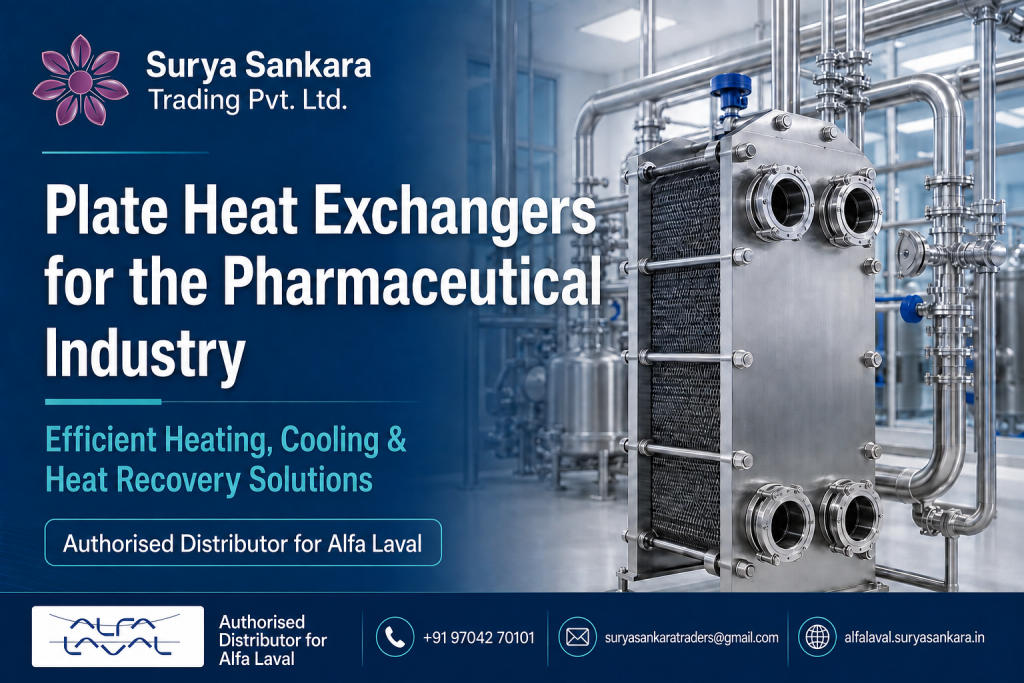
Plate Heat Exchangers for the Pharmaceutical Industry: Applications and Benefits.Plate heat exchangers for the pharmaceutical industry provide efficient heating, cooling and heat recovery across a wide range of manufacturing and utility processes. Accurate temperature control is essential in pharmaceutical production because even minor temperature variations can affect process consistency, product quality, energy consumption and manufacturing efficiency.
Pharmaceutical plants use heat exchangers in process utilities, purified-water systems, heating and cooling circuits, clean utilities and other temperature-control applications. However, every pharmaceutical duty has different requirements. The appropriate heat exchanger must therefore be selected according to the process fluid, temperature, pressure, hygiene level, cleanability, documentation requirements and risk of cross-contamination.
Surya Sankara Trading Pvt. Ltd. is an Authorised Distributor for Alfa Laval products, providing heat transfer equipment, genuine spare parts and technical support for industrial applications.
What Is a Pharmaceutical Plate Heat Exchanger?
A pharmaceutical plate heat exchanger transfers heat between two fluids through a series of thin, corrugated metal plates. The hot and cold fluids flow through alternate channels without normally coming into direct contact.
The large plate surface area and controlled flow pattern enable rapid heat transfer within a relatively compact unit. Compared with many conventional heat transfer systems, plate heat exchangers can offer:
- High thermal efficiency
- Compact installation
- Close temperature control
- Lower utility consumption
- Flexible heat transfer capacity
- Easier access for inspection and maintenance
- Heat recovery opportunities
- Reduced equipment footprint
Depending on the application, pharmaceutical manufacturers may use gasketed plate heat exchangers, hygienic plate heat exchangers, welded units, brazed units or tubular heat exchangers.
A plate heat exchanger should not automatically be selected for every pharmaceutical duty. Critical applications involving Purified Water, Water for Injection or strict hygienic requirements may require specifically designed hygienic or tubular heat exchangers. Selection must be based on the actual process and compliance requirements.
Applications of Plate Heat Exchangers in Pharmaceutical Manufacturing
Plate Heat Exchangers for Pharmaceutical Industry can support numerous processes and utility systems in pharmaceutical and biotechnology facilities.
1. Pharmaceutical Process Heating
Many pharmaceutical operations require controlled heating of process fluids, intermediate products or utility streams. A plate heat exchanger can transfer thermal energy efficiently while helping maintain the required operating temperature.
Applications may include:
- Heating process water
- Preheating feed streams
- Heating cleaning solutions
- Temperature control for manufacturing processes
- Hot-water circulation systems
- Utility heating duties
The final equipment configuration depends on the characteristics of the fluid and whether it is a product-contact or utility-side application.
2. Pharmaceutical Process Cooling
Heat generated during mixing, formulation, reaction, compression and other production activities must be controlled. Plate heat exchangers can transfer unwanted heat from the process to cooling water, chilled water or another suitable cooling medium.
Pharmaceutical process cooling applications can include:
- Reactor cooling circuits
- Cooling process water
- Chilled-water systems
- Equipment cooling
- Cooling utility fluids
- Temperature control for manufacturing areas
- Cooling after thermal processing
Effective cooling can improve process stability, protect sensitive materials and reduce the risk of production interruptions caused by excessive temperatures.
3. Purified Water and Clean-Utility Systems
Purified Water systems require carefully selected equipment because hygiene, drainability, cleanability, surface finish and prevention of contamination are critical.
Depending on the system design, a heat exchanger may be used for heating, cooling or maintaining the temperature of water circulating through a pharmaceutical facility.
However, not every standard plate heat exchanger is appropriate for Purified Water or Water for Injection applications. These duties may require specialized hygienic or tubular designs, suitable materials, validated construction and appropriate documentation.
The process designer should evaluate:
- Required hygiene standard
- Surface finish
- Materials of construction
- Drainability
- Possibility of stagnant areas
- Cleaning and sanitization method
- Leakage-detection requirements
- Documentation and validation requirements
- Risk of cross-contamination
4. Clean-in-Place System Temperature Control
Clean-in-Place systems circulate water and cleaning solutions through process equipment without requiring the entire production system to be dismantled.
Heat exchangers can assist with:
- Heating cleaning solutions
- Maintaining the required cleaning temperature
- Cooling circulated fluids when necessary
- Improving cleaning-cycle consistency
- Recovering heat from returning cleaning fluids
The selected heat exchanger must be compatible with the cleaning chemicals, operating temperature and cleaning procedure used by the pharmaceutical facility.
5. Heating, Ventilation and Air-Conditioning Systems
Pharmaceutical manufacturing facilities require controlled indoor conditions. HVAC systems may need to maintain specified temperature, humidity and pressure conditions across production rooms, laboratories, storage areas and cleanrooms.
Plate heat exchangers can be used in HVAC utility circuits for:
- Chilled-water separation
- Cooling-tower isolation
- Boiler and hot-water circuits
- Heat recovery
- Free-cooling systems
- District cooling interfaces
- Protecting sensitive equipment from contaminated utility circuits
Their compact footprint is particularly useful where plant-room space is limited.
6. Heat Recovery in Pharmaceutical Plants
Pharmaceutical production can generate significant amounts of recoverable heat. Instead of rejecting all this energy, a properly designed heat exchanger can transfer it to another process or utility stream.
Potential heat recovery applications include:
- Preheating incoming process water
- Recovering heat from hot discharge streams
- Heating cleaning water
- Preheating boiler feed water
- Recovering energy from utility systems
- Reducing heating and cooling loads
Heat recovery may reduce steam demand, cooling load and overall energy consumption. Actual savings depend on the temperatures, flow rates, operating hours and compatibility of the available streams.
Benefits of Plate Heat Exchangers for Pharmaceutical Plants
Plate Heat Exchangers for Pharmaceutical Industry
High Heat Transfer Efficiency
Corrugated plates create controlled turbulence and a large effective heat transfer surface. This allows efficient heating or cooling with a relatively small temperature difference in suitable applications.
Compact Equipment Footprint
Plate heat exchangers can provide substantial heat transfer capacity within a compact frame. This is valuable in pharmaceutical facilities where utility-room and production-floor space are limited.
Accurate Temperature Control
Consistent temperature control supports process repeatability and dependable manufacturing. A correctly selected heat exchanger can respond effectively to variations in operating conditions.
Energy Savings
High thermal efficiency and heat recovery can help reduce the consumption of steam, chilled water, cooling water and electricity.
Flexible Capacity
In suitable gasketed plate heat exchanger designs, thermal capacity may be modified by adding or removing plates, subject to frame capacity and engineering evaluation.
Serviceability
Gasketed plate heat exchangers can be opened for plate inspection, mechanical cleaning and gasket replacement. This can simplify maintenance when compared with equipment that has inaccessible internal heat transfer surfaces.
Reduced Fouling Potential
Correct plate geometry, flow distribution and operating velocity can help reduce deposits. Fouling performance nevertheless depends on the fluid properties, temperature and operating conditions.
How to Select a Heat Exchanger for the Pharmaceutical Industry
Selection should never be based only on connection size or equipment price. The supplier must evaluate the complete duty.
Important information includes:
- Type of process fluid
- Inlet and outlet temperatures
- Required flow rate
- Operating and design pressure
- Allowable pressure drop
- Fluid viscosity
- Solids or particle content
- Corrosion characteristics
- Required materials of construction
- Hygiene and cleanability requirements
- Cleaning chemicals and procedures
- Possibility of product contamination
- Applicable pharmaceutical standards
- Documentation requirements
- Available installation space
- Future capacity requirements
For hygienic applications, additional attention may be required for surface finish, gasket compliance, full drainability, channel design and prevention of cross-contamination.
Read our detailed guide on how to select a plate heat exchanger before preparing your technical enquiry.
Maintenance of Pharmaceutical Heat Exchangers
Preventive maintenance helps preserve heat transfer efficiency, operational reliability and service life.
A typical maintenance programme may include:
- Monitoring inlet and outlet temperatures
- Checking pressure drop
- Inspecting for external leakage
- Examining plate and gasket condition
- Cleaning deposits at suitable intervals
- Checking frame tightening dimensions
- Replacing worn or damaged gaskets
- Verifying instrument performance
- Maintaining service and inspection records
- Reviewing performance after process changes
A sudden reduction in heat transfer efficiency or increase in pressure drop may indicate fouling, blocked channels, flow imbalance or another operating problem.
For detailed maintenance information, read our plate heat exchanger maintenance guide and plate heat exchanger cleaning guide.
Alfa Laval Heat Transfer Solutions for Pharmaceutical Applications
Alfa Laval provides heat transfer technologies for hygienic and industrial processes. Its portfolio includes hygienic plate heat exchangers and specialized tubular heat exchangers for pharmaceutical and biotechnology applications.
Alfa Laval’s Hygienic line is designed around process hygiene, product safety, cleanability, flow distribution and energy efficiency. Different equipment configurations are available because pharmaceutical applications vary considerably in their operating and compliance requirements.
Surya Sankara Trading Pvt. Ltd. assists customers with Alfa Laval heat transfer requirements based on the available application data. Support can include:
- Application review
- Heat exchanger selection
- Supply of genuine Alfa Laval equipment
- Installation and commissioning assistance
- Genuine plates and gaskets
- Preventive maintenance support
- Cleaning and servicing guidance
- Troubleshooting
- Performance evaluation
- Replacement and upgrade consultation
Plate Heat Exchanger Supplier for Pharmaceutical Industries in Hyderabad
Hyderabad is one of India’s leading pharmaceutical and biotechnology manufacturing centres. Pharmaceutical companies in Hyderabad, Telangana and Andhra Pradesh require reliable heat transfer equipment supported by appropriate product selection and accessible technical assistance.
Surya Sankara Trading Pvt. Ltd., based in Hyderabad, supports industrial customers seeking Alfa Laval heating, cooling and heat recovery solutions.
Customers should provide process data such as fluid type, flow rate, inlet and outlet temperatures, pressure, allowable pressure drop, hygiene requirements and cleaning method. This information helps the technical team evaluate the appropriate heat exchanger configuration.
Frequently Asked Questions
What are plate heat exchangers used for in the pharmaceutical industry?
Plate heat exchangers can be used for process heating, process cooling, chilled-water circuits, hot-water systems, HVAC utilities, cleaning systems and industrial heat recovery. Suitability depends on the process and hygiene requirements.
Are plate heat exchangers suitable for Purified Water systems?
Certain specially designed heat exchangers may be suitable for Purified Water duties. Equipment selection must consider materials, surface finish, drainability, cleanability, documentation and the risk of cross-contamination.
Can a standard plate heat exchanger be used for Water for Injection?
A standard industrial plate heat exchanger should not automatically be selected for a Water for Injection application. Such duties may require specialized hygienic or tubular equipment designed for pharmaceutical water systems.
How can plate heat exchangers save energy in a pharmaceutical plant?
They can recover heat from hot process or utility streams and reuse it to preheat another stream. This may reduce steam, chilled-water and cooling-water consumption.
What information is required to select a pharmaceutical heat exchanger?
Selection normally requires fluid properties, flow rates, inlet and outlet temperatures, design pressure, allowable pressure drop, materials, hygiene requirements, cleaning procedure and required documentation.
Who supplies Alfa Laval heat exchangers in Hyderabad?
Surya Sankara Trading Pvt. Ltd. is an Authorised Distributor for Alfa Laval products and supports industrial customers with heat transfer equipment, genuine spare parts and technical assistance.
Discuss Your Pharmaceutical Heat Transfer Requirement
Are you planning a new pharmaceutical heating or cooling system, replacing an existing heat exchanger or looking to improve energy efficiency?
Share your process fluid, flow rate, temperatures, pressure, hygiene requirements and application details with Surya Sankara Trading Pvt. Ltd. Our team can help evaluate a suitable Alfa Laval heat transfer solution for your pharmaceutical facility.
Contact Surya Sankara Trading Pvt. Ltd.
Phone: +91 97042 70101
Email: suryasankaratraders@gmail.com
Location: Hyderabad, Telangana
Request a technical consultation or quotation today.
Further readings on Plate Heat exchangers
- What is plate heat exchanger
- Benefits of plate heat exchangers
- Plate heat exchanger maintenance guide
- How to select a plate heat exchanger
- Common plate heat exchanger problems
- Plate heat xchanger cleaning guide
- Energy saving using plate heat exchanger
- Plate heat exchanger buying guide
- Plate heat echanger or pharmaceutical industry
- Plate heat exchanger for food & beverage processing