
industrial line
benefits
- High energy efficiency – low operating cost
- Flexible configuration – heat transfer area can be modified
- Easy to install – compact design
- High serviceability – easy to open for inspection and cleaning and easy to clean by CIP
- Access to Alfa Laval’s global service network
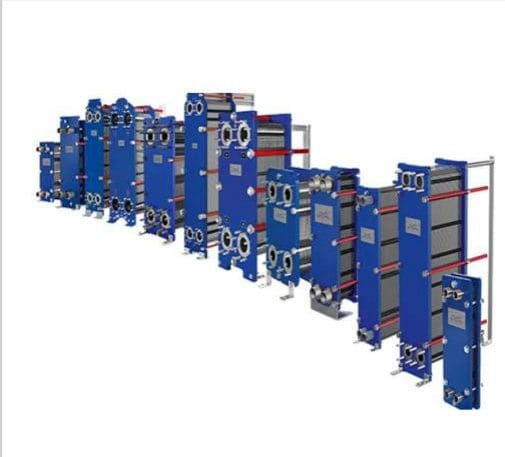
Industrial Gasketed Plate Heat Exchangers
Our wide range of industrial gasketed plate heat exchangers includes models that are suitable for all types of industries. We can support applications ranging from heating, cooling and heat recovery to condensation and evaporation, and we are constantl looking to expand and upgrade with new performance criteria and greater flexibility.
Here are some key features and aspects of industrial gasketed plate heat exchangers:
Plate Design:
- The plates are typically made of materials like stainless steel, titanium, or other alloys.
- They are corrugated to increase turbulence and improve heat transfer efficiency.
- The corrugation also provides structural strength to the plates.
Gaskets:
- Gaskets are placed between the plates to prevent fluid leakage and ensure that the fluids remain separate.
- The gaskets can be made from various materials depending on the compatibility with the fluids being processed.
Fluid Flow:
- The fluids flow in alternate channels formed by the plates.
- Counter-current flow is a common arrangement, where one fluid flows in one direction while the other flows in the opposite direction.
Heat Transfer Efficiency:
- The compact design and the turbulent flow created by the corrugated plates contribute to high heat transfer rates.
- The large surface area of the plates enhances heat exchange.
Versatility:
- Gasketed plate heat exchangers are versatile and can be used in a wide range of industries, including HVAC, chemical processing, power generation, food and beverage, and more.
- They are suitable for applications with moderate to high temperature and pressure requirements.
Maintenance and Cleaning:
- The modular design allows for easy maintenance and replacement of individual plates.
- Cleaning can be done by disassembling the unit and manually cleaning the plates or using automated cleaning systems.
Customization:
- The number of plates, plate material, and gasket material can be customized based on the specific requirements of the application.
Energy Efficiency:
- Gasketed plate heat exchangers are known for their energy efficiency due to the high heat transfer rates and the ability to recover heat from one process stream to another.
Scalability:
- These heat exchangers can be easily scaled up or down by adding or removing plates to meet changing process requirements.
Frequently Asked Questions About Industrial Gasketed Plate Heat Exchangers
What is an industrial gasketed plate heat exchanger?
An industrial gasketed plate heat exchanger transfers heat between two separate fluid streams through a series of corrugated metal plates. Elastomeric gaskets seal the plate channels and direct the hot and cold fluids through alternating passages without allowing them to mix.
How does a gasketed plate heat exchanger work?
Hot and cold fluids normally flow through alternate channels between corrugated plates, often in opposite directions. Heat passes through the thin plates from the hotter fluid to the colder fluid. The plate corrugations create turbulence, helping improve heat transfer within the permitted pressure-drop limits.
What are industrial gasketed plate heat exchangers used for?
Industrial gasketed plate heat exchangers are commonly used for process heating, cooling, heat recovery, condensation and selected evaporation duties. Applications are found in chemical processing, pharmaceuticals, food and beverages, dairy plants, breweries, power generation, HVAC systems, sugar processing, pulp and paper, and industrial utilities.
What are the principal benefits of gasketed plate heat exchangers?
Their principal benefits include compact construction, efficient heat transfer, accessible plate surfaces, configurable heat-transfer area and convenient maintenance. Depending on the design, plates may be added or removed when operating requirements change. Actual performance depends on correct thermal and hydraulic selection.
How are plate and gasket materials selected?
Plate and gasket materials must be selected according to fluid composition, temperature, pressure, concentration, cleaning chemicals and operating conditions. Stainless steel and titanium are among the available plate-material options, while gasket selection depends on chemical and temperature compatibility. Final selection should be based on complete application data.
Can a gasketed plate heat exchanger handle corrosive fluids?
It may handle certain corrosive fluids when compatible plate and gasket materials are selected. However, suitability cannot be determined from the fluid name alone. Concentration, contaminants, temperature, pressure and cleaning conditions must be reviewed before recommending materials or a particular heat-exchanger configuration.
Can the capacity of a gasketed plate heat exchanger be increased?
In many gasketed designs, thermal capacity can be adjusted by modifying the plate pack, subject to frame capacity, connection size, allowable pressure drop and operating conditions. A qualified review is necessary before adding or removing plates because every change affects flow distribution and thermal performance.
How are industrial gasketed plate heat exchangers cleaned?
Cleaning may be performed through cleaning-in-place procedures or by opening the plate pack for inspection and manual cleaning. The appropriate method depends on the deposits, plate and gasket materials, cleaning chemicals and manufacturer instructions. Harsh tools or unsuitable chemicals can damage plates and gaskets.
What information is required to select a gasketed plate heat exchanger?
Selection generally requires fluid names, flow rates, inlet and required outlet temperatures, operating pressure, design pressure, maximum allowable pressure drop, fluid concentration, fouling tendency, cleaning method, connection requirements and available installation space. Accurate process data is essential for dependable equipment selection.
Where can industries obtain gasketed plate heat exchangers in Hyderabad?
Industries in Hyderabad, Telangana and South India can contact Surya Sankara Trading Pvt. Ltd. for application discussions concerning industrial gasketed plate heat exchangers. Customers should provide their operating data so the required thermal duty, materials, pressure drop and suitable configuration can be evaluated.
Are gasketed plate heat exchangers suitable for heat recovery?
Yes, gasketed plate heat exchangers are widely considered for recovering heat between compatible process or utility streams. Their counter-current flow arrangement can support close temperature approaches. The practical energy-saving potential must be calculated using actual temperatures, flow rates, fluid properties and operating schedules.
When should another type of heat exchanger be considered?
Another design may be preferable when operating pressures, temperatures, fluid aggressiveness, gasket compatibility, particulate content or fouling conditions fall outside the practical range of a gasketed unit. Welded, semi-welded, wide-gap or other heat-exchanger technologies may be evaluated for demanding applications.
Surya Sankara Trading Pvt. Ltd. is an Authorised Distributor for Alfa Laval products, supporting industrial customers across Hyderabad, Telangana and other South Indian locations with application discussions, product enquiries and coordination for industrial gasketed plate heat exchangers. Equipment selection should be based on process temperatures, flow rates, pressure limits, allowable pressure drop, fluid compatibility and maintenance requirements.
Further readings on Plate Heat exchangers
- What is plate heat exchanger
- Benefits of plate heat exchangers
- Plate heat exchanger maintenance guide
- How to select a plate heat exchanger
- Common plate heat exchanger problems
- Plate heat xchanger cleaning guide
- Energy saving using plate heat exchanger
- Plate heat exchanger buying guide
- Plate heat echanger or pharmaceutical industry
- Plate heat exchanger for food & beverage processing