
Common Plate Heat Exchanger Problems and How to Solve Them,Plate Heat Exchangers (PHEs) are among the most efficient heat transfer solutions used across industries such as food processing, pharmaceuticals, chemicals, HVAC, power generation, and manufacturing. While these systems are designed for long-term performance, improper maintenance, scaling, gasket wear, and operational issues can reduce their efficiency.
Understanding the common plate heat exchanger problems helps industries avoid costly downtime, improve energy efficiency, and extend equipment life.
As an Authorised Distributor for Alfa Laval products, Surya Sankara Trading provides genuine Alfa Laval Plate Heat Exchangers, spare parts, maintenance support, and technical guidance for industrial applications.
Plate Heat Exchangers (PHEs) are among the most efficient heat transfer solutions used across industries such as food processing, pharmaceuticals, chemicals, HVAC, power generation, and manufacturing. While these systems are designed for long-term performance, improper maintenance, scaling, gasket wear, and operational issues can reduce their efficiency.
Understanding the common plate heat exchanger problems helps industries avoid costly downtime, improve energy efficiency, and extend equipment life.
As an Authorised Distributor for Alfa Laval products, Surya Sankara Trading provides genuine Alfa Laval Plate Heat Exchangers, spare parts, maintenance support, and technical guidance for industrial applications.
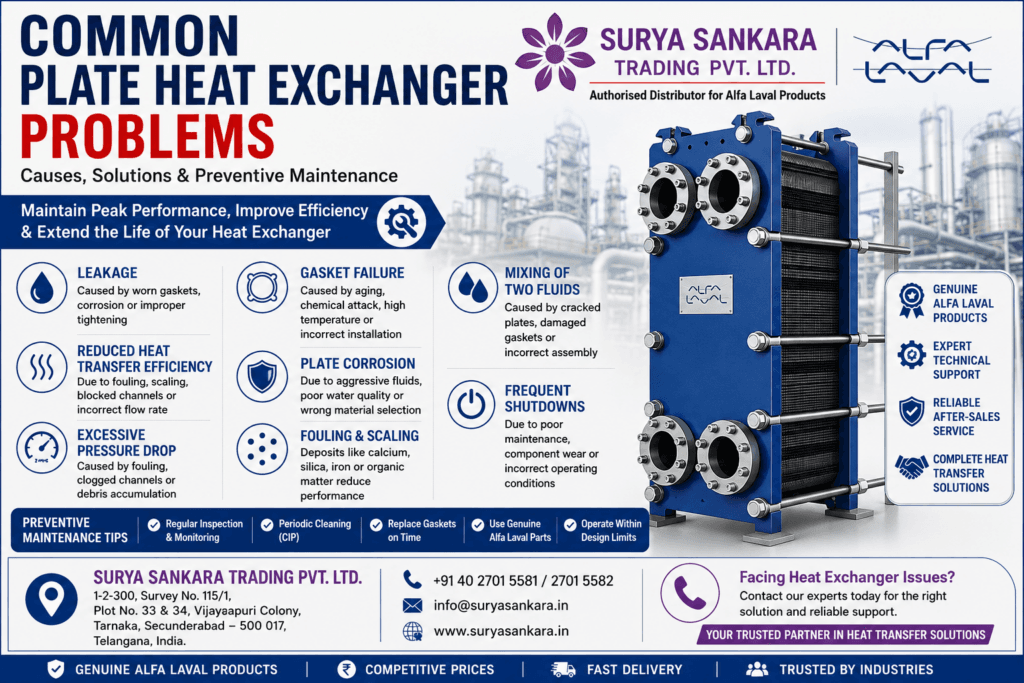
1. Plate Heat Exchanger Leakage
Leakage is one of the most common issues experienced in plate heat exchangers.
Possible Causes
- Damaged gaskets
- Incorrect tightening
- Corroded plates
- High operating pressure
- Aging seals
Solution
- Replace worn-out gaskets with genuine Alfa Laval gaskets.
- Inspect plates for cracks or corrosion.
- Follow the recommended tightening dimensions.
- Perform periodic maintenance inspections.
2. Reduced Heat Transfer Efficiency
If the outlet temperature is not reaching the desired level, the heat exchanger may not be performing efficiently.
Causes
- Fouling
- Scaling
- Blocked channels
- Air trapped inside
- Incorrect flow rate
Solution
- Perform Chemical Cleaning (CIP).
- Inspect for deposits.
- Remove trapped air.
- Verify operating parameters.
- Clean the plates regularly.
3. Excessive Pressure Drop
An unusually high pressure drop usually indicates restricted flow.
Causes
- Fouling
- Clogged channels
- Incorrect installation
- Debris accumulation
Solution
- Clean the heat exchanger.
- Flush the system.
- Replace damaged plates if necessary.
- Monitor pressure regularly.
4. Gasket Failure
Gaskets are essential for maintaining leak-free operation.
Common Reasons
- Natural aging
- Chemical attack
- High temperatures
- Incorrect installation
- Excessive compression
Prevention
- Use genuine Alfa Laval gaskets.
- Follow recommended operating limits.
- Replace gaskets during scheduled maintenance.
5. Plate Corrosion
Corrosion reduces equipment life and may eventually lead to leakage.
Causes
- Aggressive process fluids
- Incorrect plate material selection
- Poor water quality
- Chloride contamination
Solution
- Select the appropriate plate material.
- Conduct regular water quality testing.
- Replace damaged plates promptly.
6. Fouling and Scaling
Scaling acts as an insulating layer that significantly reduces heat transfer efficiency.
Common Deposits
- Calcium carbonate
- Silica
- Iron oxide
- Organic deposits
- Biological growth
Prevention
- Install proper filtration.
- Schedule periodic cleaning.
- Maintain water treatment systems.
- Monitor fluid quality.
7. Mixing of Two Fluids
If process fluids mix together, production quality may be affected.
Possible Causes
- Cracked plates
- Damaged gaskets
- Incorrect assembly
Solution
- Perform pressure testing.
- Inspect plates individually.
- Replace damaged components immediately.
8. Frequent Shutdowns
Unexpected shutdowns often indicate underlying maintenance issues.
Causes
- Poor preventive maintenance
- Excessive fouling
- Incorrect operating conditions
- Component wear
Solution
- Follow preventive maintenance schedules.
- Monitor system performance.
- Replace worn components before failure
Preventive Maintenance Tips
To maximize the life of your Alfa Laval Plate Heat Exchanger:
- Schedule periodic inspections.
- Perform regular Cleaning-In-Place (CIP).
- Replace worn gaskets on time.
- Use only genuine Alfa Laval spare parts.
- Monitor pressure and temperature.
- Check plate condition during servicing.
- Avoid operating beyond design limits.
- Maintain proper water quality.
- Record maintenance history for predictive servicing.
Read Our Other Articles Related to Plate Heat Exchangers of Alfa Laval Distributor
01) What is plate heat exchanger?
02) Benefits of Plate heat exchangers
03) Plate heat exchanger application
04) Plate heat exchanger Vs Shell & tube heat exchanger
05) Plate heat exchanger maintenance guide
06) How to select a plate heat exchanger
Why Choose Alfa Laval Plate Heat Exchangers?
Alfa Laval is recognized globally for high-performance heat transfer solutions that deliver:
- Superior thermal efficiency
- Compact design
- Energy savings
- Easy maintenance
- Long equipment life
- Reliable industrial performance
- Low operating costs
- High-quality engineering
When maintained properly, Alfa Laval Plate Heat Exchangers provide years of dependable operation even in demanding industrial environments.
Why Choose Surya Sankara Trading?
Surya Sankara Trading is an Authorised Distributor for Alfa Laval products, supplying industries across Telangana and surrounding regions with genuine Alfa Laval solutions.
We offer:
- Genuine Alfa Laval Plate Heat Exchangers
- Original Alfa Laval Spare Parts
- Gaskets and Plates
- Technical Product Selection
- Maintenance Support
- Performance Upgrades
- Installation Guidance
- After-Sales Service
- Industrial Heat Transfer Solutions
Our experienced team helps industries improve efficiency, reduce downtime, and maximize the life of their heat exchange equipment.
Frequently Asked Questions
What is the most common problem in a plate heat exchanger?
The most common problems include leakage, gasket failure, fouling, scaling, pressure drop, and reduced heat transfer efficiency due to deposits or improper maintenance.
Why is my plate heat exchanger leaking?
Leakage is usually caused by worn gaskets, cracked plates, incorrect tightening, corrosion, or excessive operating pressure
How often should a plate heat exchanger be cleaned?
Cleaning frequency depends on the application, fluid quality, and operating conditions. Many industrial systems benefit from scheduled inspections and periodic CIP cleaning to prevent fouling and maintain efficiency.
How can fouling affect heat exchanger performance?
Fouling reduces heat transfer efficiency, increases energy consumption, causes pressure drop, and may eventually lead to system failure if left untreated.
Can damaged gaskets be repaired?
Damaged gaskets are generally replaced rather than repaired. Using genuine Alfa Laval gaskets ensures reliable sealing and optimal performance.
When should plates be replaced?
Plates should be replaced if they show cracks, severe corrosion, excessive thinning, or deformation that affects performance or safety.
Keep Your Plate Heat Exchangers Running at Peak Efficiency
Experiencing leakage, reduced performance, pressure drop, or gasket issues? Don’t let minor problems turn into costly downtime.
Surya Sankara Trading, an Authorised Distributor for Alfa Laval products, provides genuine Alfa Laval Plate Heat Exchangers, original spare parts, expert technical support, maintenance guidance, and reliable after-sales service.
Contact Surya Sankara Trading today to discuss your heat exchanger requirements, schedule maintenance, or request expert assistance in selecting the right Alfa Laval solution for your industry. Our team is committed to helping you maximize performance, improve energy efficiency, and extend the life of your equipment.
Further readings on Plate Heat exchangers
- What is plate heat exchanger
- Benefits of plate heat exchangers
- Plate heat exchanger maintenance guide
- How to select a plate heat exchanger
- Common plate heat exchanger problems
- Plate heat xchanger cleaning guide
- Energy saving using plate heat exchanger
- Plate heat exchanger buying guide
- Plate heat echanger or pharmaceutical industry
- Plate heat exchanger for food & beverage processing