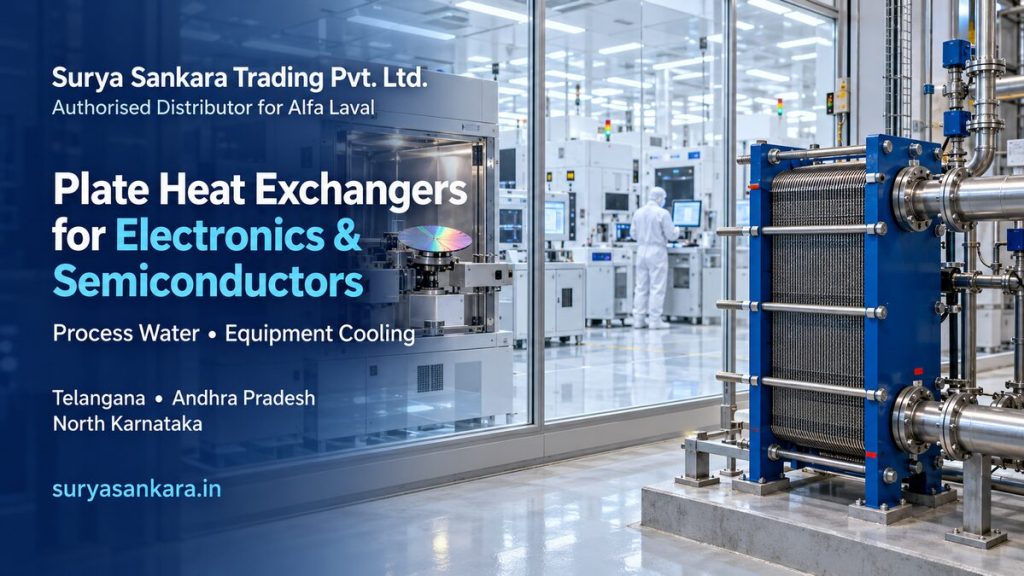
Semiconductor heat exchangers support temperature control in manufacturing processes and utility systems. Suitable plate heat exchangers can transfer heat from process cooling water, equipment-cooling circuits and selected process fluids while keeping the two fluid streams separate during normal operation.
Surya Sankara Trading is an Authorised Distributor for Alfa Laval products for Telangana, Andhra Pradesh and North Karnataka. We welcome application discussions and product enquiries from electronics manufacturers, semiconductor project teams, equipment integrators and engineering consultants within these territories.
Equipment selection must reflect the duty. A facility-water cooling application has different requirements from an ultrapure-water circuit or a corrosive chemical process.
Where Are Semiconductor Heat Exchangers Used?
Electronics and semiconductor manufacturing involve several processes that require controlled temperatures. Heat exchangers can form part of the supporting cooling and heating systems, with construction and materials selected for each application.
Process Cooling Water
Process cooling water, commonly called PCW, removes heat from suitable manufacturing equipment and utility systems.
A plate heat exchanger can transfer heat from a controlled PCW loop to a separate facility cooling-water circuit. This allows the circuits to operate with their specified water conditions while exchanging heat.
The design must account for water quality, operating pressures, required temperatures and the consequences of leakage. Circuit separation does not remove the need for treatment, monitoring or maintenance.
Equipment and Utility Cooling
Semiconductor facilities use supporting equipment such as vacuum pumps, chillers and exhaust-treatment systems. Depending on the equipment design, plate heat exchangers may serve associated liquid-cooling circuits.
For these enquiries, identify the specific equipment and provide its cooling requirements. The equipment manufacturer’s specification should guide the required coolant temperature, flow and pressure limits.
An exchanger selected for one utility circuit should not automatically be reused for another.
Ultrapure Water Temperature Control
Ultrapure water, or UPW, is used in critical semiconductor manufacturing steps where contamination control is essential.
Heat-transfer equipment for UPW requires a dedicated assessment of wetted materials, construction, cleanliness and the project’s contamination limits. Selecting a standard industrial exchanger solely because it meets the thermal duty is insufficient.
Alfa Laval provides heat-transfer solutions for ultrapure-water applications. The proposed model must be reviewed against the facility’s precise specification and qualification requirements before approval.
Wafer-Preparation Cooling
Selected wafer-preparation processes require cooling of a circulating coolant or cutting-fluid system.
The fluid composition, solids content and filtration arrangement influence the appropriate exchanger design. Abrasive or particle-bearing fluids require particular attention to channel suitability, wear and cleaning.
Describe whether the exchanger will handle the process fluid directly or cool it indirectly through a secondary circuit.
Chemical Heating and Cooling
Certain electronics and semiconductor processes require temperature control during chemical preparation or treatment.
These duties may involve aggressive media. Specialist equipment, including suitable graphite plate heat exchangers, may be considered after a detailed compatibility assessment.
Provide the chemical composition, concentration, temperature and impurities. A material that suits one chemical mixture may not suit another, even where the process name is the same.
Selecting Semiconductor Heat Exchangers
Start with the Required Temperatures
Specify inlet and required outlet temperatures on both sides of the exchanger, together with the heat load and flow rates.
Include the permissible temperature variation where this is important to the process. Stable temperature control depends on the complete system—including sensors, valves, pumps and controls—not just the heat exchanger.
For variable loads, provide the expected operating range rather than only the maximum duty.
Identify the Fluid-Purity Requirement
Clearly distinguish among:
- General facility cooling water.
- Treated process cooling water.
- Ultrapure water.
- Water-glycol mixtures or other specified coolants.
- Process chemicals.
- Particle-bearing process fluids.
This classification helps establish which materials, construction and documentation need to be considered.
Review All Wetted Materials
Assess every material that contacts the fluid, including plates, gaskets, connections and any joining materials.
A copper-brazed design may be unsuitable where copper contamination is prohibited. An all-stainless-steel construction also does not automatically establish compliance with every high-purity specification.
The proposed equipment should be reviewed against the customer’s actual process requirements.
Check Pressure Drop and Available Flow
The heat exchanger must achieve the required thermal performance within the available pumping capacity.
Provide allowable pressure drop on both circuits. Include coolant concentration and temperature because fluid properties influence hydraulic performance.
A selection based only on nominal cooling capacity may overlook these constraints.
Plan for Maintenance and Availability
Consider isolation, drainage, cleaning access and the facility’s operating requirements.
Where uninterrupted cooling is necessary, the project engineer should define standby capacity and maintenance arrangements. An individual exchanger cannot guarantee production continuity.
For existing installations, retain records of operating temperatures, flow rates and pressure drop to support performance assessment.
Comparing Construction Options
| Construction | Points to assess |
|---|---|
| Gasketed plate-and-frame | Access for plate inspection and cleaning; compatibility of plates and gaskets |
| Brazed plate | Compact installation; compatibility of plate and brazing materials; non-openable plate pack |
| Fusion-bonded plate | Suitability where an all-stainless-steel construction is required; application-specific qualification |
| Welded plate | Fluid compatibility, operating limits and the model’s servicing arrangements |
| Graphite plate | Suitability for specified corrosive fluids, subject to detailed chemical assessment |
These are selection considerations, not a recommendation that every construction is suitable for every semiconductor process.
Explore our industrial gasketed plate heat exchangers and fusion-bonded plate heat exchangers for related product information.
Can Electronics Manufacturing Recover Waste Heat?
Heat recovery may be possible where a warm fluid stream and a compatible heating requirement are available.
An assessment should establish the source temperature, recoverable duty, operating schedule and temperature needed by the receiving process. Some installations may require a heat pump to raise recovered heat to a useful level.
High-purity and chemical systems also require careful evaluation of contamination consequences and circuit separation.
Savings should be calculated from realistic operating conditions, including additional pumping, maintenance and installation costs.
Alfa Laval Product Enquiries in Our Authorised Territory
Surya Sankara Trading supports product enquiries and application-based selection coordination for Alfa Laval products within Telangana, Andhra Pradesh and North Karnataka.
Telangana
Electronics manufacturers, project consultants and equipment integrators in Hyderabad and across Telangana can enquire about suitable process-water and utility-cooling heat exchangers.
For semiconductor-related projects, include the fluid-purity requirements and technical specification at the initial enquiry stage.
Andhra Pradesh
Customers in Tirupati, Sri City, Visakhapatnam and other locations in Andhra Pradesh can submit requirements for electronics-manufacturing cooling and related applications.
State whether the requirement concerns a facility utility, an equipment skid or direct process-fluid contact. This distinction helps establish the appropriate assessment.
North Karnataka
Project teams and industrial customers in Hubballi–Dharwad, Belagavi and other locations in North Karnataka can contact Surya Sankara Trading for Alfa Laval product discussions.
We are authorised Distributors for Alfa Laval products covering North Karnataka, together with Telangana and Andhra Pradesh.
Information Required for a Quotation on Semiconductor heat exchangers
To discuss semiconductor heat exchangers or electronics-industry cooling equipment, provide:
| Information | Details required |
|---|---|
| Application | PCW, UPW, equipment cooling, process-fluid duty or heat recovery |
| Thermal duty | Required capacity and operating range |
| Fluid specification | Composition, additives, concentration and purity requirements |
| Temperatures | Inlet and required outlet temperatures on both circuits |
| Flow rates | Normal, minimum and maximum flow |
| Pressure | Operating pressure, design pressure and allowable pressure drop |
| Contamination limits | Restricted materials and relevant cleanliness requirements |
| Installation | Available space, connections and maintenance access |
| Documentation | Customer specifications, testing and qualification requirements |
| Project location | Site in Telangana, Andhra Pradesh or North Karnataka |
For replacement equipment, include a nameplate photograph, model number and description of the existing performance issue.
Frequently Asked Questions – Semiconductor heat exchangers
1. What are semiconductor heat exchangers used for?
They transfer heat in suitable process-water, equipment-cooling and selected manufacturing-fluid applications. The required purity, chemistry and operating conditions determine the appropriate equipment.
2. What is the difference between PCW and UPW?
Process cooling water primarily supports heat removal from equipment and related systems. Ultrapure water is used where critical manufacturing steps require much tighter contamination control. Their equipment specifications are not interchangeable.
3. Can any stainless steel plate heat exchanger handle ultrapure water?
No. Stainless steel construction alone does not establish suitability. All wetted materials, cleanliness, construction details and qualification requirements must be assessed against the project specification.
4. Can plate heat exchangers cool electronics manufacturing equipment?
Yes, suitable units can serve liquid-cooling circuits supporting manufacturing equipment. Selection must follow the equipment manufacturer’s required temperatures, flows, fluid specifications and pressure limits.
5. Are plate heat exchangers suitable for corrosive semiconductor chemicals?
Specialist designs may be suitable for particular chemicals. Provide the complete composition, concentration and operating conditions for a compatibility assessment before selecting materials.
6. Can a heat exchanger maintain a precise process temperature by itself?
No. It provides heat-transfer capacity, while temperature stability depends on the complete arrangement of controls, sensors, valves, pumps and available utilities.
7. Is this the same application as data-centre cooling?
There are similarities in liquid heat transfer, but the applications differ. Semiconductor manufacturing may involve ultrapure water and process chemicals, while data-centre systems primarily remove heat generated by operating IT equipment.
8. Where can customers in Telangana and Andhra Pradesh enquire about Alfa Laval products?
Customers can contact Surya Sankara Trading, an Authorised Distributor for Alfa Laval products for Telangana, Andhra Pradesh and North Karnataka, with their application and project details.
9. Does Surya Sankara Trading’s authorised territory include all of Karnataka?
The stated authorised territory includes North Karnataka, along with Telangana and Andhra Pradesh. Please include the exact project location with your enquiry.
Discuss Your Electronics or Semiconductor Cooling Requirement
Looking for plate heat exchangers for electronics and semiconductor industries?
Contact Surya Sankara Trading — Authorised Distributor for Alfa Laval products for Telangana, Andhra Pradesh and North Karnataka.
Share your application, fluid specification, required temperatures and project location. For high-purity duties, include the relevant contamination limits and qualification requirements from the outset.
For manufacturer information, explore Alfa Laval’s semiconductor heat-transfer applications and ultrapure-water cooling guidance.