Plate Heat Exchangers for Pulp and Paper Industries: Heating, Cooling and Heat Recovery Plate Heat Exchangers for Pulp and Paper Industries. Pulp and paper manufacturing uses large quantities of heat, water and process chemicals. Wood preparation, pulping, washing, bleaching, stock preparation, paper-machine operation, chemical recovery and wastewater treatment all create streams that must be heated, cooled, evaporated or condensed.
Plate Heat Exchangers for Pulp and Paper Industries applications can recover valuable secondary heat, reduce steam and cooling demand, and provide compact solutions for process and utility duties. However, mill streams may contain fibres, suspended solids, dissolved chemicals, scale-forming compounds or corrosive contaminants. The correct exchanger type must therefore be selected for the actual fluid—not simply for the required heat load.
Surya Sankara Trading Pvt. Ltd. is an Authorised Distributor for Alfa Laval products. From Hyderabad, the company supports pulp mills, paper mills, recycled-fibre plants and industrial customers evaluating Alfa Laval heat-transfer equipment, genuine spares and service requirements across India.
Why Heat Transfer Matters in Pulp and Paper Production
– Plate Heat Exchangers for Pulp and Paper Industries
Pulp and paper mills operate many interconnected water and energy loops. Hot filtrate, warm white water, process condensate, flue-gas scrubber water and evaporation-plant cooling water may contain useful heat. At the same time, other streams require preheating before washing, bleaching, stock preparation or utility use.
A well-engineered heat-transfer system may help a mill:
- recover heat from hot filtrates and process water;
- preheat cold mill water or shower water;
- cool bleaching filtrates and effluent;
- control stock, coating and chemical temperatures;
- cool hydraulic, gearbox and turbine oil;
- condense process vapours;
- support spent-liquor evaporation;
- reduce live-steam consumption;
- decrease cooling-tower load;
- improve production capacity without expanding the boiler system.
The achievable benefit depends on stream compatibility, temperatures, flow balance, fouling, corrosion, pressure drop, operating schedule and cleaning strategy. Heat-recovery claims should be based on a plant-specific heat and mass balance.
How a Plate Heat Exchanger Works
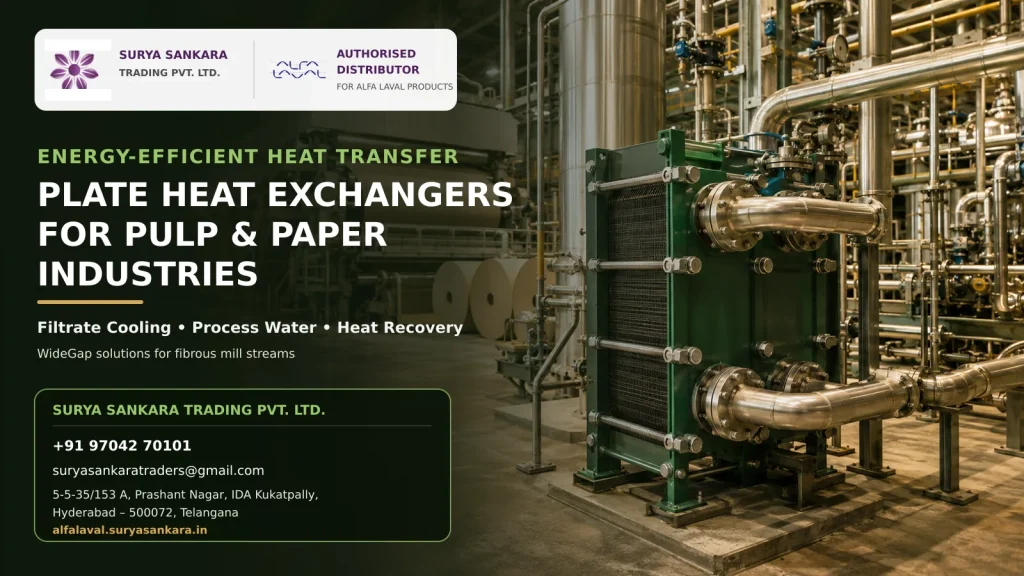
A gasketed plate-and-frame heat exchanger contains corrugated metal plates compressed between a fixed frame plate and a movable pressure plate. Ports and gaskets direct the hot and cold media through alternate channels. Heat passes through the plate surface while the two fluids normally remain separated.
Counter-current flow can create a close temperature approach, making plate exchangers useful for recovering low-grade heat. Plate corrugations create turbulence and support heat transfer, but they also influence pressure drop and the passage of fibres or particles.
For clean water, oil or utility duties, a conventional gasketed plate exchanger may be appropriate. For pulp filtrate, fibre-bearing water or other dirty streams, a WideGap or another specialised exchanger may be required. Severe fouling, long fibres, slurries or corrosive services may favour spiral, welded, graphite or other technologies.
Major Applications in Pulp and Paper Mills
– Plate Heat Exchangers for Pulp and Paper Industries
1. Filtrate Heating and Cooling
Washing and bleaching stages generate filtrates at different temperatures. A hot filtrate may need cooling before reuse or downstream treatment, while a colder washing stream may require heating.
Using a heat exchanger to transfer energy between compatible streams can reduce steam and cooling-water demand. Because filtrates may carry fibres and suspended matter, channel width and port design are critical. Alfa Laval WideGap plate heat exchangers are designed for fibrous fluids and coarse particles and can be configured with wide channels on one or both sides.
2. Bleaching-Plant Heat Recovery
Bleaching plants may contain several warm filtrate streams with heat-recovery potential. Reused wash filtrate can be preheated using secondary heat before entering the process, thereby reducing direct steam demand.
The study should assess chemical compatibility, fibre content, pH, chloride level, scaling potential and the risk of mixing incompatible streams. Material selection and leak-detection philosophy are as important as thermal performance.
3. White Water Heat Recovery
White water from paper machines and recycled-fibre processes can carry fibres, fines, fillers, inks, stickies and other contaminants. It may also contain substantial recoverable heat.
Depending on its fouling characteristics, white water may be handled by a WideGap plate exchanger, spiral heat exchanger or another suitable design. Spiral exchangers can be advantageous for heavily fouling streams because their single-channel geometry and flow characteristics can support difficult services. The final choice should be based on trials, operating history or representative samples.
4. Shower-Water Heating
Paper machines use shower water for fabrics, wires, felts and cleaning duties. Recovering heat from a compatible warm stream can preheat incoming shower water and reduce steam consumption.
The exchanger must be protected from fibre accumulation and deposits. Automatic filtration, strainers, backflushing or standby arrangements may be needed, depending on water quality and uptime requirements.
5. Stock Heating and Cooling
Pulp stock temperature can influence drainage, refining, chemical action and paper-machine operation. A heat exchanger may heat or cool a circulating stock or process-water loop.
Direct stock service requires careful attention to fibre length, consistency, additives, pressure drop and plugging risk. A conventional narrow-channel PHE should not be selected without confirming that the stock can pass reliably through the channels.
6. Process-Water Heating and Cooling
Cleaner process-water loops are often suitable for standard gasketed plate heat exchangers. Potential duties include warm-water generation, freshwater preheating, cooling-water isolation and heat-pump integration.
Water chemistry still matters. Chlorides, hardness, dissolved gases and treatment chemicals can affect corrosion and scaling. Utility data should reflect the most demanding seasonal conditions.
7. Hydraulic and Lubricating-Oil Cooling
Paper machines, turbines, gearboxes and hydraulic systems require controlled oil temperatures. Gasketed plate heat exchangers can cool oil with water or another utility in a compact footprint.
Selection should include oil viscosity over the full temperature range, fouling, water quality, design pressure, leak consequences and required redundancy. An oil cooler must also be accessible for inspection and service without disrupting critical machinery.
8. Coating-Colour and Starch-System Temperature Control
Paper coating and starch systems may require controlled heating or cooling. Viscosity, solids, additives and product stability determine whether a gasketed plate exchanger is suitable.
Where deposits can form or the fluid becomes highly viscous, a wider channel, alternative exchanger type or external circulation arrangement may be required. Cleaning procedures must be compatible with both the process material and the gasket elastomer.
9. Effluent Cooling and Wastewater Heat Recovery
Warm wastewater may require cooling before biological treatment or discharge, subject to local requirements. Recovering heat from effluent can reduce overall utility use if a suitable clean stream can accept the energy.
Effluent can contain fibres, suspended solids, biological material, scale and chemicals. WideGap or spiral exchangers may be considered, and upstream screening or clarification may be necessary. The design must prevent unacceptable cross-contamination.
10. Flue-Gas Scrubber and Condensate Heat Recovery
Warm scrubber water and process condensate can be potential secondary heat sources. A heat exchanger can transfer this energy to clean water or another suitable sink.
The fluid should be analysed for acidity, chlorides, suspended solids and corrosive compounds. Condensate quality and the consequences of leakage should be evaluated before selecting materials and exchanger configuration.
WideGap Plate Heat Exchangers for Fibrous Fluids
– Plate Heat Exchangers for Pulp and Paper Industries
Alfa Laval WideGap gasketed plate heat exchangers are developed for liquids containing fibres, coarse particles or higher viscosity. Wider plate passages and smooth port geometry help material pass through the exchanger with less risk of blockage than in a conventional narrow-channel PHE.
Typical pulp and paper duties may include:
- filtrate heating and cooling;
- shower-water heat recovery;
- fibre-bearing process water;
- selected white-water services;
- effluent cooling;
- heat interchange between dirty and clean streams;
- condensation or heat recovery involving suitable process vapours.
WideGap units can be arranged with wide-wide channels when both streams are difficult or wide-narrow channels when only one side requires the larger passage.
Potential advantages include:
- compact installation;
- high heat-transfer efficiency;
- close temperature approach;
- flexible plate-pack configuration;
- access for inspection and mechanical cleaning;
- CIP or backflushing options where suitable;
- reduced clogging risk compared with narrow-channel plates.
WideGap is not clog-proof. Excessive fibres, rags, plastic, bark fragments or process upsets can still obstruct a unit. Upstream screening, filtration, stable flow and a planned cleaning programme remain essential.
When a Spiral Heat Exchanger May Be Better
A spiral heat exchanger contains two continuous spiral channels. Its geometry can suit highly fouling liquids, slurries and streams containing solids. In some white-water, sludge, effluent and wastewater duties, a spiral exchanger may provide longer run time or easier cleaning than other technologies.
The choice between WideGap and spiral should consider:
- fibre length and solids size;
- solids concentration;
- viscosity;
- fouling mechanism;
- required temperature approach;
- allowable pressure drop;
- mechanical cleaning access;
- installation space;
- design pressure and temperature.
The correct decision is application-specific. It should not be made from a general preference for one exchanger type.
Black Liquor, Spent Liquor and Evaporation
Chemical pulp mills concentrate weak black liquor before recovery. This is an evaporation-system duty rather than a simple liquid-to-liquid heating application. Liquor concentration, viscosity, scaling, boiling-point elevation, solids and corrosion change significantly through the evaporation train.
Alfa Laval supplies evaporation and condensation technologies for pulp-production and chemical-recovery applications. A complete evaporation study should evaluate:
- feed and target dry solids;
- flow and composition;
- boiling-point elevation;
- steam and vapour conditions;
- scaling and cleaning requirements;
- condensate segregation;
- non-condensable gases;
- multiple-effect arrangement;
- mechanical or thermal vapour recompression options;
- material selection.
Do not present a standard plate heat exchanger as a universal black-liquor evaporator. The evaporation system and exchanger technology must be selected specifically for the liquor and mill process.
Vapour Condensation
Pulp and paper plants condense vapours in evaporation, chemical recovery and other process areas. Condenser selection depends on vapour load, pressure or vacuum, non-condensable gases, cooling-water temperature, pressure drop and condensate-recovery objectives.
Plate condensers, welded exchangers or other specialised designs may suit different duties. The design must account for two-phase flow and should preserve condensate quality where reuse is planned.
Heat Recovery and Energy Efficiency
Secondary heat can be valuable even when its temperature is too low for direct process heating. Counter-current plate heat exchangers can transfer heat across a close temperature approach, allowing warm filtrate, white water, condensate or scrubber water to preheat a colder stream.
Useful heat sources may include:
- evaporation-plant cooling water;
- bleaching filtrates;
- white water;
- hot process water;
- flue-gas scrubber water;
- warm effluent;
- process condensate;
- compressor or oil-cooling circuits.
Potential heat sinks may include:
- mill water;
- shower water;
- washing filtrate;
- boiler make-up water;
- process-water loops;
- building or district-heating systems where feasible.
The achievable saving depends on flow balance, temperature level, operating coincidence, exchanger approach, fouling, control and the alternative cost of steam or cooling. Published mill case studies should be treated as examples, not guarantees.
Fouling, Fibre Accumulation and Scaling
Common heat-exchanger deposits in pulp and paper plants may include:
- cellulose fibres and fines;
- resin and pitch;
- ink and stickies in recycled-fibre mills;
- calcium carbonate and other fillers;
- biological growth;
- black-liquor scale;
- corrosion products;
- coating or starch residues.
Warning signs include rising pressure drop, falling flow, reduced temperature performance, increased steam demand, unstable controls and shortened cleaning intervals.
The solution is not simply to oversize the exchanger. Very low velocity can worsen distribution and cleaning. Channel geometry, velocity, wall temperature, fouling allowance, filtration and cleaning strategy should be engineered together.
Cleaning and Backflushing
Cleaning may involve water flushing, flow reversal, backflushing, chemical CIP or opening the unit for mechanical cleaning. The method should match the deposit and equipment materials.
Before chemical cleaning, confirm:
- deposit composition;
- chemical type and concentration;
- cleaning temperature;
- circulation flow and contact time;
- plate and gasket compatibility;
- rinsing and neutralisation requirements;
- handling and disposal procedures.
Do not use metal tools or abrasive methods that scratch plate surfaces. After opening a gasketed exchanger, preserve the correct plate sequence and tighten the pack only to the manufacturer’s specified dimension.
Corrosion and Material Selection
Pulp and paper streams can range from near-neutral water to strongly alkaline liquor, acidic filtrates, chloride-bearing bleach-plant fluids and chemically aggressive condensates.
Material selection should consider:
- complete fluid composition;
- pH and temperature;
- chlorides and oxidising chemicals;
- dissolved gases;
- solids and erosion potential;
- cleaning chemicals;
- start-up and upset conditions;
- consequences of cross-leakage.
Stainless steel may suit many water and filtrate duties, but it is not universally corrosion-resistant. Higher-alloy metals, titanium, nickel alloys, graphite or welded constructions may be required for specific services.
Gaskets must also withstand the process fluid, temperature, cleaning chemicals and cyclic operation. An unsuitable elastomer can swell, harden, crack or lose sealing force.
Maintenance and Performance Monitoring
A practical mill maintenance programme should include:
- establishing clean-condition temperature and pressure-drop baselines;
- trending flows, temperatures and utility consumption;
- inspecting strainers, filters and upstream separators;
- checking for external leakage;
- recording cleaning intervals and performance recovery;
- examining gaskets for hardening, swelling or displacement;
- inspecting plates for deposits, corrosion, cracks and deformation;
- conducting integrity testing where appropriate;
- verifying plate sequence and tightening dimension after service;
- keeping correctly identified genuine spares available.
If production rate, furnish, chemical programme or temperature conditions change, the exchanger should be re-rated rather than assumed to remain suitable.
Information Required for Equipment Selection
Provide separate data for every operating case:
- Stream names and process locations
- Normal, minimum and maximum flow rates
- Hot- and cold-side inlet and target outlet temperatures
- Fluid composition, pH and conductivity
- Fibre type, length and concentration
- Suspended solids and maximum particle size
- Density, viscosity, specific heat and thermal conductivity
- Maximum allowable pressure drop on both sides
- Operating and design pressures and temperatures
- Chlorides, chemicals and corrosion concerns
- Fouling history and existing cleaning method
- CIP chemicals, concentration, temperature and duration
- Required plate, gasket and connection materials
- Available footprint and maintenance clearance
- Existing drawings and performance data for retrofit enquiries
Representative mill samples and operating history can be particularly valuable for dirty or uncertain fluids.
Support for Pulp and Paper Mills in India
India’s pulp and paper sector includes integrated wood-based mills, agro-residue mills, recycled-fibre plants, speciality-paper producers and paperboard manufacturers. Raw material, water quality, chemical programme and mill configuration vary significantly between sites.
Surya Sankara Trading Pvt. Ltd. supports enquiries for:
- WideGap exchangers for fibrous filtrates;
- shower-water and process-water heat recovery;
- selected white-water and effluent duties;
- oil and utility cooling;
- replacement and retrofit heat exchangers;
- evaporation and condensation discussions;
- plate and gasket material selection;
- genuine Alfa Laval plates and gaskets;
- cleaning, inspection and maintenance requirements.
From Hyderabad, the company can support industrial enquiries from Telangana, Andhra Pradesh, Maharashtra, Gujarat, Karnataka, Tamil Nadu, Odisha and other pulp- and paper-producing regions of India.
Frequently Asked Questions – Plate Heat Exchangers for Pulp and Paper Industries
Which plate heat exchanger is suitable for pulp-mill filtrate?
A WideGap plate heat exchanger may suit fibrous filtrate because its wider passages are designed for fibres and coarse particles. Selection still requires actual fibre content, particle size, viscosity, flow, temperatures and pressure-drop limits.
Can heat be recovered from paper-machine white water?
Yes, white water can be a useful heat source. Depending on its fibres, fillers, ink and fouling characteristics, a WideGap, spiral or another exchanger design may be appropriate.
Can a plate heat exchanger handle black liquor?
Certain plate-based or specialised exchangers may be used within black-liquor heating, evaporation or condensation systems, but a standard PHE is not automatically suitable. Concentration, scaling, corrosion and evaporation conditions require detailed engineering.
What is a filtrate cooler?
A filtrate cooler removes heat from warm process filtrate using water or another compatible medium. The recovered energy may sometimes be used to preheat a colder mill stream.
How can a pulp mill reduce steam consumption?
One approach is to recover secondary heat from filtrates, white water, process condensate, scrubber water or effluent and transfer it to colder process water or reused filtrate. A plant heat-balance study is needed to quantify the opportunity.
How often should a pulp-mill heat exchanger be cleaned?
There is no universal interval. Cleaning should be based on pressure-drop and temperature-performance trends, stream fouling, production requirements and the mill’s inspection history.
Where can pulp and paper mills obtain Alfa Laval heat exchangers in India?
Surya Sankara Trading Pvt. Ltd. is an Authorised Distributor for Alfa Laval products and supports pulp- and paper-industry heat-transfer enquiries from Hyderabad and customers across India.
Request a Technical Discussion
Planning filtrate cooling, white-water heat recovery, shower-water heating, process-water cooling, evaporation or exchanger replacement? Share your stream analysis, fibre and solids data, flows, temperatures, pressure-drop limits, material requirements and cleaning conditions with Surya Sankara Trading Pvt. Ltd.
Surya Sankara Trading Pvt. Ltd.
Authorised Distributor for Alfa Laval products
Office: 5-5-35/153 A, Prashant Nagar, IDA Kukatpally, Hyderabad – 500072, Telangana
Phone: +91 97042 70101
Email: suryasankaratraders@gmail.com
Website: https://suryasankara.in/
- What Is a Plate Heat Exchanger?
- Plate Heat Exchanger Applications
- How to Select a Plate Heat Exchanger
- Energy Saving Using Plate Heat Exchangers
- Plate Heat Exchanger Cleaning Guide
- Plate Heat Exchanger Maintenance Guide
Recommended Information
- Alfa Laval – Pulp Production
- Alfa Laval – WideGap Plate Heat Exchangers
- Alfa Laval – Chemical Pulp Mill Solutions
Disclaimer
This microsite is operated by Surya Sankara Trading Pvt. Ltd., an Authorised Distributor for Alfa Laval products. It is not Alfa Laval’s corporate website. Alfa Laval product names and trademarks belong to their respective owner.