
How to Select a Plate Heat Exchanger? – A Complete Buying & Engineering Guide. How to Select a Plate Heat Exchanger, Choosing the right Plate Heat Exchanger (PHE) is one of the most important decisions in any industrial process. A properly selected heat exchanger improves energy efficiency, reduces operating costs, increases equipment life, and ensures reliable process performance. However, selecting the wrong model can lead to poor heat transfer, excessive pressure drop, increased maintenance, and higher energy consumption.
Alfa Laval offers one of the industry’s broadest portfolios of plate heat exchangers, with options designed for heating, cooling, heat recovery, condensation, evaporation, HVAC, refrigeration, corrosive media, and demanding industrial applications
If you are looking for expert guidance, Surya Sankara Trading Pvt. Ltd. is an Authorised Distributor and Channel Partner for Alfa Laval, providing genuine Alfa Laval Plate Heat Exchangers, engineering consultation, sizing assistance, installation support, and after-sales service.
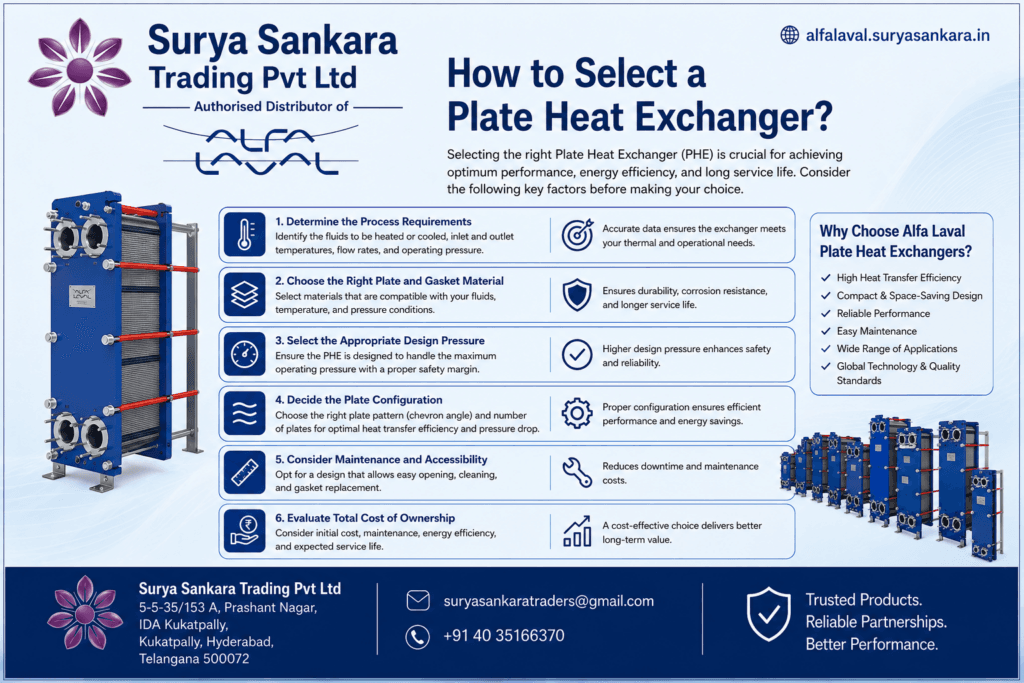
Why Proper Plate Heat Exchanger Selection Matters – How to Select a Plate Heat Exchanger?
Selecting the correct Plate Heat Exchanger helps you:
- Maximise heat transfer efficiency
- Reduce energy consumption
- Minimise maintenance costs
- Extend equipment life
- Reduce plant downtime
- Optimise production performance
- Lower total cost of ownership
A properly engineered solution delivers better long-term reliability than simply choosing the largest or least expensive unit.
Step 1: Understand Your Process Application
The first step is to identify the process duty.
Examples include:
- Process heating
- Process cooling
- Heat recovery
- Steam heating
- Condensation
- Evaporation
- Water cooling
- Oil cooling
- HVAC systems
- District cooling
- Refrigeration
- Food processing
- Pharmaceutical production
Different applications require different plate patterns, materials, gasket types, and flow arrangements. Alfa Laval’s selection guidance categorises solutions based on application, including HVAC, refrigeration, corrosive media, particle-containing fluids, and high-viscosity duties.
Step 2: Identify the Fluids
The type of fluid greatly influences heat exchanger selection.
Consider:
- Water
- Steam
- Thermal oil
- Milk
- Chemicals
- Glycol
- Sea water
- Hydraulic oil
- Food products
- Pharmaceutical liquids
Fluid properties affect:
- Plate material
- Gasket material
- Flow velocity
- Corrosion resistance
- Fouling tendency
Step 3: Know the Operating Temperatures
You should determine:
- Hot fluid inlet temperature
- Hot fluid outlet temperature
- Cold fluid inlet temperature
- Cold fluid outlet temperature
These values determine the required heat transfer area and the number of plates.
Step 4: Calculate Flow Rate
Flow rate is one of the most important sizing parameters.
You should know:
- Flow rate of hot fluid
- Flow rate of cold fluid
- Required heat duty
- Desired outlet temperatures
Incorrect flow data can lead to oversized or undersized equipment.
Step 5: Check Operating Pressure
The Plate Heat Exchanger must safely withstand the operating pressure of your process.
Consider:
- Working pressure
- Design pressure
- Pressure fluctuations
- Safety margins
For high-pressure or specialised duties, Alfa Laval provides multiple heat exchanger technologies and selector tools to match process requirements.
Step 6: Evaluate Pressure Drop
Pressure drop directly affects pumping costs and heat transfer performance.
A good design should:
- Maximise heat transfer
- Minimise pumping energy
- Maintain proper fluid velocity
The correct balance improves efficiency while avoiding excessive operating costs.
Step 7: Select the Right Plate Material
Different industries require different materials.
Common options include:
Stainless Steel
Suitable for:
- Water
- Food processing
- HVAC
- General industrial applications
Titanium
Recommended for:
- Sea water
- Chlorides
- Highly corrosive environments
Special Alloys
Used for aggressive chemicals and demanding industrial processes.
Material selection should always match the process fluid to maximise service life.
Step 8: Choose the Correct Gasket Material
The gasket prevents fluid leakage and directs flow through the plates.
Common gasket materials include:
- EPDM
- NBR (Nitrile)
- Viton (FKM)
The right gasket depends on:
- Fluid compatibility
- Operating temperature
- Chemical resistance
- Pressure conditions
Step 9: Consider Future Expansion
One of the biggest advantages of a gasketed Plate Heat Exchanger is flexibility.
If production increases in the future:
- Additional plates can often be added.
- Heat transfer capacity can be increased.
- Equipment replacement may be avoided.
This modular design helps protect your long-term investment.
Step 10: Choose a Trusted Manufacturer
Not all Plate Heat Exchangers offer the same performance.
Alfa Laval is recognised globally for:
- Advanced plate technology
- High thermal efficiency
- Reliable performance
- Long service life
- Energy savings
- Wide product portfolio
- Genuine spare parts
- Engineering support
The company also provides dedicated selection tools and engineering assistance to identify the optimal solution based on operating conditions and process data.
Why Choose Alfa Laval Plate Heat Exchangers?
Alfa Laval Plate Heat Exchangers are designed for:
- Heating
- Cooling
- Heat recovery
- Condensation
- Evaporation
- HVAC
- Refrigeration
- Chemical processing
- Food & Beverage
- Pharmaceutical manufacturing
- Marine
- Oil & Gas
Benefits include:
- High heat transfer efficiency
- Compact footprint
- Lower operating costs
- Easy maintenance
- Expandable capacity
- Low fouling
- Reliable performance
Buy Genuine Alfa Laval Plate Heat Exchangers from Surya Sankara Trading Pvt. Ltd.
Surya Sankara Trading Pvt. Ltd. is an Authorised Distributor and Channel Partner for Alfa Laval.
We provide:
- Genuine Alfa Laval Plate Heat Exchangers
- Technical consultation
- Heat exchanger sizing assistance
- Product selection support
- Installation guidance
- Preventive maintenance
- Genuine spare parts
- Prompt after-sales service
Our engineers evaluate your process data—including temperatures, flow rates, pressure, fluid properties, and heat duty—to recommend the most suitable Alfa Laval solution.
Frequently Asked Questions
How do I select the right Plate Heat Exchanger?
Choose a Plate Heat Exchanger based on your application, fluid type, temperatures, flow rates, operating pressure, pressure drop, material compatibility, fouling tendency, and future capacity requirements. Manufacturer selection tools and engineering support can simplify the process.
What information is required to size a Plate Heat Exchanger?
You typically need:
- Hot and cold fluid types
- Inlet and outlet temperatures
- Flow rates
- Heat duty
- Operating pressure
- Allowable pressure drop
- Fluid properties
- Installation requirements
Which plate material should I choose?
Stainless steel is suitable for many industrial applications, while titanium or other special alloys are preferred for corrosive fluids such as seawater or aggressive chemicals.
Can I increase the capacity later?
Yes. Most Alfa Laval gasketed Plate Heat Exchangers allow additional plates to be added, enabling future expansion without replacing the entire unit.
Where can I buy genuine Alfa Laval Plate Heat Exchangers?
You can purchase genuine Alfa Laval Plate Heat Exchangers from Surya Sankara Trading Pvt. Ltd., an Authorised Distributor and Channel Partner for Alfa Laval, with complete technical guidance and dependable after-sales support.
Need help selecting the right Plate Heat Exchanger? Contact Surya Sankara Trading Pvt. Ltd., the Authorised Distributor and Channel Partner for Alfa Laval, for expert sizing, product selection, installation guidance, and genuine Alfa Laval heat exchanger solutions tailored to your industrial process.
Further readings on Plate Heat exchangers
- What is plate heat exchanger
- Benefits of plate heat exchangers
- Plate heat exchanger maintenance guide
- How to select a plate heat exchanger
- Common plate heat exchanger problems
- Plate heat xchanger cleaning guide
- Energy saving using plate heat exchanger
- Plate heat exchanger buying guide
- Plate heat echanger or pharmaceutical industry
- Plate heat exchanger for food & beverage processing