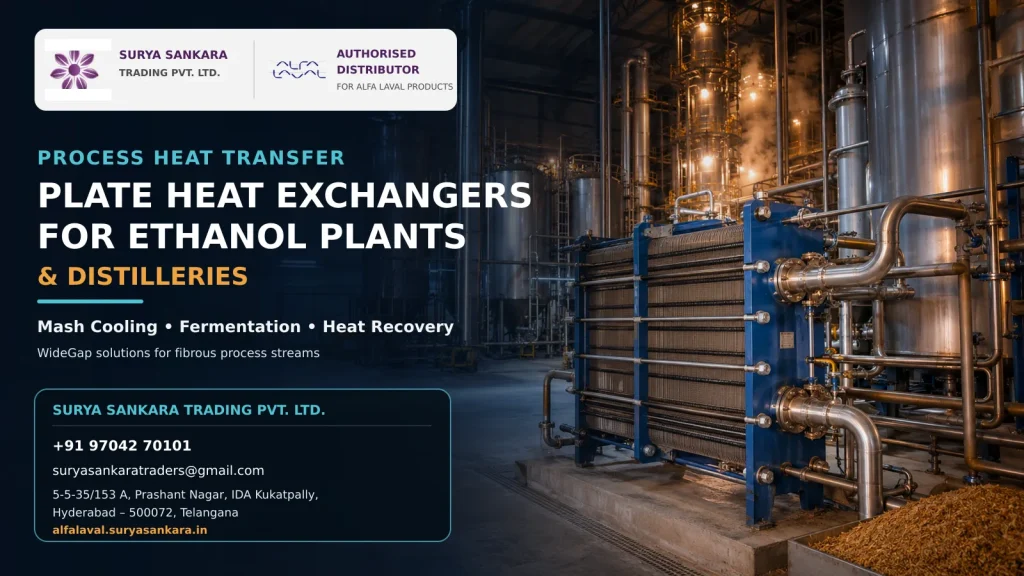
Plate Heat Exchangers for Distilleries and Ethanol Plants: Heating, Cooling and Heat Recovery. Plate Heat Exchangers for Distilleries and Ethanol Plants Ethanol production involves repeated heating, cooling, evaporation and condensation. Feedstock preparation, liquefaction, saccharification, fermentation, distillation, dehydration and stillage processing all depend on reliable thermal control. When heat is recovered effectively, an ethanol plant can reduce utility demand while maintaining production capacity and process stability.
Plate heat exchangers for ethanol plants provide compact and thermally efficient solutions for many of these duties. However, mash, beer and stillage can contain fibres, suspended solids or coarse particles. These streams cannot always pass reliably through a conventional narrow-channel exchanger. Channel geometry, plate pattern, pressure drop, fouling behaviour and cleaning strategy must match the actual process fluid.
Surya Sankara Trading Pvt. Ltd. is an Authorised Distributor for Alfa Laval products. From Hyderabad, the company supports sugar-based and grain-based ethanol producers, distilleries and process plants evaluating Alfa Laval heat-transfer equipment, genuine spares and service requirements across India.
Why Heat Transfer Is Critical in Ethanol Production
The ethanol process moves heat between streams at several temperature levels. Mash may be heated during preparation and then cooled before fermentation. Fermentation generates heat that must be removed. Fermented beer is heated before distillation, vapours are condensed, and stillage may be concentrated or used as a heat-recovery source.
A properly engineered heat-transfer system can help a plant:
- control mash heating and cooling;
- maintain stable fermentation temperatures;
- recover energy between hot mash and fermented beer;
- support distillation-column reboiling and condensation;
- cool or preheat process water;
- concentrate stillage or spent wash;
- recover heat from dryer vapour or process condensate;
- reduce the load on boilers, cooling towers and refrigeration systems;
- improve maintainability in space-constrained retrofit projects.
Thermal efficiency alone is not sufficient. Uptime depends on the exchanger’s ability to handle solids, fibres, viscosity changes and cleaning cycles without unacceptable pressure drop or repeated blockage.
How a Plate Heat Exchanger Works – Plate Heat Exchangers for Ethanol Plants
A gasketed plate-and-frame heat exchanger consists of corrugated metal plates compressed within a frame. Ports and gaskets route hot and cold media through alternate channels. Heat passes through the plates while the fluids normally remain separated.
Counter-current flow can produce a close temperature approach, which is valuable for heat recovery. Corrugations create turbulence and improve heat transfer, but they also affect pressure drop and the ability of particles to pass through the channel.
For relatively clean utility fluids, a standard gasketed plate exchanger may be suitable. For fibrous mash, beer, whole stillage or slurries, a wider channel is often required. The equipment should be selected from real process data rather than from connection size or nominal plant capacity alone.
Ethanol Feedstocks and Their Effect on Selection
Ethanol can be produced from sugarcane juice, molasses, corn, wheat, rice, cassava, sorghum and other biological materials. Each feedstock creates different solids, fibre, viscosity, protein and fouling characteristics.
Sugar- and Molasses-Based Plants
Molasses viscosity varies strongly with temperature and concentration. Sugar-based streams may contain suspended solids and scale-forming components. Reliable selection requires viscosity-versus-temperature data, concentration, solids content and cleaning conditions.
Grain-Based Plants
Milled grain mash contains particles and fibres. During liquefaction, saccharification and fermentation, its properties change with temperature, enzymes and solids conversion. Wider channels may be needed to minimise blockage and maintain run length.
Cellulosic Ethanol Plants
Cellulosic streams can contain long and abundant fibres. Depending on fibre size and process conditions, a spiral heat exchanger or another suitable technology may be more appropriate than a plate-and-frame unit. The application requires detailed engineering review.
Main Heat-Exchanger Applications
1. Slurry and Mash Heating
In grain-based production, milled feedstock is mixed with water and enzymes before heating for liquefaction. The mash can contain substantial suspended solids and requires gentle but effective heat transfer.
Alfa Laval identifies WideGap plate heat exchangers for slurry and mash duties where extra-wide plate spacing helps fibrous material and coarse particles pass through the unit. Heating may use hot water, condensate or another suitable process stream, depending on the plant heat balance.
2. Mash Cooling Before Fermentation
After liquefaction or saccharification, mash must be cooled to a temperature suitable for fermentation. Cooling duty depends on feedstock, flow, inlet temperature, fermentation requirement and available cooling-water conditions.
In warm Indian climates, seasonal cooling-water temperature can materially affect exchanger performance. The design should use realistic summer utility data rather than an optimistic annual average.
3. Fermenter Cooling
Fermentation generates metabolic heat. If this heat is not removed, temperature can rise outside the intended operating range and disturb process performance. A plate heat exchanger can isolate the fermenter cooling loop from cooling water or another utility circuit.
Close temperature approach can be useful where cooling water is only slightly colder than the fermentation set point. The exchanger, circulation system and controls must be designed together to manage the peak heat load.
4. Beer–Mash Heat Interchange
A beer–mash interchanger recovers energy between two process streams. Hot mash leaving the cooker is cooled before fermentation, while fermented beer going towards distillation is preheated. Counter-current plate technology can transfer heat between these streams and reduce both heating and cooling demand.
Because both fluids may contain solids or fibres, the channel arrangement must be suitable on both sides. Wide-wide or other application-specific configurations may be required. The benefit should be calculated from actual flows, temperatures, fouling allowances and seasonal production data.
5. Distillation Feed Preheating
Preheating fermented beer before it enters the distillation system can reduce reboiler demand. The heat source may be hot process condensate, stillage or another compatible stream.
Alcohol content, solids, vapour formation and pressure conditions must be considered. The exchanger should not be selected using only water properties.
6. Reboiler Duties
Distillation columns require heat input at the reboiler. Plate-based reboiler solutions may provide compact and efficient service where boiling behaviour, circulation, fouling and design limits are suitable.
Some whole-stillage or beer-column applications may require WideGap technology because of particles and solids. Reboiler selection is a specialised engineering task that must address two-phase flow, vapour generation, circulation stability, pressure drop and control.
7. Ethanol Vapour Condensation
Vapours leaving distillation or evaporation stages must be condensed. Condenser selection depends on vapour composition, load, pressure, non-condensable gases, cooling-water temperature, permitted pressure drop and whether condensate subcooling is required.
AlfaCond is designed for vacuum condensation duties and is listed by Alfa Laval for applications including ethanol condensers. The final configuration must be confirmed for the plant’s vapour and utility data.
8. Stillage and Spent-Wash Processing
Whole stillage, thin stillage, spent wash and related by-products can be hot, viscous and solids-laden. Potential duties include cooling, heating, energy recovery and preheating before evaporation.
A narrow-channel unit may clog rapidly. WideGap, spiral or another exchanger design may be needed depending on fibre length, particle size, solids concentration and viscosity.
9. Stillage Evaporation
Evaporation can concentrate stillage or pot ale, reduce liquid volume and support recovery of valuable by-products. Alfa Laval publishes plate evaporator and forced-circulation solutions for bioethanol and stillage concentration applications.
An evaporation study should address feed solids, target concentration, boiling-point elevation, vapour economy, circulation, entrainment, scaling, cleaning and condensate handling. No evaporator should be selected solely from tonnes-per-day plant capacity.
10. Dryer-Vapour Heat Recovery
Plants producing dried distillers grains may discharge warm, moisture-rich dryer vapour. Where composition and contamination risks permit, this energy may be recovered to produce hot water or preheat another process stream.
The evaluation should include vapour contaminants, condensation behaviour, fouling, odour, non-condensables, corrosion and cleanability. Heat recovery should not create cross-contamination or wastewater problems elsewhere in the plant.
11. Process-Water and Utility Duties
Standard plate heat exchangers may serve cleaner duties such as:
- hot-water generation;
- cooling-water circuit isolation;
- condensate cooling;
- boiler-feed-water preheating;
- heat-pump integration;
- cooling-tower separation;
- CIP-solution heating.
Utility exchangers must still be checked for water chemistry, chlorides, scaling, corrosion, temperature and pressure.
WideGap Plate Heat Exchangers for Fibrous Streams
Alfa Laval WideGap gasketed plate heat exchangers are designed for fluids containing fibres or coarse particles. Wider gaps and appropriate port geometry reduce the obstruction risk compared with conventional narrow-channel plate exchangers.
Potential advantages in a correctly engineered ethanol duty include:
- passage for mash, beer and other fibrous streams;
- high heat-transfer efficiency in a compact footprint;
- close temperature approach for heat recovery;
- configurable wide-wide or wide-narrow channels;
- access for inspection and mechanical cleaning;
- CIP and backflushing options where suitable;
- capacity adjustment by modifying the plate pack when the frame permits.
Wide channels do not eliminate fouling. Foreign objects, excessive solids, unstable velocity, deposit formation or unsuitable cleaning can still reduce performance. Upstream screening and process control may be necessary.
Heat Recovery and Energy Integration
Ethanol production offers several opportunities to transfer heat from a hot stream that needs cooling to a cold stream that needs heating. Examples include:
- hot mash to fermented beer;
- distillation condensate to process water;
- hot stillage to incoming feed;
- dryer vapour to hot-water production;
- evaporation condensate to upstream heating duties.
The achievable recovery depends on:
- hot- and cold-stream flow balance;
- inlet and target temperatures;
- minimum temperature approach;
- fouling allowance;
- pressure-drop limits;
- operating schedule and turndown;
- contamination risk;
- control and bypass requirements;
- available heat-transfer area.
A pinch or plant-wide energy study may reveal opportunities that are not obvious from a single exchanger. Published customer savings are application-specific and should never be represented as guaranteed results for another ethanol plant.
Fouling, Blockage and Pressure Drop
Mash, beer and stillage can cause fouling through fibres, proteins, oils, minerals, suspended solids and degraded organic material. Warning signs include:
- increasing pressure drop;
- falling process flow;
- failure to reach target temperatures;
- rising steam or cooling-water demand;
- unstable control-valve position;
- shorter production runs between cleaning cycles;
- external leakage.
Oversizing is not automatically the solution. Very low channel velocity may worsen product distribution and cleaning effectiveness. Channel gap, plate pattern, velocity, number of passes and cleaning method should be selected as one system.
Cleaning and Maintenance
The cleaning procedure should match the actual deposit and materials of construction. Options may include water flushing, backflushing, chemical cleaning-in-place or opening the plate pack for mechanical cleaning.
Before chemical cleaning, confirm:
- deposit composition;
- chemical type and concentration;
- temperature and circulation rate;
- contact duration;
- plate and gasket compatibility;
- rinsing, neutralisation and disposal requirements.
Do not use metal scrapers or aggressive methods that damage heat-transfer plates. When an exchanger is opened, maintain the correct plate order and tighten the pack only to the manufacturer’s specified dimension.
A practical maintenance programme should include:
- trending temperature, flow and pressure-drop data;
- inspecting strainers and upstream separation equipment;
- checking external leakage and frame condition;
- recording cleaning cycles and performance recovery;
- examining gaskets for hardening, swelling, cracking or displacement;
- inspecting plates for deposits, corrosion, deformation or cracks;
- conducting integrity tests where appropriate;
- maintaining correctly identified genuine spares.
Material and Gasket Selection
Plate materials must be compatible with process and utility fluids. Ethanol concentration, organic acids, chlorides, cleaning chemicals, pH and temperature can affect corrosion risk.
Gaskets should be evaluated for:
- ethanol and process-fluid composition;
- operating and cleaning temperatures;
- pressure and vacuum conditions;
- cleaning chemicals;
- cyclic duty and shutdown frequency;
- applicable process or food-contact requirements.
An unsuitable gasket can swell, harden, crack or lose sealing force. Spare gaskets and plates should be matched to the exchanger’s serial number and current plate-pack specification.
Safety and Process-Control Considerations
Ethanol is flammable, and distillation systems may operate with vapours, pressure or vacuum. Equipment must be incorporated into the plant’s engineering, hazardous-area, relief, earthing, fire-protection and operating procedures.
A heat exchanger does not replace:
- process hazard analysis;
- appropriate pressure relief;
- leak detection and ventilation;
- hazardous-area electrical compliance;
- validated controls and interlocks;
- operator training;
- regulatory and environmental approvals.
The exchanger’s mechanical design conditions must cover normal operation, start-up, shutdown, cleaning and credible upset cases.
Information Required for Correct Selection
Provide separate data for each operating case:
- Feedstock and stream name
- Process stage and required duty
- Normal, minimum and maximum flow rates
- Hot- and cold-side inlet and target outlet temperatures
- Ethanol, sugar, starch or solids concentration
- Density, viscosity, specific heat and thermal conductivity
- Fibre and particle content, including maximum particle size where available
- Maximum allowable pressure drop on both sides
- Operating and design pressures and temperatures
- Vapour composition, load, vacuum and non-condensable gases for condenser duties
- Fouling history and current cleaning method
- CIP chemicals, concentration, temperature and duration
- Required plate, gasket and connection materials
- Installation footprint and maintenance clearance
- Existing exchanger drawings and performance history for retrofit projects
Representative data at operating temperatures is more useful than a room-temperature laboratory value.
Support for Ethanol Plants and Distilleries in India
Plate Heat Exchangers for Ethanol Plants,India has sugarcane-, molasses-, grain- and multi-feed ethanol facilities across Uttar Pradesh, Maharashtra, Karnataka, Tamil Nadu, Telangana, Andhra Pradesh and other industrial regions. Feedstock variation, seasonal ambient conditions, cooling-water temperature and water chemistry can materially affect heat-exchanger performance.
Surya Sankara Trading Pvt. Ltd. supports enquiries for:
- mash and slurry heating or cooling;
- WideGap heat exchangers for fibrous streams;
- fermenter-cooling circuits;
- beer–mash heat recovery;
- distillation-feed preheating;
- reboiler and condenser evaluation;
- stillage and spent-wash duties;
- evaporation and heat-recovery projects;
- genuine Alfa Laval plates and gaskets;
- cleaning, inspection and maintenance requirements.
Frequently Asked Questions – Plate Heat Exchangers for Ethanol Plants
Which plate heat exchanger is suitable for ethanol mash?
A WideGap plate heat exchanger may suit fibrous mash or slurry because its wider channels are designed for fibres and coarse particles. Final selection requires actual solids, particle size, viscosity, flow, temperatures and pressure-drop limits.
How is fermentation temperature controlled in an ethanol plant?
Heat generated during fermentation is removed through a cooling circuit. A plate heat exchanger can transfer this heat to cooling water or another utility while keeping the circuits separated.
What is a beer–mash interchanger?
It recovers heat between hot mash that must be cooled before fermentation and fermented beer that must be heated before distillation. The arrangement can reduce both heating and cooling demand.
Can plate heat exchangers handle stillage or spent wash?
They can in suitable configurations, but stillage may be viscous and contain solids. WideGap, spiral or another technology should be selected from the actual stream properties and fouling behaviour.
Can heat be recovered from an ethanol dryer?
Potentially. Moist dryer vapour may be condensed to produce hot water or heat another stream, subject to vapour composition, fouling, corrosion, odour and contamination controls.
How often should an ethanol-plant heat exchanger be cleaned?
There is no universal interval. Cleaning frequency depends on the feedstock, solids, temperature, velocity, exchanger design and deposit formation. Performance trends should determine the practical interval.
Where can ethanol plants obtain Alfa Laval plate heat exchangers in India?
Surya Sankara Trading Pvt. Ltd. is an Authorised Distributor for Alfa Laval products and supports ethanol and distillery heat-transfer enquiries from Hyderabad and customers across India.
Request a Technical Discussion
Planning mash cooling, fermentation temperature control, distillation heat recovery, stillage concentration or condenser replacement? Share the stream properties, flows, temperature programme, utility data, solids content, pressure-drop limits and cleaning conditions with Surya Sankara Trading Pvt. Ltd.
Surya Sankara Trading Pvt. Ltd.
Authorised Distributor for Alfa Laval products
Office: 5-5-35/153 A, Prashant Nagar, IDA Kukatpally, Hyderabad – 500072, Telangana
Phone: +91 97042 70101
Email: suryasankaratraders@gmail.com
Website: https://suryasankara.in/
More Readings on Plate Heat Exchangers
- Plate Heat Exchangers for the Sugar Industry
- What Is a Plate Heat Exchanger?
- How to Select a Plate Heat Exchanger
- Energy Saving Using Plate Heat Exchangers
- Plate Heat Exchanger Cleaning Guide
- Plate Heat Exchanger Maintenance Guide
- Decanter Centrifuge Applications
Authoritative Info from Alfa Laval Website
- Alfa Laval – Bioethanol Production
- Alfa Laval – WideGap Plate Heat Exchangers
- Alfa Laval – AlfaCond Vacuum Condenser
Disclaimer
This microsite is operated by Surya Sankara Trading Pvt. Ltd., an Authorised Distributor for Alfa Laval products. It is not Alfa Laval’s corporate website. Alfa Laval product names and trademarks belong to their respective owner.