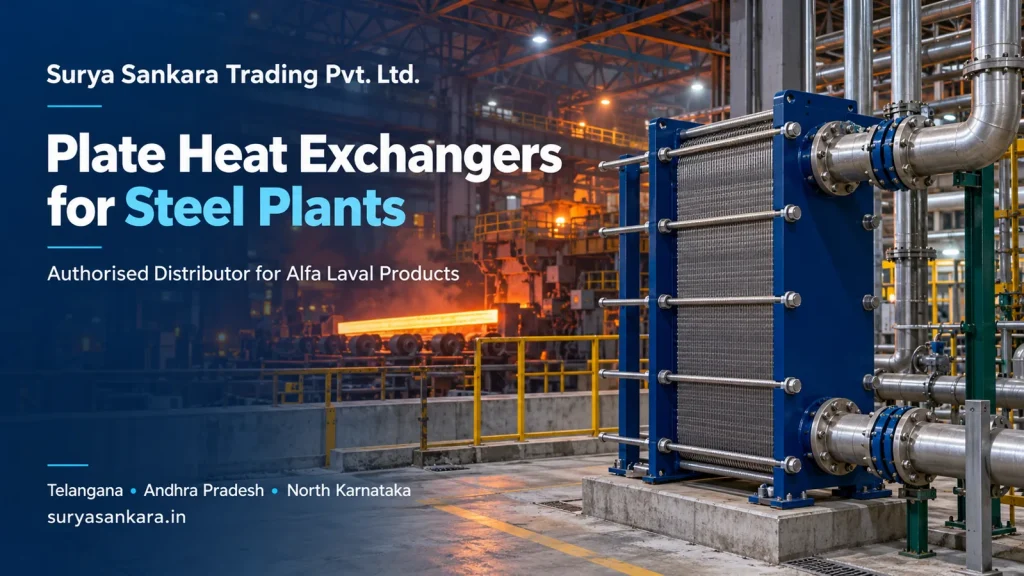
Plate Heat Exchangers for Steel Plants: Process Water and Rolling Mill Cooling. Plate heat exchangers for steel plants transfer heat from process water, lubricating oil and other industrial fluids into a separate cooling circuit. Correctly selected equipment helps maintain operating temperatures in the systems supporting steelmaking, casting and rolling.
Surya Sankara Trading is an Authorised Distributor for Alfa Laval products for Telangana, Andhra Pradesh and North Karnataka. We welcome heat-exchanger enquiries from steel manufacturers, rolling mills, engineering contractors and maintenance teams across these regions.
For each application, selection should consider the actual heat load, fluid properties, available cooling-water temperature, pressure limits and maintenance requirements.
How Are Plate Heat Exchangers Used in Steel Plants?
A plate heat exchanger transfers heat between fluids flowing through separate passages. In steel plants, this can allow treated process water to reject heat to a secondary cooling-water circuit.
Alfa Laval identifies closed-loop cooling as an application associated with furnaces, direct reduction plants and continuous casting equipment. These heat exchangers serve the cooling circuits; they do not directly cool molten steel. Alfa Laval
A practical application discussion should start with the equipment being cooled and its required operating conditions. A rolling-mill oil cooler and a furnace-water heat exchanger may need very different designs.
Applications of Plate Heat Exchangers for Steel Plants
Closed-Loop Process Water Cooling
Separating treated process water from an external cooling-water source can help maintain the intended water quality within the process circuit.
The design needs to account for conditions on both sides. Clean process water does not remove the need to assess cooling-tower water, river water or another secondary source for fouling and corrosion risks.
For critical cooling duties, the plant’s engineering team should also specify requirements for standby capacity, instrumentation and operating continuity.
Rolling Mill Lubricating Oil Cooling
Rolling-mill bearings, gearboxes and other machinery generate heat during operation. Oil cooling helps maintain the lubricant within the temperature range specified for the equipment.
Alfa Laval lists lubrication, bearing and gear-oil cooling among its steel-production applications. Alfa Laval
When enquiring about a rolling mill oil cooler, provide:
- Oil type and grade.
- Oil flow rate and inlet temperature.
- Required outlet temperature.
- Cooling-water temperature and flow.
- Allowable pressure drop.
- Startup and normal operating conditions.
Avoid selecting a replacement solely by matching connection sizes. The thermal and hydraulic requirements must also match.
Continuous Casting Auxiliary Cooling
Continuous casting installations depend on properly engineered cooling systems. A plate heat exchanger may be considered within an appropriate indirect cooling circuit, subject to the casting-equipment requirements.
The enquiry should identify whether the fluid is treated closed-loop water or water that has contacted the process. This distinction affects the assessment of solids, fouling and suitable exchanger construction.
Plant Utility Cooling
Steel plants also have auxiliary equipment with separate cooling requirements. These should be evaluated individually rather than combined under a single assumed duty.
For a utility-cooling enquiry, identify the equipment, operating hours, normal load and peak load. Include any seasonal changes in cooling-water availability or temperature.
Can a Plate Heat Exchanger Handle Water Containing Mill Scale?
Water containing mill scale requires a specific assessment before a plate heat exchanger is selected.
Steel forming and finishing can generate water streams containing scale and iron oxide particles. Alfa Laval discusses solids separation and water recycling as part of these processes. Alfa Laval
Do not assume a standard narrow-channel plate heat exchanger is suitable for an untreated stream. Provide information about suspended solids, particle size, filtration and cleaning arrangements.
Depending on the duty, the assessment may involve water treatment, a different channel configuration or another exchanger design.
Plate Heat Exchangers for Steel Plants in Telangana, Andhra Pradesh and North Karnataka
Surya Sankara Trading is an Authorised Distributor for Alfa Laval products for Telangana, Andhra Pradesh and North Karnataka. We welcome enquiries for steel-plant process-water cooling, rolling-mill oil cooling and related heat-transfer requirements.
Telangana: Hyderabad and Jeedimetla
Steel manufacturers and rolling-mill teams in Hyderabad and Jeedimetla can contact Surya Sankara Trading to discuss Alfa Laval heat exchangers for suitable process-water and lubricating-oil cooling applications.
For an equipment enquiry, share the fluid details, operating temperatures, flow rates and required cooling duty.
Andhra Pradesh: Visakhapatnam, Kurnool and Orvakal
We welcome enquiries from steel-industry facilities and project teams in Visakhapatnam, Kurnool and Orvakal.
Whether the requirement involves a new installation or replacement equipment, selection should account for cooling-water quality, available utility temperatures, pressure limits and maintenance access.
North Karnataka: Toranagallu, Ballari and Hosapete
We serve North Karnataka, including Toranagallu, Ballari and Hosapete, for Alfa Laval product enquiries associated with steelmaking and rolling-mill cooling requirements.
For existing installations, provide the equipment nameplate, available duty sheet and current operating readings to support an application discussion.
Selecting Plate Heat Exchangers for Steel Plants
A useful specification should describe the operating duty, not simply ask for a particular exchanger size.
| Information required | What to provide |
|---|---|
| Application | Process-water cooling, oil cooling or another identified duty |
| Fluids | Fluid names, composition and available analysis |
| Temperatures | Inlet and required outlet temperatures on both sides |
| Flow rates | Normal, minimum and maximum values where available |
| Heat load | Required duty in kW, if known |
| Pressure | Operating pressure, design pressure and allowable pressure drop |
| Contamination | Solids, oil contamination, scaling or fouling history |
| Operating pattern | Continuous, intermittent or variable production |
| Site constraints | Available space, connection orientation and maintenance access |
Share the highest expected cooling-water inlet temperature, not only a favourable reading taken during cooler weather. This helps establish whether the required process outlet temperature is realistic under the intended conditions.
Explore our industrial gasketed plate heat exchangers for related product information.
Reviewing an Existing Steel Plant Cooling Problem
If an existing exchanger is no longer achieving the required outlet temperature, document the operating conditions before choosing a larger replacement.
Useful records include temperatures, flow rates and pressure readings on both sides, together with the production load when the problem occurs.
Also note whether the issue started after a production increase, a change in water quality, a maintenance activity or a seasonal rise in cooling-water temperature.
These details help distinguish an equipment-sizing question from a wider cooling-system issue. For related enquiries, visit our gasketed plate heat exchanger services page.
Frequently Asked Questions
What is the purpose of a plate heat exchanger in a steel plant?
A plate heat exchanger transfers heat between separate fluid circuits. In steel plants, it can be used for process-water and oil-cooling duties associated with production machinery and supporting equipment.
Can plate heat exchangers be used for rolling mill oil cooling?
Yes, a suitable plate heat exchanger can be selected for rolling-mill oil cooling. Selection depends on the oil properties, flow rate, operating temperatures, cooling-water conditions and allowable pressure drop.
Are plate heat exchangers suitable for furnace cooling systems?
They can form part of a properly engineered indirect cooling system. Suitability must be checked against the furnace manufacturer’s requirements, operating conditions and plant engineering specifications.
Can the same exchanger be used for clean water and scale-bearing water?
Not automatically. Scale-bearing water introduces additional solids and fouling considerations. The water analysis, particle characteristics and treatment arrangements must be reviewed before choosing the exchanger.
What information is needed for a steel plant heat exchanger quotation?
Provide the application, fluids, flow rates, inlet and outlet temperatures, operating pressures and allowable pressure drop. For a replacement, include the existing model, nameplate photograph and available duty sheet.
Where does Surya Sankara Trading serve steel-industry customers?
Surya Sankara Trading is an Authorised Distributor for Alfa Laval products for Telangana, Andhra Pradesh and North Karnataka. Relevant enquiry locations include Hyderabad, Jeedimetla, Visakhapatnam, Orvakal, Kurnool, Toranagallu, Ballari and Hosapete.
How do I enquire about an Alfa Laval heat exchanger for a steel plant?
Contact Surya Sankara Trading with your plant location and cooling-duty details. Identify whether you need equipment for a new project, an existing installation or a replacement application.
Discuss Your Steel Plant Cooling Requirement
Looking for plate heat exchangers for steel plants in Telangana, Andhra Pradesh or North Karnataka?
Surya Sankara Trading welcomes enquiries for Alfa Laval products from steel producers, rolling mills and project teams. Share your process conditions, plant location and available equipment details to begin an application discussion.