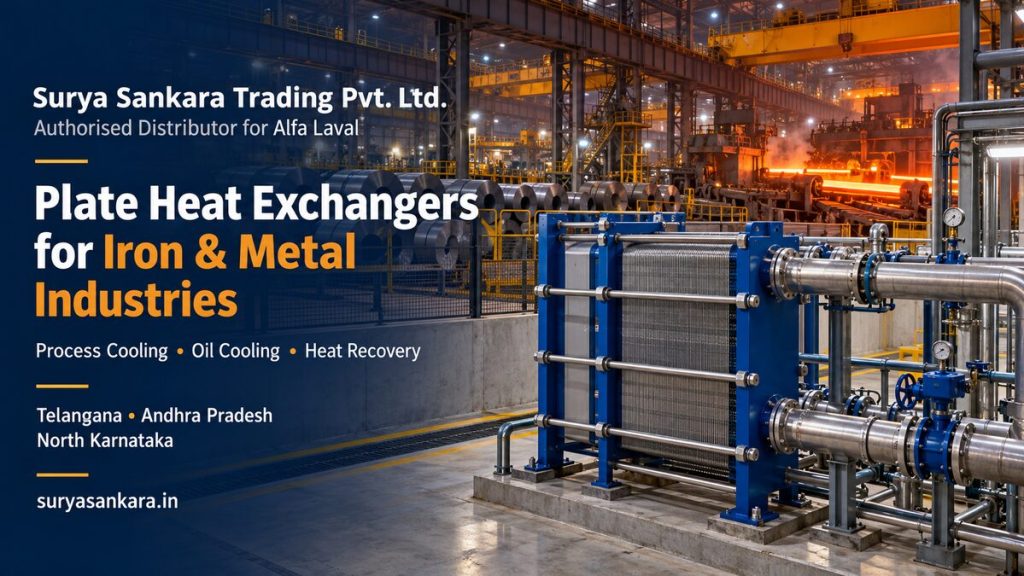
Plate Heat Exchanger for Metal Industries support temperature control in suitable cooling-water, lubrication-oil, metalworking-fluid and heat-treatment applications. In iron and steel production, the right heat-transfer equipment helps plant teams manage heat from machinery and supporting process systems.
Surya Sankara Trading is an Authorised Distributor for Alfa Laval products for Telangana, Andhra Pradesh and North Karnataka. We welcome product enquiries from steel plants, rolling mills, foundries, metalworking facilities, engineering consultants and maintenance teams within these territories.
Selection should follow the actual application: fluid composition, temperatures, flow rates, pressure limits, contamination levels and maintenance requirements.
Where Do Plate Heat Exchangers Fit in Metal Production?
Plate Heat Exchanger for Metal Industries, A plate heat exchanger transfers heat between fluids flowing through separate channels. During normal operation, the fluids exchange heat through the plates without mixing.
In metal production, this can help remove heat from an equipment-cooling circuit or a suitable process fluid. The exchanger is part of the cooling system; the heat must ultimately be rejected through a cooling tower, dry cooler, chiller or another suitable arrangement.
Standard liquid-to-liquid plate heat exchangers do not directly cool molten metal. Their role is generally within appropriately engineered fluid circuits supporting production equipment and processes.
Applications of Plate Heat Exchangers for Metal Industries
Closed-Loop Cooling Water
Steelmaking equipment may require a controlled cooling-water circuit. A plate heat exchanger can transfer heat from this circuit to a separate external cooling-water system.
Separating the circuits allows the equipment loop to maintain its specified water conditions while rejecting heat through the secondary system.
The arrangement still requires water treatment, monitoring and maintenance. Selection must account for the temperature and quality of both water streams.
Rolling Mill and Lubrication Oil Cooling
Lubrication systems serving rolling-mill equipment, bearings and gearboxes need to operate within the machinery manufacturer’s specified temperature range.
A suitable oil-to-water plate heat exchanger transfers heat from the oil to the cooling water. Important selection factors include oil grade, viscosity, operating temperature, flow and allowable pressure drop.
For a replacement enquiry, provide the existing cooler’s nameplate and measured conditions. Similar dimensions or connection sizes do not establish equivalent performance.
Metalworking Coolant Cooling
Machining and metalworking processes generate heat that must be managed through the appropriate coolant system.
Plate heat exchangers may be considered for compatible coolant-cooling duties. However, metal fines, chips, oil contamination and other deposits can affect selection and cleaning requirements.
Describe the coolant composition and contamination accurately. A narrow-channel exchanger should not be selected for a heavily contaminated fluid without assessing blockage and fouling risks. Depending on the duty, another construction, such as a spiral heat exchanger, may be more appropriate.
Quenching-Fluid Temperature Control
Heat-treatment processes may require controlled quenching-bath temperatures.
A suitable heat exchanger can remove heat from the circulating quenching fluid, but the selection must reflect the fluid properties and the heat-treatment procedure.
Provide the fluid specification, target bath temperature, production cycle and peak cooling demand. A batch process can impose a different cooling requirement from a continuous process with the same average output.
Selected Pickling and Surface-Treatment Duties
Some metal-finishing processes involve corrosive fluids that require specialist heat-transfer materials.
For certain pickling duties, graphite plate heat exchangers may be considered following a chemical-compatibility assessment. Conventional stainless steel equipment should not be assumed suitable for every acid solution.
The enquiry should identify the chemicals, concentrations, temperatures, impurities and cleaning conditions. Selection must be specific to the complete process chemistry.
Choosing Plate Heat Exchangers for Metal Industries
Define the Cooling Requirement
Specify the heat load and required temperatures on both circuits. Where the duty varies, include the normal operating range and peak conditions.
For existing equipment, distinguish between original design values and current measurements. This helps establish whether the problem relates to capacity, changed utilities, fouling or another operating issue.
Check Fluid Cleanliness
Cooling water and metalworking fluids can carry contaminants that influence channel selection and maintenance.
Useful information includes:
- Suspended-solids concentration.
- Particle size and type.
- Metal fines or scale.
- Oil contamination.
- Existing filtration arrangements.
- Previous blockage or cleaning history.
Photographs of deposits and inspection findings can make an enquiry more useful than a general description such as “dirty water.”
Confirm Material and Gasket Compatibility
Plate and gasket selection must account for the process fluid, temperature and approved cleaning chemicals.
For water circuits, provide available analysis, including chlorides and treatment details. For oil circuits, identify the lubricant and additives rather than using only a broad description such as “industrial oil.”
Assess Cross-Contamination Consequences
An internal leak between oil and water circuits can have significant operational consequences.
Where fluid separation is particularly critical, ask whether a double-wall design or other protective arrangement is appropriate. The assessment should also consider pressure relationships, leak detection and the plant’s response procedures.
No single equipment feature replaces a complete risk assessment.
Balance Heat Transfer and Pressure Drop
The exchanger must meet the thermal requirement without exceeding the available pumping capacity.
Oil viscosity, coolant concentration and temperature affect hydraulic performance. Include startup conditions where they differ significantly from normal operation.
Allow Access for Maintenance
For an openable gasketed exchanger, provide sufficient space to move the pressure plate and handle the plates safely.
Plan isolation, drainage, inspection and maintenance access before installation. These requirements are especially important when replacing equipment in a congested utility area.
Explore our industrial gasketed plate heat exchangers for related product information.
Requesting Plate Heat Exchangers for Metal Industries: Information Required
| Information | Details to provide |
|---|---|
| Application | Cooling water, lubrication oil, metalworking coolant, quenching or another defined duty |
| Fluids | Composition, oil grade, additives and concentrations |
| Temperatures | Inlet and required outlet temperatures on both sides |
| Flow rates | Normal, minimum and maximum flow |
| Heat load | Required cooling duty, where known |
| Pressure | Operating pressure, design pressure and allowable pressure drop |
| Contamination | Solids, particle sizes, scale and oil carryover |
| Operating cycle | Continuous operation, batch duty or variable load |
| Existing equipment | Model, nameplate, drawings and performance concerns |
| Project location | Site in Telangana, Andhra Pradesh or North Karnataka |
Alfa Laval Product Enquiries in Our Authorised Territory
Surya Sankara Trading supports application discussions, product enquiries and selection coordination for Alfa Laval products within Telangana, Andhra Pradesh and North Karnataka.
Telangana
Iron and metal-industry customers in Hyderabad and across Telangana can enquire about suitable heat exchangers for equipment cooling, lubrication systems and process-fluid duties.
For an existing installation, include operating measurements and describe the issue you want to resolve.
Andhra Pradesh
Steel plants, foundries, rolling mills and metalworking businesses in Visakhapatnam, Vijayawada and other locations in Andhra Pradesh can submit their application requirements.
Where cooling-water quality is challenging, share the water-analysis report at the enquiry stage. The actual fluid composition should guide material selection.
North Karnataka
Customers in Ballari, Hosapete, Hubballi–Dharwad, Belagavi and other locations in North Karnataka can contact Surya Sankara Trading for Alfa Laval product enquiries.
Provide the plant location, process details and required duty so the discussion can address the intended installation.
Troubleshooting Reduced Cooling Performance
A higher-than-expected outlet temperature does not automatically mean the heat exchanger needs replacement.
Before deciding on corrective action, compare operating data with the design conditions.
| Observation | Checks to discuss with the maintenance team |
|---|---|
| Process fluid leaves too warm | Cooling-water inlet temperature, flow rates, heat load and control settings |
| Pressure drop has increased | Strainers, flow changes, possible deposits and measurement accuracy |
| Performance changes between batches | Peak load, batch timing and available coolant conditions |
| Frequent blockage | Particle size, filtration, fluid cleanliness and channel suitability |
| Repeated leakage | Operating transients, material compatibility, gasket condition and assembly history |
These checks help frame an investigation; they do not establish the cause without inspection and operating evidence.
Use the manufacturer’s instructions and approved site procedures for cleaning and maintenance. For related enquiries, visit our gasketed plate heat exchanger services page.
Frequently Asked Questions – Plate Heat Exchanger for Metal Industries
1. What are plate heat exchangers used for in iron and metal industries?
They may be used for closed-loop cooling water, lubrication-oil cooling, metalworking-coolant cooling and suitable quenching-fluid duties. Specialist designs can also serve selected corrosive process applications.
2. Can a plate heat exchanger cool molten iron directly?
A standard liquid-to-liquid plate heat exchanger is not intended for direct contact with molten iron. It may form part of an engineered cooling-water system supporting production equipment.
3. Are plate heat exchangers suitable for rolling mill oil cooling?
Yes, for suitable applications. Selection must match the oil properties, required temperatures, flow rate, pressure limits and machinery manufacturer’s requirements.
4. Can metal working coolant pass through a plate heat exchanger?
Potentially, but coolant chemistry and contamination must be assessed. Metal chips, fines and deposits may require filtration or a different exchanger construction.
5. Can a plate heat exchanger control a quenching-bath temperature?
A suitable unit can remove heat from a circulating quenching fluid. Its capacity and construction must match the heat-treatment process, fluid properties and production cycle.
6. Which plate material is best for a metal-processing plant?
There is no universal choice. Water chemistry, process chemicals, temperature, corrosion risk and cleaning requirements determine the appropriate material.
7. When should a double-wall heat exchanger be considered?
It may be considered where the consequences of cross-contamination are significant. The decision should form part of an assessment covering fluids, pressure relationships, leak detection and operating procedures.
8. Where can customers in Telangana and Andhra Pradesh enquire about Alfa Laval products?
Customers can contact Surya Sankara Trading, an Authorised Distributor for Alfa Laval products for Telangana, Andhra Pradesh and North Karnataka, with their application details.
9. Does the authorised territory cover all of Karnataka?
No. Surya Sankara Trading’s stated authorised territory covers North Karnataka, together with Telangana and Andhra Pradesh. Include the exact project location when making an enquiry.
Discuss Your Metal-Industry Cooling Requirement
Looking for plate heat exchangers for iron, steel and metal industries?
Contact Surya Sankara Trading — Authorised Distributor for Alfa Laval products for Telangana, Andhra Pradesh and North Karnataka for Plate Heat Exchanger for Metal Industries
Share your process-fluid details, temperatures, flow rates, pressure limits and plant location. For replacement equipment, include the existing model and nameplate photograph.
For manufacturer information, explore Alfa Laval’s steel production solutions and metalworking coolant-cooling applications.
More Readings on Plate Heat Exchangers