
Plate Heat Exchanger for Data Centers: Cooling Solutions for Telangana, Andhra Pradesh and North Karnataka. Plate heat exchangers for data centers transfer heat between cooling circuits, helping facilities manage heat generated by servers and other IT equipment. Depending on the system design, they can support liquid cooling, separation of facility-water circuits, free cooling and heat recovery.
Surya Sankara Trading is an Authorised Distributor for Alfa Laval products for Telangana, Andhra Pradesh and North Karnataka. We welcome product enquiries and application discussions from data-centre operators, cooling-system integrators, engineering consultants and project teams within these territories.
The right selection depends on the cooling architecture, required temperatures, fluid properties, pressure limits and availability requirements.
What Does a Plate Heat Exchanger Do in a Data Center?
A plate heat exchanger transfers heat from a warmer fluid to a colder fluid through metal plates. The circuits remain separate during normal operation.
In a data centre, this can provide an interface between an equipment-cooling circuit and a facility cooling-water circuit. Depending on the installation, it may also separate an indoor circuit from an outdoor heat-rejection system.
The heat exchanger does not independently produce cooling. Heat must ultimately be rejected through equipment such as a chiller, cooling tower or dry cooler, or transferred to a useful heat-recovery application.
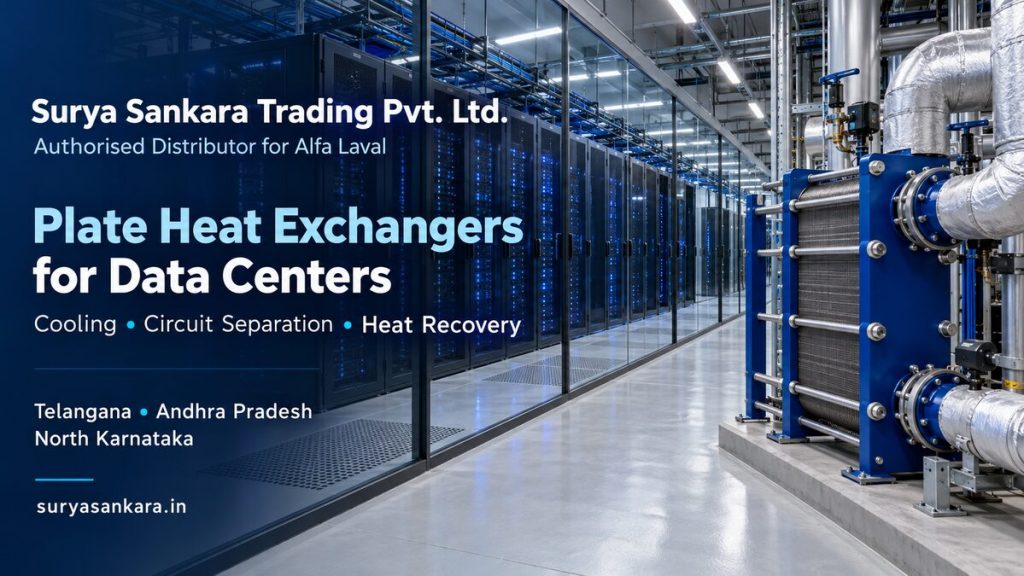
Applications in Data Center Cooling – Plate Heat Exchanger for Data Centers
Facility Cooling-Water Circuit Separation
A suitably selected plate heat exchanger can separate circuits with different water-quality or pressure requirements.
This arrangement allows heat transfer while keeping the fluids separate during normal operation. It can also help establish clear maintenance boundaries between parts of the cooling system.
The design must consider pressure relationships, material compatibility, leak detection and the consequences of a failure. Circuit separation does not eliminate the need for water treatment or monitoring.
Liquid Cooling and Coolant Distribution Units
In direct-to-chip cooling, coolant absorbs heat through cold plates attached to processors. The warmed coolant then carries that heat towards a coolant distribution unit, commonly called a CDU.
A liquid-to-liquid CDU may contain a plate heat exchanger that transfers heat from the technology cooling circuit to the facility-water circuit.
The plate heat exchanger is one component within the CDU. Pumps, controls, filtration and monitoring must also suit the IT equipment and system requirements.
For a CDU-related enquiry, provide the integrator’s specification, coolant composition, required thermal duty and permitted pressure drop. A general-purpose heat exchanger should not be substituted without checking compatibility.
Free Cooling and Waterside Economizers
Free cooling uses favourable outdoor conditions to reduce reliance on mechanical refrigeration.
In a suitable waterside economizer arrangement, a plate heat exchanger transfers heat between the facility cooling circuit and a circuit connected to external heat-rejection equipment. Depending on conditions, the system may provide partial or full free cooling.
“Free cooling” does not mean zero electricity consumption. Pumps, fans and controls still use power.
For projects in Telangana, Andhra Pradesh and North Karnataka, feasibility must be assessed using local weather data, required supply-water temperatures and the complete system design. Year-round free cooling should not be assumed.
Data Center Heat Recovery
Heat removed from servers may offer an opportunity for reuse where a suitable heat demand exists.
Possible applications depend on the temperature available and the requirements of the receiving process. Some projects may need a heat pump to raise the recovered heat to a useful temperature.
Before proposing heat recovery, assess the heat source, demand profile, distance between systems, operating schedule and additional equipment requirements.
Choosing Plate Heat Exchangers for Data Centers
Define the Cooling Duty and Operating Range
Specify the required heat-transfer duty and temperatures on both sides of the exchanger.
Include normal operation, peak load and expected part-load conditions. For phased developments, distinguish between the initial installation and future expansion requirements.
An exchanger selected only for a nameplate load may not reflect how the facility will actually operate.
Evaluate Temperature Approach
Temperature approach describes the temperature difference between the two streams at an exchanger terminal.
A close approach can be valuable in data-centre cooling, particularly where the system is designed to make greater use of favourable outdoor conditions. However, it must be assessed alongside heat-transfer area, pressure drop and cost.
The design target should come from the cooling-system specification.
Check Pressure Drop and Pumping Requirements
The exchanger must deliver the required thermal performance within the available pumping capacity.
Specify allowable pressure drop for each circuit. Include fluid concentration and temperature because these influence viscosity and hydraulic behaviour.
Assess exchanger performance as part of the complete system rather than considering heat-transfer efficiency alone.
Confirm Coolant and Material Compatibility
Data-centre cooling systems may use treated water or specified coolant mixtures.
Provide the complete fluid specification, including additives and concentrations where applicable. Plate materials, joining materials and gaskets must be compatible with both the operating fluid and any approved cleaning process.
Follow the requirements of the server manufacturer, CDU supplier and cooling-system designer.
Plan for Maintenance and Availability
Availability requirements should guide the arrangement of heat exchangers, isolation valves, instrumentation and standby capacity.
The project engineer should establish whether the design requires redundancy and how maintenance can be performed while maintaining the required cooling service.
An individual exchanger cannot, by itself, guarantee data-centre uptime.
Which Heat Exchanger Construction Is Suitable? – Plate Heat Exchanger for Data Centers
Gasketed plate-and-frame heat exchangers can suit facility-level applications where inspection and access to the plate pack are important.
Brazed plate heat exchangers can provide a compact solution for suitably specified applications, including certain CDU designs. Their plate packs cannot be opened like a gasketed unit.
Alfa Laval’s AlfaQ range includes gasketed plate heat exchangers for HVAC applications such as data centres and free cooling. The range is covered by the AHRI Liquid to Liquid Heat Exchangers certification programme. Confirm the applicable model and certified selection when this is part of the project specification.
Explore our industrial gasketed plate heat exchangers and brazed plate heat exchangers for related product information.
Information Required for a Data Center Cooling Enquiry
| Information | Details to provide |
|---|---|
| Application | Facility-water separation, CDU integration, economizer or heat recovery |
| Thermal duty | Required capacity and expected operating range |
| Temperatures | Inlet and required outlet temperatures on both circuits |
| Flow rates | Design, minimum and maximum flow |
| Fluids | Water quality, coolant composition and additive concentration |
| Pressure | Operating pressure, design pressure and allowable pressure drop |
| Availability | Redundancy and maintenance requirements defined by the project |
| Installation | Space, connection sizes and access requirements |
| Documentation | Applicable performance certification and project standards |
| Location | Project site in Telangana, Andhra Pradesh or North Karnataka |
For an existing installation, include the nameplate photograph, drawings and operating measurements.
Authorised Alfa Laval Distributor for Our Service Territories
Surya Sankara Trading’s authorised territory for Alfa Laval products covers Telangana, Andhra Pradesh and North Karnataka.
Telangana
Data-centre owners, consultants and system integrators in Hyderabad and across Telangana can contact Surya Sankara Trading for product enquiries related to suitable cooling heat exchangers.
Share the cooling-system arrangement and design conditions so the discussion can focus on the required equipment interface.
Andhra Pradesh
Project teams in Visakhapatnam, Vijayawada and other locations in Andhra Pradesh can submit application specifications for evaluation.
Where the external cooling circuit uses water with challenging chemistry, provide water-analysis details. Coastal location alone does not determine the appropriate plate material or cooling-system design.
North Karnataka
Customers in North Karnataka, including project teams in Hubballi–Dharwad, Belagavi and Kalaburagi, can enquire about Alfa Laval plate heat exchangers for suitable data-centre cooling applications.
Provide the exact project location and technical requirements when requesting a quotation.
Maintaining Cooling Performance
Monitor inlet and outlet temperatures, flow rates and differential pressure under comparable operating conditions.
A change in performance may indicate fouling, reduced flow, altered utility temperatures or a control issue. Review operating data before deciding that the exchanger needs cleaning or replacement.
Maintenance procedures must follow the manufacturer’s instructions and the facility’s approved operating plan. For related enquiries, visit our gasketed plate heat exchanger services page.
Frequently Asked Questions – Plate Heat Exchanger for Data Centers
1. Why are plate heat exchangers used in data centers?
They transfer heat between separate cooling circuits. Depending on the system, they can support facility-water separation, liquid cooling, free cooling and heat recovery.
2. Is a plate heat exchanger the same as a CDU?
No. A coolant distribution unit is a system that manages coolant circulation and operating conditions. A liquid-to-liquid CDU may contain a plate heat exchanger alongside pumps, controls and other components.
3. Can plate heat exchangers support AI server cooling?
Yes, suitably selected units can form part of liquid-cooling systems serving high-density computing equipment. Selection must follow the server, CDU and facility cooling specifications.
4. Can a plate heat exchanger replace a chiller?
Not in every operating condition. An economizer arrangement may reduce or avoid chiller operation when outdoor conditions are suitable. Mechanical cooling may still be needed during other periods.
5. Is free cooling suitable for data centers in Telangana and Andhra Pradesh?
It requires a site-specific assessment. Outdoor conditions, required coolant temperatures and the heat-rejection equipment determine whether useful partial or full free-cooling hours are available.
6. Will a plate heat exchanger reduce PUE?
A suitable cooling-system design may reduce cooling energy and improve Power Usage Effectiveness. The result depends on the entire facility; a heat exchanger alone cannot guarantee a particular PUE.
7. Who can supply Alfa Laval product support in Telangana, Andhra Pradesh and North Karnataka?
Surya Sankara Trading is an Authorised Distributor for Alfa Laval products for these territories and welcomes product enquiries and application discussions.
8. Does Surya Sankara Trading’s authorised territory include all of Karnataka?
No. The authorised territory stated here covers North Karnataka, together with Telangana and Andhra Pradesh. Share the project location when making an enquiry.
9. What information is needed for a quotation?
Provide the cooling application, thermal duty, fluids, temperatures, flow rates, pressure limits, installation requirements and project location. For replacement equipment, include existing model and nameplate details.
Discuss Your Data Center Cooling Requirement
Looking for plate heat exchangers for data centers in Telangana, Andhra Pradesh or North Karnataka?
Contact Surya Sankara Trading — Authorised Distributor for Alfa Laval products for Telangana, Andhra Pradesh and North Karnataka.
Share your cooling-system specification, project location and required operating conditions to begin an application-based discussion.
For manufacturer information, explore Alfa Laval’s data center cooling solutions.
More Readings on Plate Heat Exchangers