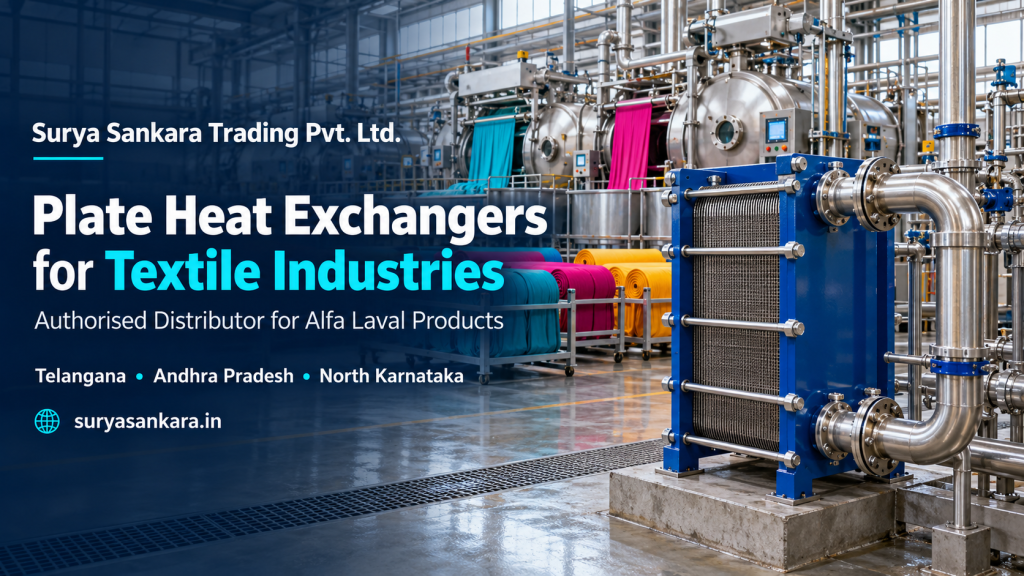
Plate Heat Exchanger for Textile Industries: Heating, Cooling and Heat Recovery. A plate heat exchanger for textile industries transfers heat between separate fluid circuits to support process-water heating, cooling and suitable heat-recovery applications. For textile wet-processing facilities, equipment selection should consider production schedules, water quality, process chemicals and cleaning requirements.
Surya Sankara Trading is an Authorised Distributor for Alfa Laval products for Telangana, Andhra Pradesh and North Karnataka. We welcome enquiries from textile-processing facilities, dyeing units, engineering consultants and project contractors across these regions.
Whether the requirement involves heating incoming water or evaluating heat recovery from a warm discharge stream, the starting point is the actual process duty.
How Does a Plate Heat Exchanger Work in Textile Processing?
A plate heat exchanger contains a series of heat-transfer plates. Hot and cold fluids flow through separate channels, transferring heat through the plate surfaces without mixing during normal operation.
In a textile installation, one circuit may contain process water while the other contains a heating or cooling utility. Another possible arrangement uses a suitable warm process stream to preheat incoming water.
Alfa Laval’s selection guidance identifies heating, cooling and heat recovery among standard gasketed plate heat exchanger duties. The appropriate model and construction depend on the application conditions.
The important distinction is that a heat exchanger transfers heat. It does not remove dyes, treat wastewater or replace the plant’s temperature-control system.
Applications of a Plate Heat Exchanger for Textile Industries
Process-Water Heating
Textile wet-processing operations may require water at defined temperatures for washing, preparation and other production stages.
A suitably selected plate heat exchanger can transfer heat from a hot utility into the process-water circuit. The specification should identify the required water temperature, flow rate and heating time.
For batch production, average daily consumption is not enough. The system must account for how much hot water is needed during each filling or processing period.
If steam is proposed as the heating medium, the exchanger and associated controls must be designed for the steam conditions and condensate removal requirements.
Heating and Cooling Around Dyeing Operations
Temperature requirements vary with the fibre, dye system, machinery and process recipe.
A plate heat exchanger may be assessed for the utility-water circuits supporting dyeing equipment. Direct circulation of dye liquor through an external exchanger requires a separate compatibility and fouling assessment.
When discussing a dyeing application, clarify:
- Whether the exchanger handles utility water or process liquor.
- Required heating and cooling rates.
- Normal and maximum temperatures.
- Chemicals and their concentrations.
- Presence of fibres, suspended matter or deposits.
- Available pressure and allowable pressure drop.
A heat exchanger should be selected around the dyeing-machine manufacturer’s requirements and the approved process conditions.
Washing and Rinsing Water Preheating
Where a facility has a suitable source of recoverable heat, incoming wash water may be preheated before a heater supplies the remaining energy.
For example, a warm discharge stream and a cooler incoming water stream can be evaluated for indirect heat exchange.
This opportunity depends on their temperatures, flow rates and timing. If hot discharge occurs when incoming water is not required, storage or another system arrangement may be necessary.
Heat recovery must also preserve the required quality of the incoming process water.
Textile Wastewater Heat Recovery
Warm wastewater can be a potential heat source, but not every textile effluent is suitable for a standard plate heat exchanger.
Before proposing equipment, examine:
- Fibre and lint content.
- Suspended solids and particle size.
- Chemical composition and pH.
- Potential for scaling or sticky deposits.
- Temperature variation between batches.
- Cleaning access and acceptable downtime.
Alfa Laval offers WideGap designs for fluids containing fibres and coarse particles. This makes channel geometry a relevant consideration, but it does not establish suitability for every textile wastewater stream. Application-specific assessment is still necessary.
Heat recovery and wastewater treatment are separate functions. Recovering heat does not make the discharge suitable for reuse or release.
Cooling of Supporting Utility Circuits
Some textile facilities have equipment requiring controlled cooling-water temperatures. A plate heat exchanger can be assessed as an interface between a suitable equipment circuit and the plant’s cooling-water system.
Provide the equipment manufacturer’s specified temperatures and flow requirements. Also identify the highest expected cooling-water inlet temperature during operation.
The available cooling-water temperature limits the outlet temperature that the exchanger can achieve.
What Benefits Can Correct Selection Provide?
A properly matched installation can support practical operating objectives:
| Objective | What the design must address |
|---|---|
| Process temperature control | Required temperatures, flow variation and suitable controls |
| Useful heat recovery | A compatible heat source and receiving process |
| Separation of circuits | Fluid compatibility and consequences of leakage |
| Maintainability | Cleaning method, access and maintenance intervals |
| Appropriate installation size | Thermal duty, pressure drop and available space |
Benefits depend on the complete installation. Avoid assuming a fixed reduction in steam consumption, water use or operating cost before the duty has been assessed.
Selecting a Plate Heat Exchanger for Textile Industries
The most useful enquiry includes conditions on both sides of the exchanger.
| Selection factor | Information to provide |
|---|---|
| Application | Water heating, cooling, liquor temperature control or heat recovery |
| Fluids | Names, composition, additives and concentrations |
| Temperatures | Inlet and required outlet temperatures on both sides |
| Flow rates | Normal, minimum and maximum flows |
| Operating pattern | Batch or continuous operation, including cycle times |
| Pressure | Operating and design pressure, plus allowable pressure drop |
| Contaminants | Fibres, lint, solids, scaling or other fouling concerns |
| Cleaning | Proposed cleaning agents, method and available access |
| Existing equipment | Model, nameplate photograph and duty sheet, where available |
Consider Batch Timing
Textile processes often have changing heating and cooling demands.
For a heat-recovery project, record when the hot stream becomes available and when another process needs heat. Two streams may have promising temperatures but incompatible operating schedules.
A realistic assessment should include these timing differences before estimating annual energy recovery.
Check Plate and Gasket Compatibility
Material selection should consider the complete process chemistry, temperature and cleaning conditions.
Do not assume that stainless steel or a particular gasket compound is suitable for every dye, salt, alkali or cleaning solution. Provide the relevant chemical information for technical assessment.
Assess Fouling Before Choosing Channel Geometry
Clean utility water and fibre-bearing wastewater present different operating challenges.
A conventional gasketed design may be considered for a suitable clean-fluid duty. Streams containing fibres or coarse particles may require wider channels or a different exchanger technology.
Explore our industrial gasketed plate heat exchangers and WideGap heat exchangers for related product information.
Textile Heat Exchanger Enquiries Across Our Service Regions
Telangana: Hyderabad, Sircilla and Warangal
Sircilla has an established textile base that includes power looms, textile processing and dyeing units. Telangana’s investment resources also identify Warangal as a textile-development location. India
Surya Sankara Trading welcomes enquiries from textile businesses and project teams in Hyderabad, Sircilla and Warangal.
For facilities with wet-processing operations, enquiries can focus on process-water heating, suitable cooling duties and heat-recovery opportunities. Share the actual process requirements rather than selecting equipment solely by the type of textile produced.
Andhra Pradesh: Chirala, Guntur and Mangalagiri
Andhra Pradesh has established textile and weaving locations, including Chirala and Mangalagiri. State resources identify these centres within its textile traditions and production network. handlooms.ap.gov.in
We welcome product enquiries from textile businesses and engineering teams in Chirala, Guntur, Mangalagiri and other Andhra Pradesh locations.
The need for a heat exchanger depends on the operations performed at the facility. A business carrying out dyeing, washing or other wet processing may have different requirements from a weaving-only or garment-stitching unit.
North Karnataka: Hubballi–Dharwad, Belagavi and Ballari
Surya Sankara Trading serves North Karnataka, including Hubballi–Dharwad, Belagavi and Ballari, for Alfa Laval product enquiries.
Textile businesses, contractors and project teams in these locations can submit heating, cooling or heat-recovery requirements for application discussions.
For an existing installation, include the equipment model, current temperatures, flow readings and the operating issue you want to address.
Evaluating Heat Recovery in a Textile Facility
Before estimating savings, identify a specific source of waste heat and a process that can use it.
A useful assessment asks:
- What is the hot stream’s temperature and flow?
- How often is it available?
- Which incoming stream requires heating?
- Do both duties operate at the same time?
- What treatment or cleaning arrangements are needed?
- How much additional pumping energy will be required?
- What installation and maintenance costs apply?
The annual benefit depends on usable recovered heat over the operating schedule—not simply the exchanger’s rated capacity.
Maintenance and Performance Monitoring
Record inlet and outlet temperatures, flow rates and pressure readings when the equipment is operating normally. These provide a reference for later comparisons.
If performance changes, investigate the wider system as well as the exchanger. Changed utility temperatures, restricted flow, fouling and altered production conditions can all affect the result.
Cleaning should follow the equipment instructions and use methods compatible with the plates, gaskets and deposits involved.
For related enquiries, visit our gasketed plate heat exchanger services page.
Frequently Asked Questions
1. What is a plate heat exchanger used for in textile industries?
A plate heat exchanger can support process-water heating, cooling and suitable heat-recovery duties in textile facilities. The exact application depends on the production process, fluid properties and required temperatures.
2. Can a plate heat exchanger recover heat from textile wastewater?
Yes, where the wastewater characteristics and operating conditions allow it. Fibres, solids, chemicals and fouling risks must be assessed before selecting the exchanger and any required pretreatment.
3. Can plate heat exchangers be used with dyeing machines?
They may be suitable for supporting utility circuits or specifically assessed process duties. Direct handling of dye liquor requires confirmation of chemical compatibility, pressure limits, fouling behaviour and machine requirements.
4. Is a standard plate heat exchanger suitable for water containing lint?
Not automatically. Lint and fibres can affect flow and cleaning requirements. A wider-channel design, screening or another exchanger technology may need to be considered.
5. Will heat recovery reduce steam consumption?
It can reduce the additional heating required when recovered heat usefully preheats a process stream. The actual reduction depends on temperatures, flow rates, operating schedules and system losses.
6. Does a heat exchanger remove colour or chemicals from textile wastewater?
No. It transfers heat between circuits. Colour removal, chemical treatment and compliance with discharge requirements need appropriate wastewater-treatment processes.
7. Where can textile businesses enquire about Alfa Laval heat exchangers?
Surya Sankara Trading is an Authorised Distributor for Alfa Laval products for Telangana, Andhra Pradesh and North Karnataka. Businesses can submit their plant location and operating requirements through the contact page.
8. What details are needed for a textile heat exchanger quotation?
Provide the application, fluid composition, inlet and outlet temperatures, flow rates, pressure limits and operating schedule. For wastewater duties, include information about fibres, solids and cleaning requirements.
Discuss Your Textile Heating or Cooling Requirement
Looking for a plate heat exchanger for textile industries in Telangana, Andhra Pradesh or North Karnataka?
Surya Sankara Trading — Authorised Distributor for Alfa Laval products welcomes enquiries for process-water heating, suitable cooling applications and heat-recovery assessments.
Share your plant location, process details and required operating conditions to begin an application discussion.
For manufacturer guidance, explore Alfa Laval’s plate heat exchanger selection guide.
More Readings on Plate Heat Exchangers