
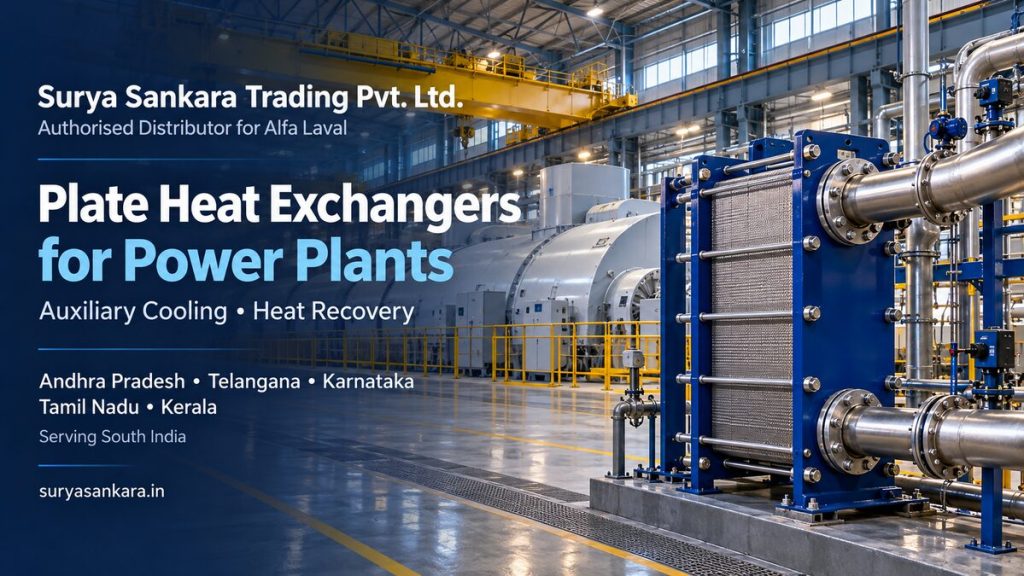
Plate Heat Exchanger for Power Plants in South India. A plate heat exchanger for power plants transfers heat between fluid circuits in suitable auxiliary cooling and heat-recovery applications. Depending on the installation, these duties may include closed-loop cooling water, lubrication oil cooling and equipment utility cooling.
Surya Sankara Trading is an Authorised Distributor for Alfa Laval products, supporting product enquiries and application discussions across Andhra Pradesh, Telangana, Karnataka, Tamil Nadu and Kerala.
For power-generation facilities, selecting the right exchanger requires more than matching a connection size or nominal capacity. The equipment must meet the plant’s thermal duty, fluid compatibility, pressure limits and operating requirements.
Where Are Plate Heat Exchangers Used in Power Plants?
Plate Heat Exchanger for Power Plants, Plate heat exchangers may serve several auxiliary systems within a power-generation facility. Each application must be assessed against the equipment manufacturer’s requirements and the plant’s engineering specification.
They should not be treated as universal replacements for boilers, steam generators or main turbine condensers.
Closed-Loop Cooling Water
A plate heat exchanger can separate an equipment cooling-water loop from the plant’s external cooling-water circuit.
Heat passes from the warmer equipment circuit to the colder utility circuit through the plates. During normal operation, the fluids remain separate.
This arrangement can help maintain controlled water conditions in the equipment loop. However, water treatment, leak monitoring and maintenance remain necessary on the relevant circuits.
Selection should account for the highest expected cooling-water inlet temperature, rather than favourable conditions measured during only one season.
Lubrication Oil Cooling
Suitable plate heat exchangers may be considered for lubrication systems associated with rotating machinery, subject to the machinery manufacturer’s approval.
The assessment should include:
- Lubricant grade and composition.
- Oil viscosity across startup and operating temperatures.
- Required oil outlet temperature.
- Oil and coolant flow rates.
- Allowable pressure drop.
- Operating and design pressures.
For replacement enquiries, provide the existing cooler’s nameplate and measured performance. An exchanger with similar dimensions may have a different thermal or hydraulic capability.
Auxiliary Equipment Cooling
Plate Heat Exchanger for Power Plants contain supporting equipment with their own cooling requirements. A plate heat exchanger may form part of a suitable secondary cooling circuit serving these systems.
The enquiry should identify precisely which equipment needs cooling, the heat load and the available utility conditions. A general description such as “power plant cooler” is insufficient for a dependable selection.
Selected Heat-Recovery Duties
Where a plant has a suitable warm fluid stream and a compatible demand for heat, a plate heat exchanger may support heat recovery.
For example, an engineering assessment may identify an opportunity to preheat a colder water stream using heat that would otherwise be rejected.
The value of the project depends on the temperature available, operating hours, simultaneous demand and additional system costs. Heat recovery should be evaluated against the complete plant arrangement.
How a Plate Heat Exchanger Works
A plate heat exchanger provides channels for hot and cold fluids, separated by heat-transfer surfaces.
Heat moves through the plates from the hotter fluid to the colder fluid. The plate configuration, heat-transfer area and flow arrangement are selected to achieve the required duty within the permitted pressure drop.
In a gasketed plate-and-frame unit, the plate pack can be opened for inspection and maintenance. Other constructions, including brazed, fusion-bonded and welded equipment, have different operating and servicing characteristics.
The appropriate design depends on the application.
Selecting a Plate Heat Exchanger for Power Plant Cooling
Establish the Required Duty
Define the heat load and the required inlet and outlet temperatures on both sides.
Where operating data is incomplete, identify the missing information before requesting a final equipment selection. Estimates should be clearly distinguished from measured or approved design values.
Check Seasonal Cooling Conditions
Cooling-water availability and temperature can change with the season and the plant’s operating conditions.
For projects across South India, use site-specific utility data. A selection for a facility in Andhra Pradesh should not automatically be reused for a plant in Karnataka or Kerala simply because the proposed cooling duty appears similar.
Review Water Quality and Materials
Cooling-water composition influences material selection and fouling behaviour.
Provide available information on chlorides, suspended solids, hardness, treatment chemicals and other relevant contaminants. Coastal location alone does not establish whether seawater is being used; the actual cooling medium must be identified.
Where seawater or aggressive water is involved, plate materials and the complete design require a specific compatibility assessment.
Confirm Pressure and Flow Requirements
Thermal performance must be considered alongside the available pumping capacity.
Specify operating pressure, design pressure and allowable pressure drop on both circuits. Include relevant startup, shutdown and pressure-transient conditions in the engineering review.
Plan for Availability and Maintenance
A power plant’s operating requirements may call for standby capacity or a particular maintenance arrangement.
The plant engineer should establish the redundancy philosophy and isolation requirements. Leave sufficient space for the maintenance activities required by the selected exchanger construction.
Information Required for an Equipment Enquiry
| nformation | Details to share |
|---|---|
| Plant application | Closed-loop cooling, oil cooling, auxiliary cooling or heat recovery |
| Fluids | Water composition, lubricant grade, additives and contaminants |
| Thermal requirements | Heat load and inlet/outlet temperatures |
| Flow rates | Normal, minimum and maximum conditions |
| Pressure limits | Operating pressure, design pressure and allowable pressure drop |
| Operating schedule | Continuous duty, variable load or intermittent operation |
| Existing equipment | Model, serial number, nameplate and drawings |
| Project location | State, city or plant location |
| Maintenance requirements | Access, cleaning arrangements and availability requirements |
Alfa Laval Distributor in South India
If you are looking for an Alfa Laval distributor in South India, Surya Sankara Trading welcomes enquiries for suitable plate heat exchanger products and applications.
As an Authorised Distributor for Alfa Laval products, Surya Sankara Trading supports application discussions, product enquiries and selection coordination. The proposed equipment should be assessed using the plant’s operating data and project specification.
Telangana
Power-sector customers and engineering teams in Hyderabad and across Telangana can discuss new cooling requirements, replacement equipment and existing heat-exchanger applications.
For an operating plant, providing actual temperatures and flow measurements helps make the initial discussion more useful.
Andhra Pradesh
Enquiries are welcome from Andhra Pradesh, including project teams in Visakhapatnam, Vijayawada and other locations.
For facilities using coastal or other challenging water sources, identify the actual water chemistry and treatment conditions at the enquiry stage.
Karnataka
Customers in Bengaluru and across Karnataka can submit requirements for power-generation auxiliary cooling and related heat-transfer duties.
Include expected load variation and utility conditions so the assessment reflects the intended operating range.
Tamil Nadu
Surya Sankara Trading welcomes product enquiries from Chennai and other locations in Tamil Nadu.
For replacement projects, share the current exchanger specification and explain whether the objective is replacement, additional capacity or investigation of reduced performance.
Kerala
Customers in Kochi and across Kerala can discuss suitable plate heat exchanger requirements for power-generation and supporting utility systems.
The selection should reflect the facility’s actual cooling medium, required temperatures and maintenance arrangements.
Maintenance and Performance Monitoring
Routine monitoring helps plant teams understand whether an exchanger is performing as expected.
Record inlet and outlet temperatures, flow rates and pressure drop under comparable load conditions. A deterioration in cooling may result from fouling, but it may also reflect warmer cooling water, reduced flow or a control-system issue.
Cleaning methods must suit the deposits, plate materials and gaskets. Follow the manufacturer’s instructions and the plant’s approved maintenance procedures.
For related enquiries, visit our gasketed plate heat exchanger services page.
Frequently Asked Questions
1. What is a plate heat exchanger used for in a power plant?
It may be used for suitable auxiliary duties such as closed-loop cooling water, lubrication oil cooling and selected heat-recovery applications. The exact duty determines the required construction and configuration.
2. Can a plate heat exchanger replace a power plant’s main condenser?
It should not be assumed to do so. A main turbine condenser has specific steam-handling and vacuum requirements. Auxiliary plate heat exchangers serve different duties, and any replacement requires a dedicated engineering assessment.
3. Which type of plate heat exchanger is suitable for power plant cooling?
The answer depends on the fluids, temperature, pressure, fouling conditions and maintenance needs. Gasketed, brazed, fusion-bonded or welded designs may suit different applications.
4. Can a plate heat exchanger use seawater for cooling?
A suitable design may use seawater, but materials and operating conditions require careful assessment. Provide seawater composition, temperature, fouling conditions and treatment details before selecting equipment.
5. Why is cooling-water temperature important?
The available coolant temperature affects the achievable process outlet temperature and required exchanger selection. Design calculations should consider the most demanding expected operating conditions.
6. Where can I enquire about an Alfa Laval distributor in South India?
You can contact Surya Sankara Trading, an Authorised Distributor for Alfa Laval products, for product enquiries and application discussions across Andhra Pradesh, Telangana, Karnataka, Tamil Nadu and Kerala.
7. Can customers in Karnataka and Tamil Nadu request a quotation?
Yes. Customers in Karnataka and Tamil Nadu can submit their application details, plant location and operating requirements to Surya Sankara Trading for an equipment enquiry.
8. Can customers in Andhra Pradesh, Telangana and Kerala enquire about replacement heat exchangers?
Yes. Include the existing model, nameplate photograph, fluid details, temperatures and flow rates. Explain whether the enquiry concerns a like-for-like replacement or a changed duty.
9. What should I check before replacing an underperforming cooler?
Check actual flow rates, inlet temperatures, pressure drop, instrumentation and possible fouling. A performance issue does not always mean that the exchanger is incorrectly sized or requires replacement.
Discuss Your Power Plant Cooling Requirement
Looking for a plate heat exchanger for power plants or an Alfa Laval distributor serving South India?
Contact Surya Sankara Trading — Authorised Distributor for Alfa Laval products with your application and project requirements.
Enquiries are welcome from Andhra Pradesh, Telangana, Karnataka, Tamil Nadu and Kerala. Share your operating data, plant location and existing equipment details to support an application-based discussion.
Explore our industrial gasketed plate heat exchangers for related product information.
For manufacturer guidance, visit Alfa Laval’s plate heat exchanger selection guide.