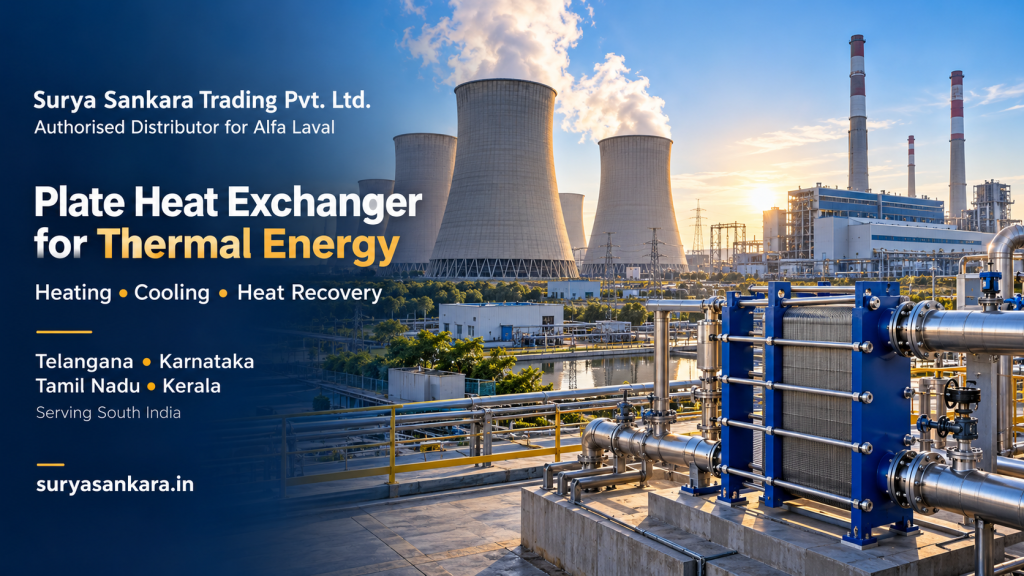
Plate Heat Exchanger for Thermal Energy: Heating, Cooling and Heat Recovery. A plate heat exchanger for thermal energy transfers heat between fluid circuits for heating, cooling or heat recovery. When correctly selected, it can help a facility reuse available heat, maintain process temperatures and separate circuits with different operating requirements.
Surya Sankara Trading is an Authorised Distributor for Alfa Laval products, supporting application discussions and product enquiries across Telangana, Karnataka, Tamil Nadu and Kerala.
For industrial and commercial facilities across South India, equipment selection should begin with a clear question: where is heat available, where is it needed, and what temperatures must the system achieve?
What Is Thermal Energy Transfer? – Plate Heat Exchanger for Thermal Energy
Thermal energy transfer occurs when heat moves from a hotter medium to a colder one. In a plate heat exchanger, the fluids pass through separate channels and exchange heat through the plate surfaces without mixing during normal operation.
A heat exchanger does not generate heat. It transfers available heat between circuits. It also does not store energy by itself; storage requires a separate medium or system, such as a suitably designed water tank.
This distinction matters when planning a heating upgrade, cooling installation or heat-recovery project.
Applications of Plate Heat Exchangers in Thermal Energy Systems
Process Heating
Plate heat exchangers can transfer heat from a suitable hot utility to a process fluid. Applications may include process-water heating, controlled liquid heating and selected preheating duties.
The heating medium could be hot water or, for a suitably engineered configuration, steam. Steam applications require attention to control, condensate drainage and operating conditions.
The appropriate plate material, gasket compound and construction depend on the fluids and design limits.
Process and Utility Cooling
A plate heat exchanger can transfer heat from a process circuit to cooling water or another suitable cooling medium.
Separating the circuits allows each side to operate with its own water quality and pressure requirements, within the exchanger’s design limits. This can be useful when equipment requires a controlled closed-water circuit while the plant uses a separate external cooling-water system.
The available coolant temperature determines what cooling result is achievable.
Waste Heat Recovery
Some facilities reject heat from a warm process stream while using purchased energy to heat another stream. A heat-recovery assessment explores whether these duties can be connected.
For example, a suitable warm liquid stream may preheat incoming process water before a boiler or another heater supplies the remaining heat.
Successful recovery depends on more than the exchanger. The heat source and receiving process must have compatible temperatures, flow rates and operating schedules. Fouling, material compatibility and the consequences of leakage also require assessment.
Hot-Water Systems
Plate heat exchangers can separate a primary heating circuit from a secondary hot-water circuit.
Applications may include industrial utility systems and commercial buildings with a defined hot-water demand. For potable-water duties, material suitability, water quality and applicable system requirements must be considered.
Selection should account for peak demand and the actual temperature available from the heat source.
Heat Pumps and Thermal Storage
Plate heat exchangers can form part of heat-pump systems and thermal-storage installations.
In a heat-pump application, the exchanger’s role and construction depend on whether it handles refrigerant or a secondary liquid circuit. Refrigerant duties require a model specifically selected for the refrigerant, pressure and operating envelope.
In a storage installation, a heat exchanger may transfer energy into or out of the storage system. The storage medium and temperature determine the technology required; a standard gasketed unit should not be assumed suitable for high-temperature molten-salt duties.
Selecting a Plate Heat Exchanger for Thermal Energy
A reliable specification describes both sides of the heat exchanger.
| Selection factor | Information to provide |
|---|---|
| Application | Heating, cooling, heat recovery or storage interface |
| Fluids | Composition, additives, concentration and contaminants |
| Temperatures | Inlet and required outlet temperatures on both sides |
| Flow | Normal, minimum and maximum flow rates |
| Heat duty | Required thermal load in kW, where known |
| Pressure | Operating and design pressures, plus allowable pressure drop |
| Operating pattern | Continuous operation, batch cycles or seasonal use |
| Maintenance | Cleaning requirements and available access |
Understand the Temperature Approach
The temperature approach describes how closely the temperature of one stream approaches that of the other at an exchanger terminal.
A closer approach may allow more heat recovery, but it changes the required selection and can affect heat-transfer area, pressure drop and cost.
The target should therefore follow the process requirement and economic assessment rather than an assumption that the smallest possible temperature difference is always best.
Balance Heat Transfer and Pumping Requirements
An exchanger must deliver the required thermal duty without exceeding the available pumping capacity.
Assess the pressure drop on both sides together with the wider system. A unit that appears attractive based on heat duty alone may create an unsuitable hydraulic load.
Select Materials for the Actual Fluids
Water chemistry, chlorides, treatment chemicals, temperature and cleaning agents influence material selection.
Similarly, gasket compatibility must be checked against the complete operating and cleaning conditions. A material suitable for one installation may not suit another with different water quality or process chemistry.
Which Construction Is Suitable?
Gasketed plate heat exchangers are useful for suitable applications where opening the plate pack for inspection and maintenance is important.
Brazed and fusion-bonded plate heat exchangers provide compact alternatives for compatible duties, but their plate packs are not opened like a gasketed unit.
Welded and semi-welded designs may be considered where the fluid, temperature or pressure calls for a different construction.
The choice should follow engineering assessment rather than the application name alone.
Explore our industrial gasketed plate heat exchangers and fusion-bonded plate heat exchangers for related product information.
Thermal Energy Enquiries Across South India
Surya Sankara Trading welcomes enquiries from facility owners, engineering consultants, project contractors and maintenance teams across South India.
Customers in Hyderabad and Telangana can discuss process heating, cooling and heat-recovery requirements. Enquiries from Bengaluru and other locations in Karnataka, Chennai and other locations in Tamil Nadu, and Kochi and other locations in Kerala can be assessed using the same application-based approach.
Location helps establish project coordination requirements. Equipment sizing, however, must use the site’s actual fluid conditions, utility temperatures and operating schedule.
For a new installation, share the design specification and available utilities. For a replacement, provide the existing nameplate, drawings and measured performance.
Evaluating Potential Energy Savings
A heat exchanger does not deliver a fixed percentage saving in every installation.
For a heat-recovery project, compare:
- Recoverable heat at realistic operating conditions.
- The amount of recovered heat the receiving process can actually use.
- Annual operating hours and overlap between the two processes.
- Additional pumping and auxiliary energy.
- Installation, cleaning and maintenance costs.
- The cost of the heating or cooling energy being displaced.
A practical assessment should distinguish between the exchanger’s rated thermal capacity and the energy recovered over a year.
Maintenance for Consistent Thermal Performance
Monitor temperatures, flow rates and pressure drop under comparable operating conditions. Changes can help identify a problem, although fouling is only one possible cause.
Warmer cooling water, reduced flow, control-valve problems or inaccurate instruments can also affect performance.
Cleaning methods must suit the deposits, plate materials and gaskets. Follow the manufacturer’s instructions rather than applying a universal chemical concentration or cleaning temperature.
For maintenance enquiries, visit our gasketed plate heat exchanger services page.
Frequently Asked Questions – Plate Heat Exchanger for Thermal Energy
1. What does a plate heat exchanger do in a thermal energy system?
It transfers heat between separate fluid circuits. Depending on the installation, it can support process heating, cooling, heat recovery or the transfer of energy into and out of a storage system.
2. Does a plate heat exchanger produce thermal energy?
No. It transfers existing heat from a hotter medium to a colder one. A boiler, heat pump, solar thermal collector or another source provides the heat.
3. Can a plate heat exchanger recover industrial waste heat?
Yes, where the available heat source and receiving process are compatible. Temperature, flow, fluid properties and operating schedules determine how much heat can be usefully recovered.
4. Can it be used in a thermal power plant?
Plate heat exchangers may suit selected auxiliary cooling and heat-transfer duties in thermal power plants. Suitability must be checked for each circuit; they are not a universal replacement for boilers or main turbine condensers.
5. Are plate heat exchangers suitable for solar thermal systems?
Suitable models can transfer heat between a solar thermal circuit and a secondary circuit. Selection must account for the heat-transfer fluid, maximum temperatures, pressures and the system’s operating conditions.
6. Which heat exchanger is best for thermal energy recovery?
There is no single best design for every project. Fluid compatibility, temperature, pressure, fouling, cleaning access and lifecycle cost determine whether a gasketed, brazed, fusion-bonded or welded design is appropriate.
7. Where can customers in Telangana and Karnataka enquire about Alfa Laval heat exchangers?
Customers in Telangana and Karnataka can contact Surya Sankara Trading, an Authorised Distributor for Alfa Laval products, with their heating, cooling or heat-recovery requirements.
8. Can customers in Tamil Nadu and Kerala contact Surya Sankara Trading?
Yes. Customers in Tamil Nadu and Kerala can submit product and application enquiries, including their plant location, fluid details and operating conditions, to establish the scope of support required.
9. What information is needed for a quotation?
Provide the application, fluids, inlet and outlet temperatures, flow rates, pressure limits and installation details. For replacement equipment, include the model number, nameplate photograph and current operating concerns.
for Alfa Laval products, with their heating, cooling or heat-recovery requirements.
8. Can customers in Tamil Nadu and Kerala contact Surya Sankara Trading?
Yes. As Surya Sankara Trading Pvt Ltd., is an Authorised Distributor for South India ,Customers in Tamil Nadu and Kerala can submit product and application enquiries, including their plant location, fluid details and operating conditions, to establish the scope of support required.
9. What information is needed for a quotation?
Provide the application, fluids, inlet and outlet temperatures, flow rates, pressure limits and installation details. For replacement equipment, include the model number, nameplate photograph and current operating concerns.
Discuss Your Thermal Energy Application
Planning a plate heat exchanger for thermal energy, process cooling or heat recovery?
Surya Sankara Trading — Authorised Distributor for Alfa Laval products welcomes enquiries from Telangana, Karnataka, Tamil Nadu, Kerala and across South India.
Share your process data and required outcome so the proposed equipment can be assessed against the application.
For manufacturer guidance, visit Alfa Laval’s Heating and Cooling Hub.
More Readings on Plate Heat Exchangers
- Plate Heat Exchangers for the Sugar Industry
- What Is a Plate Heat Exchanger?
- How to Select a Plate Heat Exchanger
- Energy Saving Using Plate Heat Exchangers
- Plate Heat Exchanger Cleaning Guide
- Plate Heat Exchanger Maintenance Guide
- Decanter Centrifuge Applications
Disclaimer
This microsite is operated by Surya Sankara Trading — Authorised Distributor for Alfa Laval products in South India and welcomes enquiries from Telangana, Karnataka, Tamil Nadu, Kerala and across South India. It is not Alfa Laval’s corporate website. Alfa Laval product names and trademarks belong to their respective owner.