aldec
Authorised Distributor for Alfa Laval products of Aldec Alfa Laval decanter centrifuges
Application
Unique Features:
ALDEC decanter centrifuges are capable of handling a wide range of flow rates. They are designed to be efficient, simple to install, easy to maintain and straightforward to operate. Installation, operating and service life costs are minima
Materials
- The bowl, conveyor, inlet tube, outlets, cover and other parts in direct contact with process media are all made of stainless steel.
- The discharge ports, conveyor flights and feed zone are protected with
materials that are highly resistant to erosion. - Various types of additional optional wear protection can be added, including
conveyor flights protected with flame-sprayed hard surfacing, and/or
sintered tungsten carbide tiles
Sludge Decanter Centrifuge
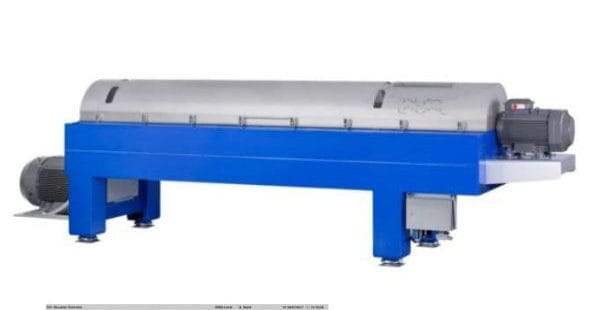
Alfa Laval ALDEC decanter centrifuges are designed for the sludge thickening and dewatering process in municipal and industrial wastewater treatment plants, with a focus on cost-efficiency, reliability, easy operation and sustainability.
benefits
- Reduces sludge volume, which cuts down on transport and disposal costs
- High capacity at small footprint: compact, modular design saves space
- High performance combined with low energy consumption
- Wear-resistant design with anti-blocking feature.
- Complete, fully enclosed cleaning-in-place (CIP)
Frequently Asked Questions About ALDEC Decanter Centrifuges
What is an ALDEC decanter centrifuge?
An ALDEC decanter centrifuge is a solid-bowl centrifuge developed for continuous sludge thickening and dewatering. It uses centrifugal force to separate suspended solids from liquid in municipal and industrial wastewater sludge. The separated solids are continuously conveyed towards the discharge end while the clarified liquid leaves through a separate outlet.
What is an ALDEC decanter centrifuge used for?
ALDEC decanter centrifuges are primarily used for sludge thickening and dewatering in municipal sewage-treatment plants and industrial effluent-treatment facilities. They help reduce the liquid content and overall volume of sludge before transportation, further treatment or disposal. Equipment selection depends on the sludge characteristics and required separation result.
How does an ALDEC decanter centrifuge work?
Sludge enters a rapidly rotating cylindrical-conical bowl. Centrifugal force moves the denser solids towards the bowl wall, while the lighter liquid forms an inner layer. A screw conveyor rotating at a controlled differential speed continuously transports the settled solids towards the discharge ports. The separated liquid exits independently from the bowl.
What is the difference between sludge thickening and sludge dewatering?
Sludge thickening increases the concentration of solids while the sludge generally remains pumpable. Sludge dewatering removes more liquid to produce a firmer solids cake and a separated liquid stream. The required ALDEC configuration and operating parameters depend on whether the process objective is thickening, dewatering or another specified separation duty.
Can an ALDEC centrifuge process industrial wastewater sludge?
Yes, ALDEC decanter centrifuges may be considered for suitable industrial wastewater sludges. However, industrial sludge varies considerably in composition, abrasiveness, particle size, density and chemical properties. Feed characteristics, operating temperature and the required solids and liquid quality must be evaluated before selecting the appropriate equipment and wear-protection arrangement.
What factors affect sludge-dewatering performance?
Performance is influenced by feed-solids concentration, particle characteristics, sludge temperature, flow rate, polymer type and dosage, bowl speed, differential speed, pond depth and required separation result. Because sludge characteristics can change over time, operating settings may need adjustment. Performance should therefore be evaluated using representative application data rather than assumed values.
Does an ALDEC decanter centrifuge require polymer dosing?
Polymer conditioning is frequently used to improve solids aggregation and separation during sludge dewatering, but the requirement and dosage depend on the sludge. Polymer type, preparation quality, mixing conditions and injection location can affect the result. Application testing and operational optimisation are recommended instead of specifying a universal polymer dosage.
What information is required to select an ALDEC decanter?
Selection normally requires the sludge source, feed flow rate, solids concentration, temperature, particle characteristics, required cake condition, required centrate quality, operating hours and polymer information. Installation space, electrical supply, automation requirements, discharge arrangements, cleaning procedures and expected variations in feed conditions should also be discussed.
What are the benefits of continuous sludge dewatering?
Continuous sludge dewatering can reduce sludge volume and simplify downstream handling, transportation and disposal. A decanter centrifuge also offers an enclosed, compact and continuously operating separation process. Actual operational and economic benefits depend on the sludge characteristics, equipment selection, process settings, maintenance practices and disposal arrangements at each facility.
How is an ALDEC decanter centrifuge cleaned?
Cleaning requirements depend on the sludge and operating schedule. The machine may use flushing or cleaning procedures recommended for its specific configuration. Operators should follow the applicable Alfa Laval instructions regarding cleaning sequence, cleaning media, shutdown procedures and safety. Unapproved chemicals or improper procedures could damage wetted components or affect safe operation.
What maintenance does an ALDEC decanter require?
Maintenance generally includes inspecting wear-protected areas, bearings, seals, conveyor components, discharge zones, drive systems and lubrication points. Vibration, noise and operating performance should be monitored regularly. Maintenance frequency must follow the applicable equipment manual, operating conditions and service recommendations rather than a single standard schedule for every installation.
How is wear managed in a sludge decanter centrifuge?
Wear depends on the abrasiveness, concentration, size and shape of the solids being processed. Suitable wear-protection options may be considered for feed zones, conveyor flights and discharge areas. The appropriate protection should be selected using representative process information and periodically inspected as part of the equipment’s preventive-maintenance programme.
Can one ALDEC model handle every sludge type?
No. Sludges differ in solids concentration, particle characteristics, density, abrasiveness, organic content and dewatering behaviour. The required centrifuge size, configuration, wear protection and operating settings must be selected for the particular application. Customers should provide accurate and representative feed information before equipment selection.
Where can I enquire about an ALDEC decanter centrifuge in Hyderabad?
Surya Sankara Trading Pvt. Ltd., an Authorised Distributor for Alfa Laval products, supports ALDEC decanter centrifuge enquiries from Hyderabad, Telangana and other South Indian locations. Customers can share their wastewater-treatment application and sludge data for an initial discussion about the required thickening or dewatering duty.
Why should customers contact an authorised distributor?
An authorised distributor can help customers communicate application requirements accurately and coordinate product enquiries through the appropriate manufacturer-supported channel. This is particularly important for decanter centrifuges because correct selection depends on sludge properties, required separation results, installation conditions, materials, wear protection, controls and associated process requirements.
Surya Sankara Trading Pvt. Ltd. is an Authorised Distributor for Alfa Laval products in India, supplying genuine Aldec Alfa Laval Decanter Centrifuges backed by expert technical guidance, product selection assistance, and reliable after-sales support. We help industries choose the right Alfa Laval separation solutions for efficient sludge dewatering, wastewater treatment, and industrial processing applications.
Why Choose Surya Sankara Trading for Alfa Laval Aldec Decanter Centrifuges?
When businesses search for Alfa Laval Aldec Decanter Centrifuges, they need more than just a supplier—they need an authorised source with technical expertise. Surya Sankara Trading Pvt. Ltd., as an Authorised Distributor for Alfa Laval products, provides genuine Aldec decanter centrifuges, application engineering support, product recommendations, installation guidance, and dependable after-sales service. Our team assists customers across municipal wastewater treatment plants, food processing industries, chemical plants, pharmaceutical manufacturing, mining, and industrial processing sectors in selecting the most suitable Alfa Laval separation technology.
What industries use Alfa Laval Aldec Decanter Centrifuges?
Alfa Laval Aldec Decanter Centrifuges are widely used in:
- Municipal wastewater treatment
- Industrial wastewater treatment
- Food and beverage processing
- Chemical processing
- Pharmaceutical manufacturing
- Mining and minerals
- Pulp and paper
- Oil and biofuel industries
Why should I buy from an authorised Alfa Laval distributor?
Purchasing from an Authorised Distributor for Alfa Laval products ensures:
- Genuine Alfa Laval equipment
- Manufacturer-backed quality
- Correct product selection
- Professional technical support
- Reliable after-sales service
- Access to original spare parts and maintenance assistance
Further readings on Plate Heat exchangers
- What is plate heat exchanger
- Benefits of plate heat exchangers
- Plate heat exchanger maintenance guide
- How to select a plate heat exchanger
- Common plate heat exchanger problems
- Plate heat xchanger cleaning guide
- Energy saving using plate heat exchanger
- Plate heat exchanger buying guide
- Plate heat echanger or pharmaceutical industry
- Plate heat exchanger for food & beverage processing