
Decanter vs Disc Stack Separator. What Is the Difference Between a Decanter and a Disc Stack Separator? Choosing the correct centrifugal separation equipment can significantly influence product quality, operating efficiency, solids recovery and overall processing costs.Two widely used technologies are the decanter centrifuge and disc stack separator. Although both rely on centrifugal force to separate materials of different densities, their designs make them suitable for different process conditions.
When comparing Decanter vs Disc Stack Separator technologies, understanding solids concentration, particle size, clarification requirements and process objectives is essential for selecting the right centrifugal separation solution
A decanter centrifuge is generally preferred when the process contains relatively high concentrations of solids or larger solid particles and continuous solids removal is important.
A disc stack separator, on the other hand, is typically selected when the process requires highly efficient clarification of liquids containing lower solids concentrations and finer particles.
Alfa Laval identifies decanters and disc stack centrifuges as two important centrifugal separation technologies. Its guidance indicates that decanters are particularly suited to higher solids concentrations and larger particles, while disc stack centrifuges are suited to lower solids concentrations and smaller particles.
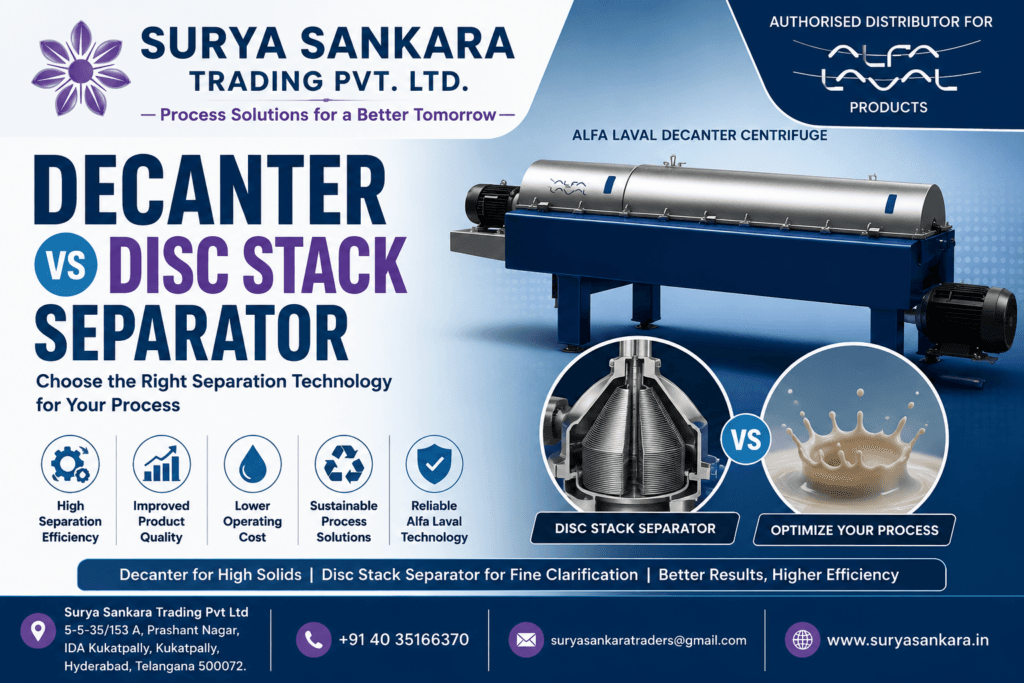
What Is a Decanter Centrifuge?
A decanter centrifuge is a horizontal centrifugal separation machine designed primarily for continuous solid-liquid separation.
Inside the rotating bowl, centrifugal force causes denser solid particles to move towards the bowl wall. A screw conveyor rotating at a controlled differential speed continuously transports the separated solids towards the discharge end.
The clarified liquid exits separately from the machine.
Alfa Laval decanters are designed to provide continuous solid-liquid separation while offering controllable performance across varying feed conditions.
Key Advantages of a Decanter Centrifuge
- Continuous solids removal
- Suitable for relatively high solids loads
- Handles varying feed conditions
- Effective sludge thickening and dewatering
- Capable of two-phase and certain three-phase separation duties
- Suitable for demanding industrial processes
- Can produce relatively dry separated solids
- Continuous processing supports high-capacity operations
Typical Decanter Applications
Decanter centrifuges are widely applicable in:
- Wastewater and sludge treatment
- Food and beverage processing
- Starch processing
- Biofuels and ethanol
- Oil recovery
- Chemical processing
- Mineral and mining applications
- Industrial wastewater
- Water treatment
- Biomass and renewable-energy processes
For example, the Alfa Laval ALDEC range is specifically designed for sludge thickening and dewatering in municipal and industrial wastewater treatment, potable-water works, solid-waste plants and biogas plants.
What Is a Disc Stack Separator?
A disc stack separator, also known as a disc stack centrifuge, uses a rapidly rotating bowl containing a stack of conical discs.
These discs dramatically increase the effective separation area. The technology uses very high centrifugal forces to separate phases according to differences in density.
Depending on the separator design and application, solids can be removed manually, intermittently or continuously. Disc stack separators can perform both liquid-solid and liquid-liquid separation duties.
Key Advantages of Disc Stack Separators
- Excellent liquid clarification
- Efficient removal of fine particles
- High separation efficiency
- Compact equipment footprint
- Suitable for liquid-liquid-solid separation
- High-quality purified liquid output
- Useful where fine separation is critical
- Suitable for many hygienic and industrial processes
Typical Disc Stack Separator Applications
Disc stack centrifuges can be found in applications involving:
- Dairy processing
- Beverage clarification
- Brewing
- Edible oils
- Pharmaceutical and biotech processing
- Marine fuel and lubricant purification
- Industrial oil cleaning
- Chemical processing
- Protein and fermentation processes
- Fine liquid clarification
The following Decanter vs Disc Stack Separator comparison highlights the major differences in solids handling, clarification performance and typical industrial applications.
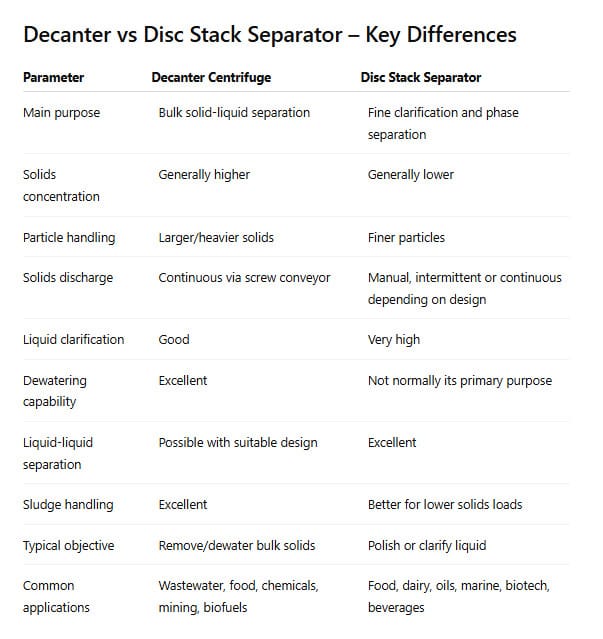
The choice therefore should not simply be based on which centrifuge has the highest rotational speed. The correct solution depends on feed solids concentration, particle size, phase densities, required clarification level, throughput and the desired condition of the discharged solids or liquid product.
When Should You Choose a Decanter Centrifuge?
When evaluating Decanter vs Disc Stack Separator options, industries should consider feed characteristics, solids concentration, required throughput and the desired quality of the separated phases..A decanter centrifuge should be considered when your process involves a significant solids load and requires continuous removal of separated material.
It can be particularly valuable when the goal is to:
- Dewater sludge
- Recover solids from process streams
- Reduce waste volume
- Produce a drier solids cake
- Process high volumes continuously
- Handle fluctuations in feed conditions
For industries dealing with sludge, biomass, minerals, wastewater or other solids-rich process streams, a decanter can provide a highly effective separation solution.
When Should You Choose a Disc Stack Separator?
A disc stack separator is generally a stronger choice when clarity, fine-particle removal or separation of two liquid phases is the primary objective.
Consider a disc stack centrifuge when you need to:
- Clarify a liquid to a high degree
- Separate very fine suspended solids
- Purify oils
- Separate two immiscible liquids
- Improve final product purity
- Recover valuable liquid phases
- Process feed with relatively low solids concentration
Disc stack technology can therefore be highly effective where separation precision is more important than bulk solids dewatering.
Can a Decanter and Disc Stack Separator Be Used Together?
Yes.
In some industrial processes, the best solution is not decanter OR disc stack separator, but decanter AND disc stack separator.
A decanter can perform the first-stage bulk separation, removing most of the solids from the feed. The partially clarified liquid can then be sent to a disc stack separator for finer clarification or liquid-phase separation.
Alfa Laval notes that decanters, disc stack centrifuges and filters may be combined at different stages or used in series to achieve the required separation result.
This combination can provide:
Bulk solids removal → Fine clarification → Higher product quality
Why Choose Alfa Laval Centrifugal Separation Technology?
Alfa Laval has extensive experience in industrial centrifugal separation and provides separation technologies for industries including food, energy, water, wastewater, marine and industrial processing.
Its decanter centrifuges are engineered for continuous solid-liquid separation, while its disc stack separators provide high-speed separation where fine clarification and phase separation are required.
Choosing the correct equipment, however, requires more than selecting a centrifuge model. Feed characteristics, solids concentration, particle size, flow rate, required product quality and operating conditions should all be evaluated.
Alfa Laval Separation Solutions in Hyderabad – Surya Sankara Trading Pvt. Ltd.
Surya Sankara Trading Pvt. Ltd. is an Authorised Distributor for Alfa Laval products, supporting industries seeking reliable Alfa Laval process and separation solutions.
For customers in Hyderabad, Telangana and across India, our team can assist in identifying suitable separation equipment based on your application and process requirements.
Whether your requirement involves a decanter centrifuge, disc stack separator or an integrated separation process, choosing equipment based on actual process conditions can improve efficiency, product recovery and long-term operating performance.
Read Our Other Articles Related to Plate Heat Exchangers of Alfa Laval Distributor
01) What is plate heat exchanger?
02) Benefits of Plate heat exchangers
03) Plate heat exchanger application
04) Plate heat exchanger Vs Shell & tube heat exchanger
05) Plate heat exchanger maintenance guide
06) How to select a plate heat exchanger
07) Common Plate Heat Exchanger Problems
08) Plate Heat Exchanger Cleaning Guide
09) Energy Saving Using Plate Heat Exchangers
Frequently Asked Questions
What is the main difference between a decanter and disc stack separator?
A decanter centrifuge is primarily designed for continuous processing of streams containing significant amounts of solids, while a disc stack separator is generally used for finer clarification and separation of liquids containing lower concentrations of smaller particles.
Which is better: decanter or disc stack separator?
Neither technology is universally better. A decanter is generally better for bulk solids removal and dewatering, whereas a disc stack separator is better for fine clarification and liquid-liquid separation.
Can a disc stack separator remove solids?
Yes. Disc stack centrifuges can separate solids from liquids, particularly finer solids at relatively lower concentrations.
Can a decanter separate two liquids?
Yes. Suitable decanter configurations can separate solids and liquid phases, including applications requiring three-phase separation.
Can decanter and disc stack centrifuges work together?
Yes. A decanter can remove bulk solids first, followed by a disc stack separator for finer clarification or phase separation.
Which separator is suitable for wastewater sludge?
A decanter centrifuge is commonly used for sludge thickening and dewatering. Alfa Laval’s ALDEC range, for example, is designed specifically for wastewater sludge applications.
Find the Right Separator for Your Process
Not Sure Whether You Need a Decanter or Disc Stack Separator? Don’t select a centrifuge based on specifications alone. Select it based on your process.
Share your application, feed composition, solids percentage, particle characteristics, required flow rate and desired separation result with Surya Sankara Trading Pvt. Ltd.
Our team can help you identify the appropriate Alfa Laval decanter centrifuge or disc stack separation solution for your industrial application.
Talk to Surya Sankara Trading Today
If you need expert guidance on Alfa Laval Decanter vs Alfa Laval Disc Stack Separator selection, contact Surya Sankara Trading Pvt. Ltd., an Authorised Distributor for Alfa Laval products. Get expert assistance. Compare the right technology. Improve your separation process. Request an Alfa Laval Separation Solution Consultation Today.