
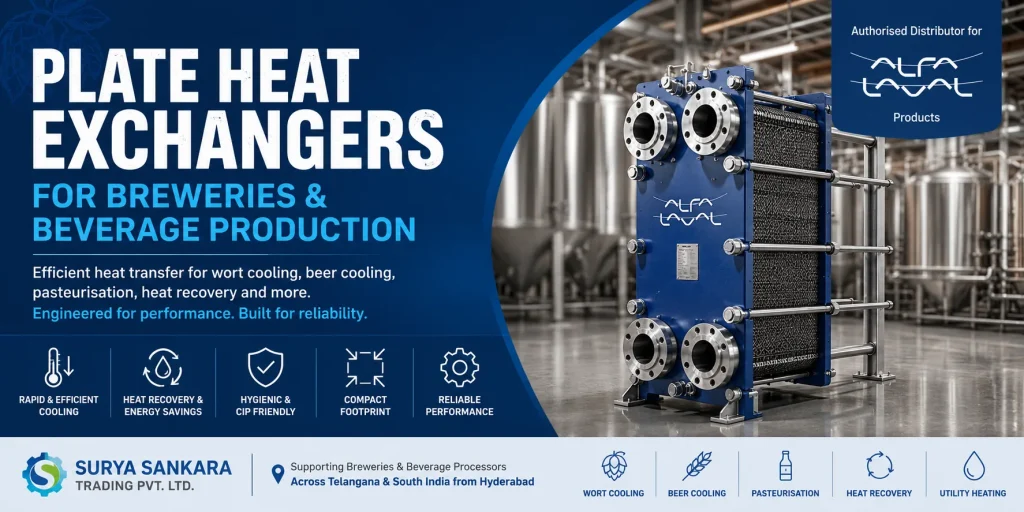
Plate Heat Exchangers for Breweries and Beverage Production. Brewing depends on accurate and repeatable temperature control. Wort must be cooled rapidly before fermentation, beer may require cooling at several stages, yeast must be handled gently, and packaged or process beverages may require pasteurisation. Plate heat exchangers for breweries provide compact heat transfer for many of these duties when the equipment is correctly selected for the product, flow, temperature programme, hygiene and cleaning method. A brewery heat exchanger should never be selected from production capacity alone. Wort composition, solids, viscosity, operating schedule, cooling-water temperature, glycol conditions, allowable pressure drop and clean-in-place requirements all influence the design.
Surya Sankara Trading Pvt. Ltd. is an Authorised Distributor for Alfa Laval products. From Hyderabad, the company supports breweries and beverage processors evaluating Alfa Laval heat-transfer equipment, genuine spares and service requirements in Telangana and South India.
Why Temperature Control Is Critical in Brewing
Temperature affects almost every important stage of beer production. Inconsistent cooling or heating can influence fermentation timing, flavour, microbiological control, utility consumption and production capacity.
Reliable heat transfer can support:
- Rapid wort cooling before yeast pitching.
- Stable fermentation and maturation conditions.
- Controlled beer cooling before filtration or packaging.
- Beverage pasteurisation and product cooling.
- Gentle yeast cooling and storage.
- Heating of water for brewing and cleaning.
- Recovery of useful heat from hot process streams.
- Reduced demand on cooling towers, chillers and boilers.
The correct exchanger design must protect product quality while meeting the brewery’s thermal duty.
How a Brewery Plate Heat Exchanger Works
A gasketed plate-and-frame heat exchanger contains corrugated metal plates clamped inside a frame. Product and utility fluids pass through alternate channels without intentionally mixing. Heat moves through the plates from the warmer stream to the colder stream.
The corrugated plate pattern promotes turbulence, which can deliver effective heat transfer within a relatively small footprint. For suitable brewery duties, a plate heat exchanger may offer:
- Compact installation.
- Close temperature approach.
- Low product hold-up.
- Fast response to process changes.
- Access for inspection in gasketed designs.
- Clean-in-place capability when designed correctly.
- The possibility of changing thermal area in selected configurations.
- Heat recovery between compatible process streams.
The result still depends on accurate sizing, suitable materials, proper controls and disciplined cleaning.
Brewery and Beverage Applications
Wort Cooling
After boiling, hot wort must be cooled to the required fermentation temperature before yeast is introduced. A wort cooler may use one or more cooling stages involving brewing water, chilled water or glycol.
Design considerations include:
- Hot-wort inlet temperature.
- Required pitching temperature.
- Wort flow rate and batch duration.
- Cooling-water temperature throughout the year.
- Glycol concentration and temperature, if used.
- Wort solids and fouling tendency.
- Maximum allowable product pressure drop.
- Target hot-water recovery.
Hot wort can transfer useful energy to incoming brewing water. The recovered hot water may be stored for a subsequent brew or cleaning duty when the overall process and water-quality requirements allow it.
Beer Cooling
Beer may require cooling after fermentation, during maturation, before filtration or ahead of bright-beer storage and packaging. The exchanger must provide controlled cooling without excessive pressure loss or product disturbance.
For carbonated beverages or duties with higher design pressure, the mechanical design and pressure rating require particular attention. Never assume that a standard hygienic exchanger is suitable merely because the thermal load is small.
Beverage Pasteurisation
Plate heat exchangers may form part of a pasteurisation system for beer, soft drinks, energy drinks, juices and other beverages. A multi-section unit can combine regeneration, heating, holding-system integration and final cooling, depending on the process design.
The pasteurisation system must be engineered around:
- Product characteristics and microbiological objective.
- Required time-temperature programme.
- Flow diversion and control philosophy.
- Product-to-utility pressure relationship.
- Start-up, shutdown and recirculation conditions.
- Cleaning validation and food-safety requirements.
The heat exchanger alone does not establish or certify the pasteurisation process.
Yeast Cooling
Yeast requires gentle and dependable temperature control during collection, storage and propagation. An appropriate plate heat exchanger can provide rapid cooling in a compact format, subject to hygiene, viscosity and cleaning considerations.
Brewing-Liquor Heating and Cooling
Brewing water may be heated or cooled to meet mashing, sparging or other process requirements. Heat recovered from wort or another clean stream may help reduce the external utility duty.
CIP Solution Heating
Clean-in-place systems may use plate heat exchangers to heat water or cleaning solutions. Chemical concentration, temperature, materials, pressure and control requirements must be supplied during selection.
Utility and Glycol Cooling
Plate heat exchangers can isolate process-cooling circuits from cooling-tower water, refrigeration systems or other utility loops. The design should consider glycol concentration, low-temperature viscosity, freezing risk, fouling and water quality.
Applications Beyond Beer
Similar heat-transfer principles apply to many beverage plants, including:
- Carbonated soft drinks.
- Fruit juices and pulpy beverages.
- Energy and functional drinks.
- Bottled and process water.
- Malt-based and non-alcoholic beverages.
- Wine and cider.
- Syrups and liquid ingredients.
Products containing pulp, fibres or high viscosity may require wider channels or another heat-exchanger configuration. Product data must therefore be reviewed before model selection.
Hygienic Design and Product Safety
Breweries require equipment that supports their food-safety and sanitation programmes. Important considerations include:
- Food-contact suitability of plates, gaskets and connections.
- Uniform flow distribution and minimisation of dead zones.
- Drainability and product recovery.
- Cleanable product-contact surfaces.
- Suitable surface finish.
- Prevention and detection of cross-contamination.
- Traceability of genuine replacement parts.
- Validated CIP procedures.
Where leakage between product and utility circuits would create a significant hazard, the designer may evaluate pressure relationships, monitoring, double-wall plates or another suitable safeguard.
Plate and Gasket Selection
Stainless steel is widely used for hygienic beverage applications, but the exact plate grade must suit the product, water quality, chlorides, cleaning agents, temperature and corrosion conditions.
Gasket compatibility should be assessed against:
- Wort, beer, syrup or beverage ingredients.
- Alcohol content.
- Product and cleaning temperatures.
- Caustic, acid and sanitising chemicals.
- Cleaning frequency and exposure time.
- Steam or hot-water sterilisation, where applicable.
Incorrect gasket selection can lead to swelling, hardening, loss of elasticity or premature leakage. Always provide the complete product and cleaning chemistry.
Pressure Drop and Product Handling – Plate Heat Exchangers for Breweries
Available pressure drop is a valuable design parameter. Adequate channel velocity can support heat transfer and cleanability, but excessive pressure drop can burden pumps and disturb the process.
Selection should balance:
- Required outlet temperature.
- Product viscosity and solids.
- Flow distribution.
- Pump capability.
- Carbonation and pressure requirements.
- Fouling resistance.
- CIP velocity.
- Turndown and future capacity.
A very low pressure-drop specification can force a larger exchanger or reduce channel velocity. The allowable value should reflect the actual process rather than an arbitrary limit.
Fouling in Brewery Heat Exchangers
Deposits can arise from:
- Wort proteins and carbohydrates.
- Hop and grain particles.
- Yeast residues.
- Beer stone or mineral scale.
- Syrups and sugar deposits.
- Pulp or fibres in beverages.
- Hard cooling water.
- Inadequate rinsing or unsuitable CIP conditions.
Fouling reduces thermal performance and may increase pressure drop. Upstream filtration, proper channel geometry, correct velocity and an effective cleaning programme help control deposits.
Operators should monitor inlet and outlet temperatures, flow, pressure drop and cleaning trends. A gradual change can indicate fouling before production is seriously affected.
Cleaning and CIP Considerations
A suitable cleaning procedure depends on the deposit, plate material, gasket, chemical and local food-safety requirements. A typical programme may involve product recovery, pre-rinsing, alkaline cleaning, intermediate rinsing, acid cleaning where required, final rinsing and sanitisation.
The brewery should establish:
- Cleaning chemical and concentration.
- Temperature and circulation time.
- Required CIP flow and channel velocity.
- Rinse-water quality.
- End-point verification.
- Inspection frequency.
- Safe isolation and chemical-handling procedures.
Do not increase chemical strength or temperature without checking plate and gasket limits. Refer to the internal Plate Heat Exchanger Cleaning Guide for broader guidance while following the equipment manual and plant procedure.
Alfa Laval Solutions for Brewery Heat Transfer
Alfa Laval’s official food and beverage information lists beer-wort heating, beer cooling, beverage pasteurisation and CIP heating among plate heat-exchanger applications. Hygienic ranges such as FrontLine, BaseLine, ClipLine and selected M line configurations serve different thermal, pressure and cleanability needs.
For example:
- Hygienic plate patterns can support gentle, uniform product treatment.
- Clip-on, glue-free gasket arrangements can simplify servicing in applicable models.
- Multi-section configurations may integrate heating, regeneration and cooling.
- Higher design-pressure configurations may be evaluated for carbonated-beverage duties.
- Thermal area may be adjustable in selected gasketed designs when process requirements change.
The suitable Alfa Laval model and configuration must be confirmed from current technical data and the brewery’s actual duty. Surya Sankara does not recommend equipment from a product name or brewery capacity alone.
Heat Recovery and Brewery Energy Efficiency
Wort cooling presents a useful heat-recovery opportunity because hot wort and cooler brewing water are often available during the same production sequence. The warmed water can potentially support the next brew or another planned duty.
A heat-recovery study should examine:
- Batch timing and hot-water storage.
- Water-quality requirements.
- Minimum temperature approach.
- Seasonal cooling-water conditions.
- Product and utility pressure relationships.
- Fouling and CIP impact.
- Pumping energy.
- Bypass and control strategy.
- Actual steam, refrigeration, water and electricity costs.
Do not use a universal savings percentage. Recoverable energy depends on the process temperatures, flow rates, exchanger condition and operating schedule.
Information Required for Correct Selection
Product and Process Data
- Product: wort, beer, yeast, juice, syrup or another beverage.
- Composition, alcohol, solids, pulp or fibres.
- Density, viscosity, specific heat and thermal conductivity where available.
- Normal, minimum and maximum flow rates.
- Batch or continuous operation.
- Product inlet and required outlet temperatures.
Utility Data
- Cooling water, chilled water, glycol, hot water or steam-system arrangement.
- Utility inlet temperature and available flow.
- Required or expected utility outlet temperature.
- Glycol type and concentration.
- Water quality and fouling tendency.
Mechanical and Installation Data
- Operating and design pressures.
- Allowable pressure drop on both circuits.
- Design temperature.
- Connection type, size and standard.
- Available floor space and service clearance.
- Existing piping and control arrangement.
- Indoor or outdoor installation conditions.
Hygiene and Cleaning Data
- Required food-contact standards.
- Cleaning chemical, concentration and temperature.
- CIP flow and cleaning frequency.
- Sanitisation or sterilisation method.
- Required production run length.
- Cross-contamination risk assessment.
For the broader sizing process, read How to Select a Plate Heat Exchanger.
Common Brewery Heat-Exchanger Problems – Plate Heat Exchangers for Breweries
Wort Is Not Reaching the Required Temperature
Possible causes include increased flow, warmer cooling water, insufficient utility flow, fouling, trapped air, incorrect valve position or a change in wort properties.
Cooling Takes Longer Than Before
Compare current flow, temperatures and pressure drop with clean baseline data. Fouling or utility deterioration may be responsible, but the cause should be verified before opening the unit.
Pressure Drop Is Increasing
Deposits, blocked channels, strainers, incorrect valve positions or excessive flow may increase resistance. Do not simply raise pump pressure without investigating.
External Leakage Is Visible
Possible causes include gasket damage, ageing, chemical incompatibility, incorrect plate-pack tightening, plate misalignment or pressure transients. Isolate the equipment safely and follow the manufacturer’s instructions.
Utility Consumption Has Increased
Fouling, lower heat recovery, changed production conditions, poor control or degraded cooling-water temperature can increase energy and water demand.
The Plate Heat Exchanger Maintenance Guide explains preventive checks in more detail.
Plate Heat Exchangers for Breweries in South India – Plate Heat Exchangers for Breweries
Breweries and beverage plants in Hyderabad, Telangana, Andhra Pradesh, Karnataka, Tamil Nadu and Kerala operate under varying water, climate and utility conditions. Summer cooling-water temperatures, local water hardness, refrigeration capacity and production schedules can materially affect exchanger performance.
Surya Sankara Trading Pvt. Ltd., located in Hyderabad, supports customers evaluating Alfa Laval plate heat exchangers for:
- Wort and beer cooling.
- Beverage heating and pasteurisation duties.
- Yeast cooling.
- Brewing-water and CIP heating.
- Glycol and utility circuits.
- Heat-recovery projects.
- Genuine plates, gaskets and service requirements.
Support is application-based; final equipment suitability is confirmed against the complete operating data and current Alfa Laval documentation.
Frequently Asked Questions
What is the main use of a plate heat exchanger in a brewery?
Wort cooling is one of the most common uses. Plate heat exchangers can also support beer cooling, beverage pasteurisation, yeast cooling, CIP heating and utility heat recovery.
Can hot wort be used to recover energy?
Yes. Heat from hot wort can potentially warm brewing water for a later duty. The achievable recovery depends on flow, temperatures, timing, storage, hygiene and the exchanger design.
Can the same heat exchanger handle beer and fruit beverages?
Not automatically. Products with pulp, fibres, higher viscosity or different cleaning requirements may need another plate pattern, channel gap, gasket or exchanger type.
Is a plate heat exchanger suitable for carbonated beverages?
It can be, provided the unit is designed for the actual pressure, temperature, product and hygiene requirements. Higher-pressure duties require an appropriately rated configuration.
How often should a brewery plate heat exchanger be cleaned?
Cleaning frequency depends on the product, production time, temperature, fouling rate and validated sanitation programme. Performance trends and hygiene requirements should guide the schedule.
Which data is needed to size a wort cooler?
Provide wort flow, inlet and target outlet temperatures, batch time, product properties, cooling-water or glycol conditions, pressure, allowable pressure drop, fouling and CIP requirements.
Where can breweries obtain Alfa Laval plate heat exchangers in Hyderabad?
Surya Sankara Trading Pvt. Ltd. is an Authorised Distributor for Alfa Laval products and supports brewery and beverage heat-transfer enquiries from Hyderabad and other South Indian locations.
Request Application-Based Support
Planning a new wort cooler, replacing an underperforming exchanger or studying brewery heat recovery? Share your application data with Surya Sankara Trading Pvt. Ltd. for a technical discussion.
Please provide the product and composition, flow rate, inlet and required outlet temperatures, utility conditions, operating and design pressure, allowable pressure drop, fouling information, cleaning chemistry, installation constraints and current equipment details.
Surya Sankara Trading Pvt. Ltd.
Authorised Distributor for Alfa Laval products
Office: 5-5-35/153 A, Prashant Nagar, IDA Kukatpally, Hyderabad – 500072, Telangana
Phone: +91 97042 70101
Email: suryasankaratraders@gmail.com
Website: https://suryasankara.in/
Further readings on Plate Heat exchangers
- What is plate heat exchanger
- Benefits of plate heat exchangers
- Plate heat exchanger maintenance guide
- How to select a plate heat exchanger
- Common plate heat exchanger problems
- Plate heat xchanger cleaning guide
- Energy saving using plate heat exchanger
- Plate heat exchanger buying guide
- Plate heat echanger or pharmaceutical industry
- Plate heat exchanger for food & beverage processing
Microsite Disclaimer
This microsite is operated by Surya Sankara Trading Pvt. Ltd., an Authorised Distributor for Alfa Laval products. It is not Alfa Laval’s corporate website. Alfa Laval product names and trademarks belong to their respective owner.