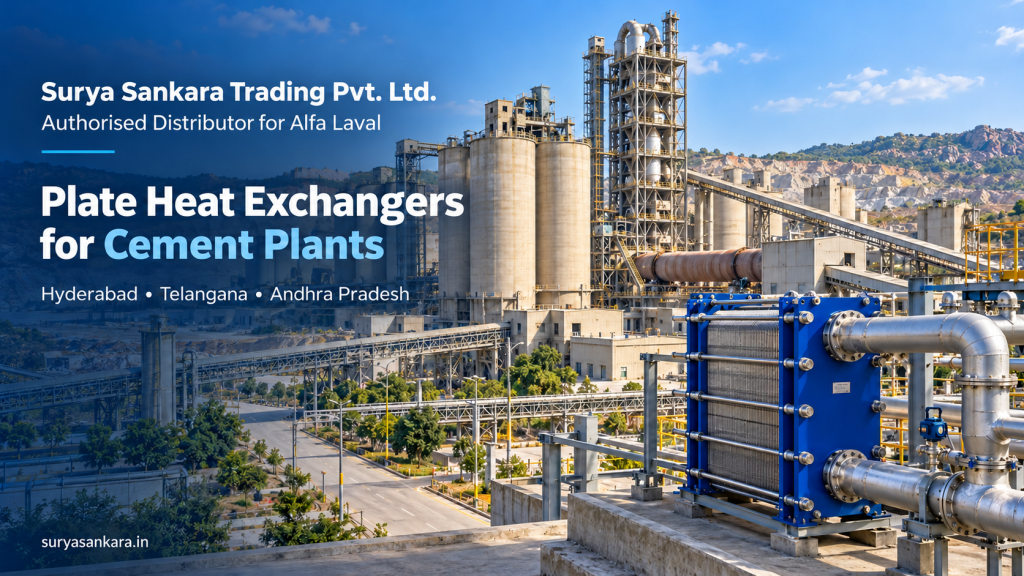
Plate Heat Exchangers for Cements Plants in Telangana and Andhra Pradesh. Plate heat exchangers for cement plants can support lubrication oil cooling, hydraulic oil cooling and cooling-water duties where the equipment design and operating conditions are suitable. Selecting the right heat exchanger helps plant teams manage heat generated by machinery and maintain the required fluid temperatures.
Surya Sankara Trading is an Authorised Distributor for Alfa Laval products, supporting product enquiries from Hyderabad and cement-industry customers across Telangana and Andhra Pradesh. Selection for Plate Heat Exchangers for Cements Plants starts with the application: the fluids involved, heat load, operating temperatures, pressure limits and maintenance requirements.
Where Are Plate Heat Exchangers Used in Cement Plants?
Cement production involves grinding, material handling and other operations supported by mechanical equipment and utility systems. Several associated liquid-cooling circuits may be suitable for plate heat exchangers.
The applications below are opportunities for engineering assessment. Compatibility with the original equipment manufacturer’s requirements must be confirmed before selecting or replacing a cooler.
Lubrication Oil Cooling
Lubrication systems serving gearboxes and other rotating equipment need to keep oil within the equipment manufacturer’s specified temperature range.
A suitable oil-to-water heat exchanger transfers heat from the circulating oil to the cooling water. Selection should account for oil grade, viscosity at operating and startup temperatures, flow rate and allowable pressure drop.
For replacement enquiries, provide the existing cooler’s nameplate details and actual operating temperatures. Matching connection sizes alone is not enough to establish that a replacement will perform correctly.
Hydraulic Oil Cooling
Where cement-plant machinery uses hydraulic power units, an appropriately selected plate heat exchanger may provide oil cooling.
Important considerations include hydraulic fluid compatibility, peak heat load, pressure fluctuations and cooling-water availability. The cooler must suit the hydraulic system’s circuit arrangement and pressure limits.
Compact oil-cooling equipment may be useful where installation space is restricted, but accessibility for inspection and servicing should remain part of the design.
Closed-Loop Cooling Water
A water-to-water plate heat exchanger can separate an equipment cooling circuit from the plant’s external cooling-water circuit.
This arrangement allows the equipment loop to use controlled water quality while transferring heat to the secondary water system. It does not eliminate the need for water treatment, leak monitoring or maintenance.
Before selecting the exchanger, establish the maximum expected cooling-water inlet temperature. A design based only on favourable winter conditions may not meet the required duty during hotter operating periods
Compressor Auxiliary Cooling
Depending on the compressor package, plate heat exchangers may be considered for lubricant cooling or a supporting closed-water circuit.
Any modification should follow the compressor manufacturer’s temperature, pressure and flow requirements. Confirm the existing arrangement before proposing a replacement or changing the cooling method.
Why Consider Gasketed Plate Heat Exchangers?
Gasketed plate heat exchangers transfer heat through corrugated plates, with the two fluids flowing through separate channels.
Potential advantages for suitable cement-plant utility duties include:
- Compact installation: useful when plant-room space is limited.
- Access for maintenance: the plate pack can be opened for inspection and cleaning.
- Application-specific selection: plate arrangement and materials can be selected for the duty.
- Capacity flexibility: some configurations can accommodate changes after engineering review.
These advantages depend on correct sizing and suitable fluids. A plate heat exchanger is not automatically the best choice for every cement-plant application.
Explore our industrial gasketed plate heat exchangers for related product information.
Selecting Plate Heat Exchangers for Cement Plants
The most useful enquiry includes operating data from both sides of the proposed heat exchanger.
| Information required | What to provide |
|---|---|
| Application | Lubrication oil, hydraulic oil, cooling water or another identified duty |
| Fluid details | Oil grade, water composition, additives and possible contaminants |
| Temperatures | Inlet and required outlet temperatures on both sides |
| Flow rates | Normal, minimum and maximum flow where available |
| Heat load | Required cooling duty, if known |
| Pressure limits | Operating pressure, design pressure and allowable pressure drop |
| Installation details | Available space, connections and maintenance access |
| Existing equipment | Model, serial number, drawings and current performance concerns |
Account for Oil Viscosity
Oil properties change with temperature. The conditions at startup may differ considerably from normal operation.
Provide the oil manufacturer’s data and expected temperature range so the selection can account for both heat transfer and hydraulic performance.
Check Cooling-Water Quality
Cooling-water quality affects material selection and maintenance planning. Share available information on suspended solids, hardness, chlorides and treatment chemicals.
Where fouling or corrosion has already occurred, include photographs and inspection records. These can help frame the application discussion more effectively than a request for a particular plate material without supporting data.
Plan for Cleaning Access
Consider the space needed to open the unit and handle plates safely. Isolation, draining and maintenance arrangements should be assessed during installation planning.
For an existing unit, follow the manufacturer’s instructions for cleaning, gasket replacement and reassembly. See our gasketed plate heat exchanger services page for service enquiries.
Can Plate Heat Exchangers Recover Heat in Cement Plants?
Heat recovery may be possible when a suitable liquid stream contains reusable heat and another process needs that heat at a compatible temperature.
An assessment should establish:
- The available temperature and flow of the heat source.
- The temperature required by the receiving process.
- Whether both streams are available at the same time.
- Piping, pumping and maintenance requirements.
- The expected benefit compared with installation and operating costs.
A standard liquid-to-liquid gasketed plate heat exchanger should not be treated as a direct replacement for equipment handling hot clinker or dust-laden kiln exhaust. Those duties require a separate technology assessment.
Support for Hyderabad, Telangana and Andhra Pradesh
Surya Sankara Trading welcomes enquiries from cement manufacturers, grinding units, engineering contractors and maintenance teams in Hyderabad, Telangana and Andhra Pradesh.
As an Authorised Distributor for Alfa Laval products, Surya Sankara Trading supports application discussions, product enquiries and selection coordination for suitable heat-exchanger requirements.
Whether your enquiry concerns a new cooling circuit, an existing cooler replacement or a maintenance requirement, share the plant location and application details at the outset. This helps establish the scope and the information needed for the next step.
Frequently Asked Questions – Plate Heat Exchangers for Cements Plants
1. What are plate heat exchangers used for in cement plants?
Plate heat exchangers may be used for lubrication oil cooling, hydraulic oil cooling and water-to-water cooling duties. Suitability depends on the machinery requirements, fluid properties, operating pressures and temperatures.
2. Can a plate heat exchanger cool cement-mill lubrication oil?
Potentially, yes. The selection must match the lubrication system’s oil grade, viscosity, flow rate, required outlet temperature and allowable pressure drop. The mill or lubrication-system manufacturer’s requirements should guide the assessment.
3. Which is better for a cement plant: a plate or shell-and-tube heat exchanger?
The answer depends on the duty. Compare fluid cleanliness, pressure, temperature, space, maintenance access and lifecycle requirements. A compact plate design may suit some liquid-cooling applications, while other duties may require a different construction.
4. Can plate heat exchangers work with cooling-tower water?
They can be considered for suitable cooling-tower-water applications. Selection should account for water quality, the highest expected inlet temperature, fouling conditions and the planned treatment and maintenance programme.
5. How often should a cement-plant heat exchanger be cleaned?
There is no single cleaning interval for every installation. Follow the equipment manual and assess operating trends, inspection findings and water conditions. Compare temperatures and pressure drop under similar operating conditions when evaluating changes in performance.
6. Can replacing a heat exchanger reduce energy consumption?
An improved selection or restoration of a fouled unit may benefit system performance, but savings are application-specific. Evaluate the complete cooling system, including pumping demand and operating hours, before estimating a financial or energy benefit.
7. Where can cement plants in Telangana and Andhra Pradesh enquire about Plate Heat Exchangers for Cements Plants?
Cement-industry customers in Hyderabad, Telangana and Andhra Pradesh can contact Surya Sankara Trading, an Authorised Distributor for Alfa Laval products, to discuss their application and product requirements.
8. What should I send when requesting a quotation for Plate Heat Exchangers for Cements Plants?
Send the application, fluid details, temperatures, flow rates, pressure limits and plant location. For an existing unit, include the nameplate photograph, model number and a description of the operating problem or replacement requirement.
Discuss Your Cement-Plant Cooling Requirement
Looking for plate heat exchangers for cement plants in Telangana or Andhra Pradesh?
Contact Surya Sankara Trading, an Authorised Distributor for Alfa Laval products, with your application data. Include the cooling duty, operating conditions and existing equipment details so your enquiry can be assessed against the actual plant requirement.
For manufacturer information, visit Alfa Laval’s gasketed plate-and-frame heat exchanger overview.
More Readings on Plate Heat Exchangers