
Plate Heat Exchangers for HVAC and Refrigeration, Efficient temperature control is essential in commercial buildings, industrial plants, cold-storage facilities, data centres and district cooling networks. The heat exchanger at the centre of the system must deliver the required thermal duty without creating excessive pressure drop or unnecessary energy consumption. For this reason, plate heat exchangers for HVAC and refrigeration are widely used wherever compact, responsive and efficient heat transfer is required.
Alfa Laval provides gasketed, brazed, fusion-bonded and semi-welded plate heat exchanger solutions for a broad range of heating, cooling and refrigeration duties. Surya Sankara Trading Pvt. Ltd., an Authorised Distributor for Alfa Laval, supports customers with application review, equipment selection, sizing assistance, genuine spare parts and after-sales service.
How a Plate Heat Exchanger Works
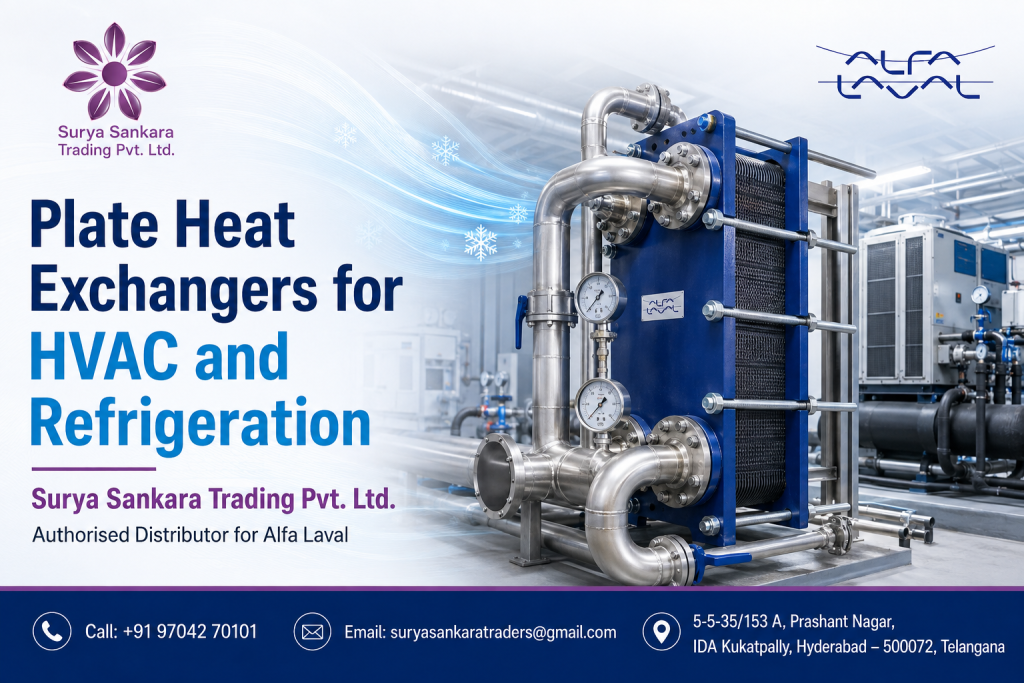
A plate heat exchanger uses a series of thin, corrugated metal plates to transfer heat between two separate fluids. Alternate flow channels guide the warm and cold fluids across opposite sides of each plate. The fluids normally remain separated while thermal energy passes through the plate material.
The corrugated plate pattern creates turbulence and a large heat-transfer area within a compact frame. When properly selected, the unit can deliver efficient heating or cooling with close temperature approaches and a smaller footprint than many conventional alternatives.
Why Plate Heat Exchangers Suit HVAC Systems
HVAC systems must respond to changing occupancy, outdoor temperature and cooling loads. A properly engineered plate heat exchanger can help meet these variable demands while separating different water circuits.
Key benefits can include:
– High thermal efficiency
– Compact installation footprint
– Fast response to load changes
– Separation of primary and secondary circuits
– Flexible capacity in gasketed units
– Lower fluid inventory
– Convenient inspection and servicing, depending on design
– Support for heat recovery and free cooling
Actual performance depends on correct sizing, clean system water, proper controls, suitable materials and operation within design limits.
Major HVAC Applications
District Cooling Substations
District cooling networks distribute chilled water from a central plant to multiple buildings. A plate heat exchanger can separate the distribution network from the building circuit while transferring cooling efficiently. This hydraulic separation can protect both sides from differences in water quality, pressure and operating conditions.
Data Centre Cooling
Servers generate continuous heat and require dependable cooling. Plate heat exchangers can be used in chilled-water circuits, liquid-cooling systems and free-cooling arrangements. Low approach temperatures and controlled pressure drop are especially important because cooling efficiency directly affects overall facility energy use.
Free Cooling
When outdoor conditions are suitable, free cooling can reduce the load on mechanical refrigeration equipment. A plate heat exchanger transfers heat to an external cooling source while maintaining separation between system circuits. The achievable saving depends on climate, temperatures, operating hours and system design.
Ice-Storage Systems
Ice storage shifts part of the cooling load to off-peak hours. Plate heat exchangers can transfer energy between glycol and water circuits during charging and discharging. Material compatibility and freeze protection must be considered carefully.
Commercial and Industrial Chilled-Water Systems
Hotels, hospitals, offices, manufacturing facilities and shopping centres may use plate heat exchangers to isolate chillers, cooling towers, process loads and building loops. Correct hydraulic design helps maintain stable performance across varying demand.
Plate Heat Exchangers in Refrigeration
Refrigeration duties can expose heat exchangers to refrigerants, oils, glycol, ammonia or other media at challenging pressures and temperatures. The equipment type must therefore be chosen for the specific refrigerant and duty.
Plate heat exchangers may serve as:
– Evaporators
– Condensers
– Economisers
– Desuperheaters
– Oil coolers
– Glycol coolers
– Heat-recovery units
– Refrigeration intercoolers
Refrigerant distribution is critical. Uneven flow can reduce capacity and increase the risk of unstable operation. Equipment should be sized by specialists using complete operating data.
Choosing between Gasketed, Brazed and Semi-Welded Designs
Gasketed Plate-and-Frame Heat Exchangers
Gasketed units can be opened for inspection and cleaning. Their thermal capacity may often be adjusted by adding or removing plates within the permitted frame configuration. They are commonly used for water-to-water and water-to-glycol HVAC duties.
Brazed Plate Heat Exchangers
Brazed plate heat exchangers are compact, gasket-free units commonly used in chillers, heat pumps and refrigeration systems. Their suitability depends on the refrigerant, pressure, temperature and compatibility with the brazing material.
Fusion-Bonded Plate Heat Exchangers
Fusion-bonded all-stainless-steel designs can be considered where copper or nickel is unsuitable or where media compatibility demands a different construction. Alfa Laval’s AlfaNova range, for example, is designed without copper or nickel and can suit selected HVAC and refrigeration duties.
Semi-Welded Plate Heat Exchangers
Semi-welded units combine welded channels with gasketed channels. They may be selected as evaporators or condensers for demanding refrigeration duties, including applications involving aggressive media. Model and material selection must be based on the refrigerant and operating conditions.
AHRI-Certified Thermal Performance
Published thermal performance is important because an undersized heat exchanger can increase pump energy, reduce cooling capacity and raise operating costs. The Alfa Laval AlfaQ range is intended for HVAC applications such as district cooling substations, ice-storage systems, data centre cooling and free cooling. Models within the applicable range are certified under the AHRI liquid-to-liquid heat exchanger programme, providing independent verification that thermal performance corresponds with published ratings.
Certification does not eliminate the need for proper system design. Flow rates, temperatures, fouling factors, pressure drop, water quality and control strategy must still be evaluated.
Improving HVAC Energy Efficiency
A heat exchanger should not be selected only by connection size or purchase price. System-level efficiency depends on the balance between heat-transfer area and allowable pressure drop.
An optimised selection can support:
– Lower pumping demand
– Improved chiller operating conditions
– Efficient heat recovery
– Greater use of free cooling
– Stable supply temperatures
– Reduced operating costs
Oversizing without analysis can increase cost, while undersizing can compromise capacity and force pumps or chillers to work harder.
Essential Selection Data – Plate Heat Exchangers for HVAC and Refrigeration
Provide the following information for accurate selection:
1. Required heating or cooling duty
2. Fluid or refrigerant on each side
3. Inlet and required outlet temperatures
4. Design and operating flow rates
5. Operating and design pressures
6. Maximum allowable pressure drop
7. Fluid concentration and properties
8. Fouling tendency and water quality
9. Plate, gasket and brazing-material compatibility
10. Minimum and maximum load conditions
11. Connection and space requirements
12. Applicable codes and certification requirements
For refrigeration duties, refrigerant type, evaporation or condensation temperature, superheat, subcooling and oil conditions may also be required.
Maintenance and Reliable Operation
Even an efficient heat exchanger can lose performance when scaling, corrosion or debris restricts the channels. Good practice includes:
– Monitoring inlet and outlet temperatures
– Recording flow and pressure drop
– Maintaining water treatment
– Using suitable strainers or filtration
– Inspecting for leakage
– Cleaning according to the manufacturer’s guidance
– Replacing worn components with genuine spare parts
– Investigating unexplained changes in system performance
Never open, isolate or clean pressurised refrigeration equipment without competent personnel and the required safety procedures.
Why Choose Alfa Laval Solutions?
Alfa Laval provides a broad portfolio covering liquid-to-liquid HVAC duties, heat pumps, chillers and industrial refrigeration. Available designs can address different pressures, temperatures, refrigerants, space constraints and service requirements. The right solution is determined through technical selection rather than a one-model-fits-all approach.
Support from Surya Sankara Trading Pvt. Ltd.
Surya Sankara Trading Pvt. Ltd. is an Authorised Distributor for Alfa Laval in Hyderabad. We provide:
– HVAC and refrigeration application consultation
– Heat exchanger sizing and selection assistance
– Genuine Alfa Laval plate heat exchangers
– Installation and commissioning guidance
– Genuine plates, gaskets and spare parts
– Preventive-maintenance support
– Troubleshooting and performance optimisation
– Professional after-sales service
We support customers in Hyderabad, Telangana and industrial locations across India.
Frequently Asked Questions
Which plate heat exchanger is suitable for an HVAC system?
The choice depends on the fluids, temperatures, flow rates, pressure, allowable pressure drop, water quality and maintenance needs. Gasketed plate-and-frame units are frequently used for water-to-water or water-to-glycol duties.
Can a plate heat exchanger be used with a chiller?
Yes. It can isolate chilled-water circuits, support condenser or evaporator duties, provide free cooling or separate glycol and water loops. The design must match the specific system.
What is the role of a plate heat exchanger in district cooling?
It transfers cooling between the district network and the building loop while keeping the circuits hydraulically separated.
Are plate heat exchangers suitable for ammonia refrigeration?
Certain fusion-bonded or semi-welded designs may be suitable for ammonia duties. Compatibility, pressure and temperature must be verified for the selected model.
Where can I buy Alfa Laval HVAC heat exchangers in Hyderabad?
Contact Surya Sankara Trading Pvt. Ltd., an Authorised Distributor for Alfa Laval, for technical consultation, equipment selection, genuine products and after-sales support.
Need a dependable plate heat exchanger for a chiller, district cooling substation, data centre, cold-storage facility, heat pump or industrial refrigeration system?
Contact Surya Sankara Trading Pvt. Ltd. for Plate Heat Exchangers for HVAC and Refrigeration and application-based Alfa Laval selection and support.
- Phone: +91 97042 70101
- Email: suryasankaratraders@gmail.com
- Office: 5-5-35/153 A, Prashant Nagar, IDA Kukatpally, Hyderabad – 500072, Telangana
Share your fluids, temperatures, flow rates, pressure, allowable pressure drop and application details so our team can assist with an appropriate technical recommendation.
Further readings on Plate Heat exchangers
- What is plate heat exchanger
- Benefits of plate heat exchangers
- Plate heat exchanger maintenance guide
- How to select a plate heat exchanger
- Common plate heat exchanger problems
- Plate heat xchanger cleaning guide
- Energy saving using plate heat exchanger
- Plate heat exchanger buying guide
- Plate heat echanger or pharmaceutical industry
- Plate heat exchanger for food & beverage processing