
Plate Heat Exchangers for Dairy Processing: Hygienic Heating, Cooling and Heat Recovery
Dairy processing depends on precise and reliable temperature control. Raw-milk reception, pasteurization, cooling, cream processing, cultured-product production and Cleaning-in-Place all require heat transfer that protects hygiene while supporting consistent product quality. Plate heat exchangers for dairy processing provide a compact and thermally efficient way to heat, cool and recover energy from liquid dairy streams.
The correct unit is not selected from capacity alone. Product viscosity, solids content, temperature programme, holding time, pressure drop, fouling behaviour, cleaning method and hygienic requirements must be considered together.
Surya Sankara Trading Pvt. Ltd. is an Authorised Distributor for Alfa Laval products. Based in Hyderabad, the company supports application discussions for dairy and food-processing plants seeking Alfa Laval heat-transfer equipment, genuine spares and technical support.
Why Plate Heat Exchangers Suit Dairy Processing
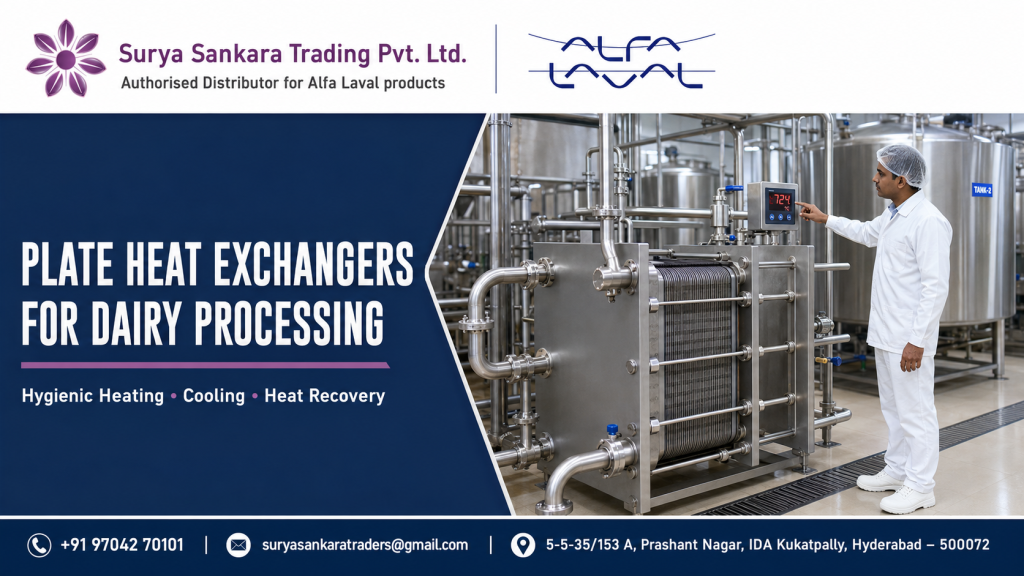
A gasketed plate-and-frame heat exchanger contains a series of corrugated plates held within a frame. Alternate channels carry the product and heating or cooling medium without intentional mixing. The plate pattern creates high turbulence at relatively low flow velocity, supporting efficient heat transfer in a compact footprint.
For suitable dairy liquids, the design can provide:
- Rapid and controlled heating or cooling.
- Compact installation compared with many conventional alternatives.
- Close temperature approach.
- Product-to-product heat regeneration.
- Flexible thermal area through plate-pack configuration.
- Access for inspection and maintenance.
- Cleaning-in-Place compatibility when properly designed.
- Multi-section configurations for pasteurization duties.
The actual benefits depend on product properties, utility conditions and equipment configuration.
Major Dairy Applications
Milk Pasteurization
Pasteurization requires the milk to follow a defined temperature-and-time programme. A multi-section plate heat exchanger can combine regeneration, final heating and cooling within one frame, subject to the process design.
Raw-Milk Cooling
Rapid cooling after reception helps the plant maintain the required storage temperature. The exchanger must be sized for peak flow, incoming milk temperature and the available chilled-water or glycol conditions.
Milk and Cream Heating
Plate heat exchangers can heat milk or cream before separation, standardization or other processing. Higher viscosity and fat content influence channel selection and pressure drop.
Cultured Dairy Products
Yoghurt, fermented milk and cultured-product processes require accurate heating and cooling. Product viscosity and sensitivity may require specialized plate patterns or another heat-exchanger type.
Cheese-Milk Treatment
Heating and cooling of cheese milk requires hygienic design and gentle product handling. Process temperatures and required capacity must be reviewed with the complete cheese-making line.
Whey Processing
Whey heating and cooling duties vary according to composition and downstream concentration or powder processing. Fouling behaviour and cleaning cycles are important design inputs.
Ice-Cream Mix and Dairy Desserts
Viscous mixes may contain sugar, fat, stabilizers or particulates. A standard narrow-channel plate exchanger is not automatically suitable; the product must be evaluated before equipment selection.
CIP-Solution Heating
Plate heat exchangers can heat cleaning solutions used in dairy CIP systems. Chemical concentration, temperature, flow and materials compatibility must be defined.
How Heat Regeneration Works in Milk Pasteurization
In a regenerative section, hot pasteurized milk transfers heat to incoming cold milk across the plates. This preheats the incoming product and simultaneously begins cooling the pasteurized stream.
Effective regeneration can:
- Reduce the external heating duty.
- Lower chilled-water or refrigeration demand.
- Improve overall energy efficiency.
- Reduce utility load and operating cost.
Regeneration performance is application-specific. It depends on the temperature programme, available pressure drop, surface area, flow balance and operating conditions. Do not apply a generic heat-recovery percentage to every dairy plant.
Hygienic Design Considerations
Product-Compatible Materials
Plate and gasket materials must suit the dairy product, temperature, cleaning chemicals and applicable food-contact requirements.
Uniform Flow Distribution
Well-designed distribution areas help avoid stagnant zones and promote consistent thermal treatment across the plate pack.
Cleanability
The channels, ports, gaskets and flow arrangement must support the required CIP velocity and cleaning programme. Mechanical access may also be required for inspection.
Product Separation
The product and utility circuits must remain separated. Where the risk assessment requires additional protection, suitable double-wall arrangements may be evaluated.
Drainability and Piping Design
Hygienic performance depends on the complete installation, not the exchanger alone. Connections, piping slope, valves, instrumentation and control logic must be considered.
Pressure Relationship
The pressure programme should reduce the risk of contamination if a leakage event occurs. This requires process engineering and appropriate monitoring.
Alfa Laval Hygienic Plate Heat Exchangers
Alfa Laval offers hygienic gasketed plate heat exchangers for dairy, food and beverage duties. Product selection depends on the application, capacity and hygienic requirements.
The Alfa Laval FrontLine range is designed for applications with strict hygienic control, gentle product treatment, cleanability and long operating periods. Alfa Laval describes the range as suitable for heat-sensitive dairy, food and beverage media.
Depending on the duty, Alfa Laval options may include:
- FrontLine for demanding hygienic processes.
- BaseLine for standard hygienic heating and cooling.
- ClipLine for smaller hygienic duties.
- Specialized plate patterns and materials.
- Multi-section frames.
- Double-wall plate options for selected risk requirements.
The final model and configuration must be confirmed from current Alfa Laval documentation and actual process data.
Design Information Required
For an application review, provide:
Product Data
- Milk, cream, whey, cultured product or dairy mix.
- Composition, fat and total-solids content.
- Viscosity at operating temperatures.
- Presence and size of fibres or particulates.
- Fouling tendency and product sensitivity.
Thermal Duty
- Product inlet and required outlet temperatures.
- Heating or cooling medium and its temperatures.
- Normal, minimum and maximum flow.
- Batch or continuous operation.
- Required holding-time relationship where applicable.
Hydraulic Data
- Available product-side pressure.
- Allowable pressure drop on both circuits.
- Design and operating pressure.
- Connection size and piping arrangement.
Hygienic and Cleaning Requirements
- CIP chemicals, concentration and temperature.
- Required CIP flow.
- Cleaning frequency and production run length.
- Applicable food-contact or plant standards.
- Inspection and validation requirements.
Accurate data allows the thermal area, plate pattern, channel arrangement, gasket and frame to be selected together.
Pressure Drop and Thermal Efficiency – Plate Heat Exchangers for Dairy Processing
Higher turbulence can improve heat transfer, but it also consumes pressure drop. An undersized exchanger may create excessive pumping demand or product stress. An oversized unit may operate at insufficient channel velocity, reducing cleanability or increasing investment.
Good selection balances:
- Required temperature programme.
- Product handling.
- Allowable pressure drop.
- Pumping energy.
- Fouling resistance.
- CIP performance.
- Future capacity requirements.
Read How to Select a Plate Heat Exchanger for a broader selection checklist.
CIP and Dairy Heat-Exchanger Cleaning – Plate Heat Exchangers for Dairy Processing
A typical cleaning programme may include product recovery, pre-rinse, alkaline cleaning, intermediate rinse, acid cleaning when required, final rinse and sanitization. The sequence depends on plant procedures, deposits, materials and food-safety requirements.
Important factors include:
- Correct chemical concentration.
- Required temperature and circulation time.
- Adequate channel velocity.
- Correct flow direction.
- Complete rinsing.
- Monitoring of conductivity, temperature or return condition.
- Periodic inspection and performance verification.
Do not compensate for poor thermal performance by changing chemicals without identifying the cause. Fouling, incorrect flow, plate damage, gasket condition and instrumentation errors can produce similar symptoms.
Read our Plate Heat Exchanger Cleaning Guide for general maintenance guidance. Dairy plants should always follow their validated hygiene procedures and the applicable Alfa Laval manual.
Common Problems in Dairy Plate Heat Exchangers – Plate Heat Exchangers for Dairy Processing
Reduced Heating or Cooling Performance
Possible causes include fouling, changed flow, air pockets, incorrect utility temperature, control-valve issues or a modified product.
Increased Pressure Drop
Deposits, blocked channels, an incorrect plate arrangement or higher-than-design flow may increase pressure loss.
Product or Utility Leakage
Stop and investigate leakage. Possible causes include gasket deterioration, incorrect tightening, plate damage, corrosion or operating conditions outside the design.
Short Production Runs
Rapid fouling may result from inappropriate channel geometry, excessive surface temperature, unstable product, low flow velocity or an unsuitable cleaning programme.
Uneven Pasteurization Control
Temperature sensors, flow control, holding section, diversion logic and heat-exchanger performance must be evaluated as one system.
Troubleshooting should be systematic; do not change multiple parameters simultaneously.
Maintenance Priorities
- Record temperature and pressure trends.
- Inspect for external leakage.
- Monitor pressure drop and thermal approach.
- Verify frame tightening dimension according to the manual.
- Inspect plates for fouling, deformation, corrosion or cracks.
- Check gasket condition and seating.
- Use genuine, compatible replacement parts.
- Confirm the plate sequence after service.
- Pressure-test and validate before returning to hygienic duty.
Read our Plate Heat Exchanger Maintenance Guide.
Dairy Plate Heat Exchanger Support in Hyderabad and South India
South India has a broad dairy-processing base across Telangana, Andhra Pradesh, Karnataka, Tamil Nadu and Kerala. Plants range from milk-chilling centres and cooperative dairies to private processors manufacturing pasteurized milk, curd, yoghurt, cheese, cream, butter and dairy ingredients.
Surya Sankara Trading Pvt. Ltd. is based in Hyderabad and handles application discussions for customers seeking Alfa Laval plate heat exchangers for dairy processing in South India. The company does not claim to be Alfa Laval itself; it operates as an Authorised Distributor for Alfa Laval products.
For enquiries related to a dairy plate heat exchanger in Hyderabad, milk-processing equipment in Telangana or hygienic heat-transfer applications elsewhere in South India, share the actual process and utility data for a configuration review.
Why Work With Surya Sankara Trading Pvt. Ltd.?
Surya Sankara can support:
- Application consultation.
- Alfa Laval equipment selection coordination.
- Genuine equipment, plates, gaskets and spares.
- Installation and commissioning guidance.
- Cleaning and maintenance planning.
- Troubleshooting coordination.
- After-sales support.
This website is a Surya Sankara Trading Pvt. Ltd. microsite and not Alfa Laval’s corporate website.
Frequently Asked Questions
Why are plate heat exchangers used in dairies?
They provide compact and efficient heating, cooling and heat regeneration for suitable liquid dairy streams, with hygienic configurations that support inspection and CIP.
Can one plate heat exchanger perform regeneration, heating and cooling?
Multi-section configurations can combine these duties within one frame. The arrangement depends on the pasteurization programme, capacity and control system.
Which plate heat exchanger is suitable for milk pasteurization?
Selection depends on flow, temperature programme, pressure drop, hygiene, CIP and plant requirements. Alfa Laval FrontLine and BaseLine configurations may be evaluated according to the duty.
Can a plate heat exchanger process viscous dairy products?
Suitability depends on viscosity, particulates and fouling behaviour. Specialized plates or a different exchanger technology may be required.
How often should a dairy plate heat exchanger be cleaned?
Cleaning frequency follows the validated dairy-plant programme and actual fouling behaviour. Monitor thermal performance and pressure drop in addition to scheduled CIP.
How does heat recovery reduce dairy utility cost?
The hot processed product can transfer heat to the cold incoming product, reducing external heating and cooling demand. Actual savings are application-specific.
Where can dairy plants obtain Alfa Laval plate heat exchanger support in South India?
Contact Hyderabad-based Surya Sankara Trading Pvt. Ltd., an Authorised Distributor for Alfa Laval products, for application-based selection and support.
Request a Dairy Heat-Transfer Review
Share the product, composition, flow rate, inlet and outlet temperatures, utility temperatures, operating pressure, allowable pressure drop, CIP programme and available installation space.
Surya Sankara Trading Pvt. Ltd.
Authorised Distributor for Alfa Laval products
Office: 5-5-35/153 A, Prashant Nagar, IDA Kukatpally, Hyderabad – 500072, Telangana
Phone: +91 97042 70101
Email: suryasankaratraders@gmail.com
Website: https://suryasankara.in/
Further readings on Plate Heat exchangers
- What is plate heat exchanger
- Benefits of plate heat exchangers
- Plate heat exchanger maintenance guide
- How to select a plate heat exchanger
- Common plate heat exchanger problems
- Plate heat xchanger cleaning guide
- Energy saving using plate heat exchanger
- Plate heat exchanger buying guide
- Plate heat echanger or pharmaceutical industry
- Plate heat exchanger for food & beverage processing