
Plate Heat Exchangers for Chemical Processing: Efficient and Reliable Heat Transfer. Chemical plants depend on controlled heat transfer for reaction temperature management, feed preheating, product cooling, condensation, evaporation, utility isolation and energy recovery. Plate heat exchangers for chemical processing can provide high thermal efficiency within a compact footprint, but successful operation depends on correct materials, seals, channel geometry and process design.
Chemical duties cannot be selected by flow rate and temperature alone. Fluid composition, concentration, contaminants, corrosion behaviour, phase change, viscosity, solids, fouling, pressure, temperature cycling and cleaning method all influence whether a gasketed, semi-welded, welded, graphite or another heat-exchanger design is appropriate.
Surya Sankara Trading Pvt. Ltd. is an Authorised Distributor for Alfa Laval products. Its Hyderabad-based team supports application discussions for industrial customers evaluating Alfa Laval heat-transfer equipment, genuine spares and after-sales support.
Why Plate Heat Exchangers Are Used in Chemical Plants
A plate heat exchanger transfers heat through a series of thin plates that separate the hot and cold media. Corrugations create turbulence and mechanical strength while supporting a large heat-transfer area in a small volume.
For suitable chemical duties, the technology can offer:
- Compact installation.
- Close temperature approach.
- Efficient counter-current heat transfer.
- Low fluid hold-up.
- Rapid response to process changes.
- Access for inspection in gasketed designs.
- Capacity flexibility in selected plate-and-frame units.
- Heat recovery between process streams.
- Multiple plate, gasket and construction options.
These advantages are application-dependent. A standard gasketed unit is not suitable for every corrosive, toxic, flammable, high-pressure or high-temperature fluid.
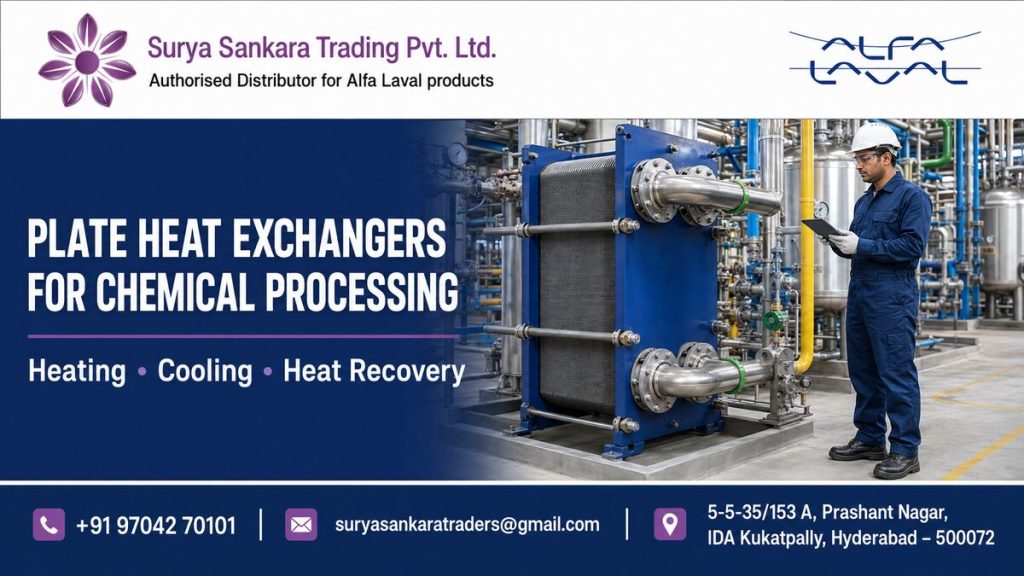
Common Chemical-Processing Applications – Plate Heat Exchangers for Chemical Processing
Process-Stream Heating
Feed or intermediate streams may require controlled heating before reaction, mixing, separation or storage. The utility may be hot water, thermal fluid, condensate or another process stream.
Product Cooling
Reactor discharge, finished chemicals and intermediate products often need cooling before storage or downstream processing. Cooling-water quality and fouling risk must be evaluated.
Heat Recovery
Heat from a hot outgoing stream can preheat a cold incoming stream. Close temperature approaches can improve energy recovery, provided the risk of cross-contamination and the pressure relationship are acceptable.
Reactor Temperature Control
An external circulation loop can transfer heat to or from a reactor. Flow stability, response time, pressure drop and compatibility with the circulating fluid are important.
Condensation and Evaporation
Certain plate designs can be used for condensing vapours or evaporating liquids. Phase-change distribution, pressure drop and fouling behaviour require specialized thermal design.
Utility Isolation
Plate heat exchangers can separate process cooling water from a closed clean-water, glycol or equipment-cooling loop. This can protect sensitive equipment from poor-quality utility water.
Acid and Alkali Heating or Cooling
Highly corrosive fluids may require special metals, graphite plates, welded construction or another technology. Concentration and temperature must be stated accurately because corrosion resistance can change substantially with both.
Solvent and Hydrocarbon Duties
Gasket compatibility, emissions risk, operating pressure and fire-safety requirements must be reviewed. A gasketed plate exchanger should not be assumed suitable without a formal compatibility assessment.
Types of Plate Heat Exchangers for Chemical Duties – Plate Heat Exchangers for Chemical Processing
Gasketed Plate-and-Frame Heat Exchangers
These units use elastomeric gaskets to seal the channels. They can be opened for inspection, mechanical cleaning and plate replacement. Heat-transfer area may be adjusted in some configurations by changing the plate pack.
They are often considered for utility duties and compatible process liquids within the approved pressure and temperature range.
Semi-Welded Plate Heat Exchangers
Pairs of plates are welded into cassettes, reducing gasket exposure on one circuit. Semi-welded designs can suit fluids that are incompatible with standard gaskets or duties requiring improved containment.
Welded Plate Heat Exchangers
Welded designs can be evaluated for higher temperature, pressure, aggressive fluids, phase change or duties where gasket limitations are unacceptable. Service and cleaning arrangements differ by technology.
Graphite Plate Heat Exchangers
Graphite can provide corrosion resistance for certain aggressive chemicals where common metals are unsuitable. Alfa Laval Diabon units use graphite plate materials for demanding corrosive-media duties.
Wide-Channel Plate Heat Exchangers
Fluids containing fibres, coarse particles or higher viscosity may require wider channels. Particle size, concentration and settling behaviour must be reviewed before selection.
Corrosion: The First Material-Selection Question
Material selection is central to chemical heat-exchanger reliability. A material that performs well with a dilute fluid may corrode rapidly at another concentration or temperature.
Provide:
- Complete chemical names and composition.
- Normal and maximum concentration.
- Trace contaminants and cleaning chemicals.
- Operating and design temperatures.
- pH and oxidizing or reducing conditions.
- Chloride and halide concentration.
- Expected start-up, shutdown and upset conditions.
Possible plate materials depend on the duty and may include stainless-steel grades, titanium, nickel alloys, other specialty alloys or graphite. The appropriate option must be confirmed through current corrosion data and Alfa Laval engineering.
Do not select a plate material from a generic statement such as “stainless steel is corrosion resistant.”
Gasket Compatibility
In gasketed units, the elastomer must tolerate:
- The process fluids on both sides.
- Temperature and pressure.
- Cleaning chemicals.
- Steam or thermal cycling where applicable.
- Oils, solvents and trace contaminants.
- Expected service life and shutdown conditions.
Common elastomer families have different strengths and limitations. A gasket compatible with water may swell, harden or degrade in a solvent or oil. Chemical name, concentration and temperature must be checked together.
Where gasket exposure is unacceptable, semi-welded, welded or graphite arrangements may be evaluated.
Fouling and Scaling in Chemical Processes
Fouling reduces heat transfer, increases pressure drop and can accelerate under-deposit corrosion. Chemical fouling may result from crystallization, polymerization, precipitation, biological growth, suspended solids or temperature-sensitive reactions.
Design considerations include:
- Wall temperature.
- Channel velocity and shear.
- Plate pattern and gap.
- Residence time.
- Solids size and concentration.
- Cooling-water quality.
- Start-up and shutdown procedure.
- Cleaning method and interval.
High turbulence can reduce deposition in suitable duties, but it also uses pressure drop. The design must balance thermal performance, pumping energy and fouling risk.
Alfa Laval Options for Chemical Processing
Alfa Laval offers multiple plate heat-exchanger technologies rather than one universal chemical-industry model.
Industrial Gasketed Range
Industrial gasketed plate-and-frame exchangers can support heating, cooling and heat recovery with accessible plate packs and flexible configurations.
Alfa Laval Diabon
The Alfa Laval Diabon plate heat exchanger combines compact plate heat transfer with graphite corrosion resistance for selected highly corrosive fluids. Alfa Laval lists applications involving various acids, pickling solutions, electrolytes and other aggressive media; exact suitability remains concentration- and temperature-dependent.
AlfaVap
AlfaVap is a semi-welded plate-and-frame design intended for rising-film evaporation or thermosiphon reboiler duties involving concentrated or viscous media.
Compabloc
Compabloc is a welded plate-and-block heat exchanger used for demanding process heating, cooling, heat recovery, condensation and reboiling duties. The correct configuration depends on pressure, temperature, fluid and cleaning needs.
WideGap
WideGap configurations can be considered for fibrous, viscous or particle-containing fluids where standard narrow channels may be unsuitable.
Selection must use current Alfa Laval technical data and the customer’s actual duty.
Process Data Required for Selection
Fluid Information
- Exact chemical name and composition for both sides.
- Concentration range.
- Density, viscosity, specific heat and thermal conductivity.
- Solids, fibres or crystals.
- Corrosion and toxicity information.
- Fouling, scaling or polymerization tendency.
Thermal Requirements
- Normal, minimum and maximum flow.
- Inlet and required outlet temperatures.
- Heating or cooling utility conditions.
- Heat load, if known.
- Batch, continuous or cyclic operation.
Mechanical Requirements
- Operating and design pressure.
- Allowable pressure drop on both sides.
- Design temperature.
- Connection standard and size.
- Materials and plant-code requirements.
- Location, hazardous-area and installation conditions.
Maintenance Requirements
- Cleaning method and chemicals.
- Desired run length.
- Access and lifting provisions.
- Spare-parts strategy.
- Inspection and leakage-detection requirements.
Read How to Select a Plate Heat Exchanger for a general selection workflow.
Heat Recovery in Chemical Plants
Recovering process heat can reduce steam, hot-water, cooling-water or refrigeration demand. Plate technology can be attractive where close temperature approaches and a compact footprint are important.
A heat-recovery study should examine:
- Hot- and cold-stream availability.
- Operating schedules and load variation.
- Minimum temperature approach.
- Pressure-drop cost.
- Fouling and cleaning.
- Risk if the two fluids leak or mix.
- Bypass and start-up control.
- Economic value of recovered energy.
Energy savings should be calculated from measured or reliable process data rather than assumed percentages.
Cleaning and Maintenance
The cleaning method depends on deposits and equipment construction.
Cleaning-in-Place
CIP may be suitable when deposits can be dissolved or dispersed chemically. Confirm chemical compatibility with plates, gaskets and frame components.
Mechanical Cleaning
Gasketed units can be opened for inspection and manual cleaning when site procedures permit. Use non-damaging tools and follow the manufacturer’s tightening instructions during reassembly.
Condition Monitoring
Track:
- Inlet and outlet temperatures.
- Flow and pressure drop.
- Utility consumption.
- External leakage.
- Product contamination indicators.
- Cleaning frequency and result.
A gradual loss of duty or rise in pressure drop can indicate fouling. Sudden changes may indicate a process, control or mechanical issue.
Refer to the Plate Heat Exchanger Cleaning Guide and Plate Heat Exchanger Maintenance Guide.
Common Chemical-Application Problems
Rapid Plate Corrosion
Check fluid composition, contaminants, temperature, concentration, cleaning chemicals and whether upset conditions exceeded the design basis.
Gasket Swelling or Hardening
Review chemical compatibility, temperature exposure, cleaning procedure and storage or installation practices.
Increasing Pressure Drop
Possible causes include fouling, crystallization, blocked channels, incorrect flow or a changed product.
Reduced Thermal Performance
Examine flow, temperatures, fouling, bypassing, plate arrangement and instrumentation before modifying the plate pack.
Cross-Contamination Risk
Leakage can have safety, quality and environmental consequences. Pressure relationships, leakage detection and alternative double-wall or welded designs should be assessed where risk is significant.
Fatigue from Cycling
Frequent pressure and temperature changes can stress plates, gaskets, welds and connections. Provide realistic cycle data during selection.
Chemical-Industry Support in Hyderabad and South India
South India has major chemical, pharmaceutical, specialty-chemical, agrochemical, bulk-drug, fertilizer, refinery and process-industry clusters across Telangana, Andhra Pradesh, Karnataka, Tamil Nadu and Kerala.
Surya Sankara Trading Pvt. Ltd. is based in Hyderabad and handles application discussions for customers seeking Alfa Laval plate heat exchangers for chemical processing in South India. For enquiries related to chemical heat exchangers in Hyderabad, industrial heat recovery in Telangana or process heating and cooling elsewhere in South India, provide the complete fluid and operating data before requesting a model.
Location does not determine the metallurgy or configuration. Chemical compatibility and the process duty remain the basis of selection.
Why Work With Surya Sankara Trading Pvt. Ltd.?
As an Authorised Distributor for Alfa Laval products, Surya Sankara can support:
- Application consultation.
- Equipment selection coordination.
- Genuine Alfa Laval equipment, plates, gaskets and spares.
- Installation and commissioning guidance.
- Cleaning and maintenance planning.
- Troubleshooting coordination.
- After-sales support.
Surya Sankara Trading Pvt. Ltd. is an independent authorised distributor. This microsite is operated by Surya Sankara and is not Alfa Laval’s corporate website.
Frequently Asked Questions -Plate Heat Exchangers for Chemical Processing
Are plate heat exchangers suitable for corrosive chemicals?
They can be, provided the plate material, gasket or welded construction is compatible with the exact chemical, concentration and temperature. Standard stainless steel is not suitable for every corrosive duty.
Which plate material is best for chemical processing?
There is no universal material. Selection may involve stainless steel, titanium, specialty alloys or graphite depending on the fluid and operating conditions.
Can plate heat exchangers handle acids?
Some specialized designs can handle selected acids. Concentration, temperature, contaminants and material compatibility must be verified for each application.
What causes fouling in chemical heat exchangers?
Crystallization, precipitation, polymerization, suspended solids, scaling and utility-water deposits are common possibilities. The actual mechanism must be identified before selecting a cleaning method.
Can a plate heat exchanger recover heat between process streams?
Yes, when thermal, hydraulic, compatibility and leakage-risk requirements permit. Actual energy recovery must be calculated from the process data.
When should a welded exchanger be considered?
Welded or semi-welded designs may be considered when gasket compatibility, pressure, temperature, containment or phase-change requirements make a standard gasketed design unsuitable.
Where can chemical plants obtain Alfa Laval PHE support in South India?
Contact Hyderabad-based Surya Sankara Trading Pvt. Ltd., an Authorised Distributor for Alfa Laval products, for application-based selection and support.
Request a Chemical Heat-Transfer Review
Share both fluid compositions, concentration ranges, flow rates, inlet and outlet temperatures, operating and design pressures, allowable pressure drop, materials requirements, fouling tendency, cleaning method and installation conditions.
Surya Sankara Trading Pvt. Ltd.
Authorised Distributor for Alfa Laval products
Office: 5-5-35/153 A, Prashant Nagar, IDA Kukatpally, Hyderabad – 500072, Telangana
Phone: +91 97042 70101
Email: suryasankaratraders@gmail.com
Website: https://suryasankara.in/
Further readings on Plate Heat exchangers
- What is plate heat exchanger
- Benefits of plate heat exchangers
- Plate heat exchanger maintenance guide
- How to select a plate heat exchanger
- Common plate heat exchanger problems
- Plate heat xchanger cleaning guide
- Energy saving using plate heat exchanger
- Plate heat exchanger buying guide
- Plate heat echanger or pharmaceutical industry
- Plate heat exchanger for food & beverage processing