
Plate Heat Exchangers for Brewery in Telangana and Karnataka. Plate heat exchangers for breweries support controlled heat transfer during wort cooling, beer cooling and selected utility duties. Choosing equipment that matches the brewing process helps operators achieve the required temperatures while managing hygiene, water use and maintenance.
Surya Sankara Trading is an Authorised Distributor for Alfa Laval products, supporting brewery equipment enquiries from Hyderabad and other locations in Telangana, as well as Bengaluru and other locations in Karnataka.
Whether you operate a microbrewery, craft brewery or larger production facility, heat-exchanger selection should begin with your batch volume, cooling time, product characteristics and available cooling utilities.
What Does a Plate Heat Exchanger Do in a Brewery?
Plate Heat Exchangers for Brewery is A plate heat exchanger transfers heat between fluids flowing through separate channels. In wort cooling, heat passes from hot wort to a colder medium without the fluids mixing during normal operation.
The required outlet temperature depends on the brewing process and yeast requirements. A suitable unit must achieve that temperature at the intended flow rate while staying within the brewery’s pressure-drop and hygiene requirements.
A brewery heat exchanger should therefore be selected for a defined duty rather than by physical size or connection diameter alone.
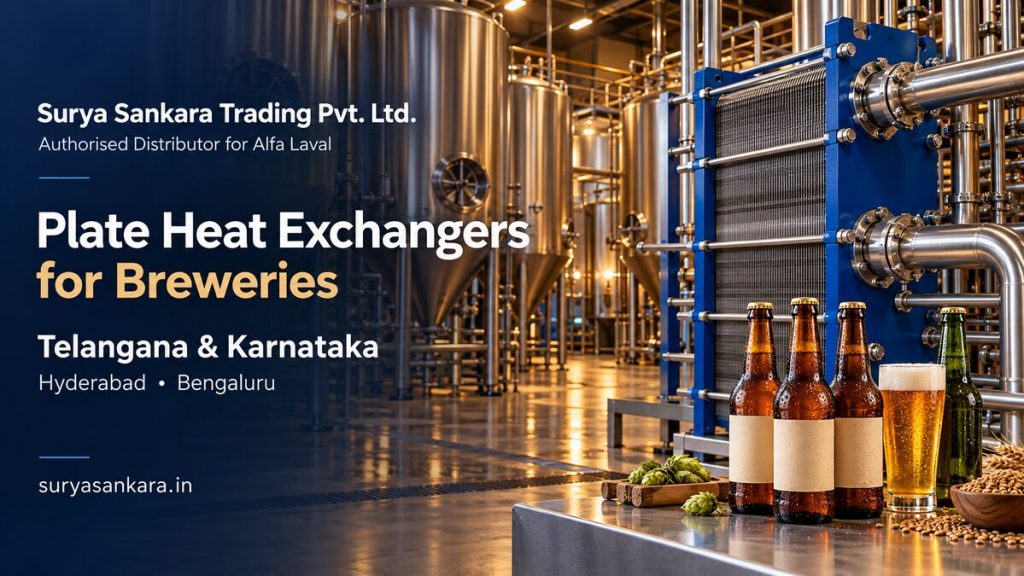
Main Brewery Applications – Plate Heat Exchangers for Brewery
Wort Cooling Before Fermentation
Wort cooling is a key application for brewery plate heat exchangers. After boiling and the appropriate solids-separation stage, hot wort must be cooled to the temperature specified for fermentation.
The equipment selection should consider:
- Wort volume per batch.
- Required transfer and cooling time.
- Wort inlet and target outlet temperatures.
- Available cooling-water or chilled-water conditions.
- Product flow rate and allowable pressure drop.
- Cleaning requirements and potential solids carryover.
A useful starting point is the required transfer rate. For example, transferring a 2,000-litre batch in 40 minutes requires an average product flow of 3,000 litres per hour. This establishes a flow requirement; it does not determine the heat-exchanger model without the remaining thermal and hydraulic data.
Beer Cooling
Plate heat exchangers can also support beer cooling at suitable stages of production.
The required configuration depends on beer temperature, flow, carbonation conditions and downstream processing. Pressure control is particularly important when handling carbonated beer, so the exchanger should be assessed as part of the complete process.
A wort-cooling unit should not automatically be assumed suitable for every beer-cooling application.
Yeast Cooling
Specialist yeast-cooling systems may incorporate plate heat exchangers to help maintain suitable handling and storage temperatures.
Yeast concentration, viscosity, flow behaviour and cleaning needs must be considered. This requires a duty-specific selection rather than reusing the specification of a general water cooler.
Brewery Utility Cooling
Breweries may also use plate heat exchangers in water or glycol utility circuits.
Utility-side equipment and product-contact equipment have different requirements. Clearly identify whether an enquiry concerns wort, beer, yeast or a secondary cooling circuit so the appropriate construction can be assessed.
Can Wort Cooling Support Heat Recovery?
Wort cooling creates an opportunity to recover heat into water where the process arrangement allows it. The heated water may then support a suitable brewery hot-water requirement.
The practical benefit depends on whether the brewery can store and use the recovered water at the right time and temperature.
Before proposing heat recovery, establish:
- The volume and temperature of water available after cooling.
- The brewery’s hot-water demand.
- Storage capacity and hygiene requirements.
- The timing of consecutive batches.
- Additional piping, controls and pumping requirements.
Heat recovery should be assessed against the actual brewing schedule. A universal percentage saving cannot be assumed for every installation.
Choosing the Right Brewery Plate Heat Exchanger
Match Batch Size and Cooling Time
Two breweries producing the same daily volume may require different heat exchangers. One may transfer smaller batches throughout the day, while another may need to cool a larger batch within a short production window.
Share both batch volume and target cooling time when requesting a selection.
Use Real Cooling-Utility Conditions
Provide the highest expected cooling-water inlet temperature, together with the chilled-water or glycol conditions where applicable.
For breweries in Telangana and Karnataka, the design should reflect the installation’s measured or specified seasonal conditions. City names alone do not provide enough information to size the equipment.
Confirm Hygienic Construction
Product-contact applications require suitable materials, connections, gasket compatibility and cleaning arrangements.
Alfa Laval offers plate heat exchanger ranges for food and beverage applications. The appropriate model and configuration must be confirmed for the brewery’s specific process.
An industrial utility exchanger should not be selected for direct product contact solely because its nominal cooling capacity appears suitable.
Check Maintenance Access
Allow sufficient room for inspection, plate-pack opening and safe servicing where an openable gasketed design is selected.
Consider isolation, drainage, access to connections and the availability of suitable replacement parts during installation planning.
Cleaning and Maintenance
Cooling performance and hygiene depend on an appropriate cleaning and maintenance programme.
Use the equipment manufacturer’s instructions and the brewery’s validated cleaning procedure. Cleaning chemicals, temperature, concentration and circulation conditions must suit the product deposits, plate materials and gaskets.
Useful operating records include:
- Product and coolant inlet and outlet temperatures.
- Product and coolant flow rates.
- Pressure drop under comparable operating conditions.
- Cleaning dates and inspection findings.
- Any leakage or change in cooling time.
If cooling performance deteriorates, investigate utility temperature, flow restrictions, instrument accuracy and fouling before assuming that the exchanger needs replacement.
For existing equipment enquiries, visit our gasketed plate heat exchanger services page.
Plate Heat Exchangers for Brewery Enquiries in Telangana and Karnataka
Surya Sankara Trading welcomes enquiries from brewery owners, brewing teams, project consultants and maintenance personnel across Telangana and Karnataka, including Hyderabad and Bengaluru.
As an Authorised Distributor for Alfa Laval products, Surya Sankara Trading supports product discussions and application-based selection coordination.
For a new brewery, provide the planned production schedule and utility specifications. For an existing installation, include the current heat exchanger’s model, nameplate photograph and operating data.
This helps distinguish between a new capacity requirement, a change in utility conditions and a maintenance-related performance issue.
Frequently Asked Questions
1. Why are plate heat exchangers used in breweries?
Plate heat exchangers provide compact heat transfer for duties such as wort cooling and beer cooling. Suitable hygienic models can also provide access for inspection and cleaning, depending on their construction.
2. Which plate heat exchanger is suitable for a microbrewery?
The suitable unit depends on batch volume, cooling time, wort temperatures, available cooling medium and pressure-drop limits. A smaller brewery still needs a thermal and hydraulic assessment; production volume alone is insufficient.
3. What temperature should wort reach after cooling?
The target temperature should follow the brewery’s recipe, yeast requirements and fermentation procedure. Specify this temperature when requesting equipment selection rather than using one universal value for all beer styles.
4. Can a brewery use water and glycol for wort cooling?
A staged cooling arrangement may use water for initial cooling and a chilled utility for a further cooling stage. The configuration, fluid suitability and safeguards must be assessed for the process. Coolant and wort remain in separate channels during normal operation.
5. Can a brewery plate heat exchanger recover heat?
Yes, a suitable wort-cooling arrangement can transfer heat into water for potential reuse. The benefit depends on the temperature achieved, available storage and the brewery’s demand for heated water.
6. How often should a brewery heat exchanger be cleaned?
Follow the brewery’s validated hygiene procedure and the equipment manufacturer’s instructions. Cleaning frequency depends on the product, operating schedule and process requirements; visible performance loss should not be the only trigger.
7. Where can breweries in Telangana enquire about Alfa Laval heat exchangers?
Breweries in Hyderabad and across Telangana can contact Surya Sankara Trading, an Authorised Distributor for Alfa Laval products, with their wort-cooling, beer-cooling or utility heat-transfer requirements.
8. Does Surya Sankara Trading accept brewery enquiries from Karnataka?
Yes. Brewery customers in Bengaluru and other locations in Karnataka can discuss their application and product requirements with Surya Sankara Trading. Share the plant location, project scope and operating data to establish the next steps.
9. What information is required for a brewery heat exchanger quotation?
Provide batch volume, required cooling time, product and coolant temperatures, flow rates, pressure limits and cleaning requirements. For replacement equipment, include the existing model and nameplate details.
Discuss Your Brewery Cooling Requirement
Looking for plate heat exchangers for breweries in Telangana or Karnataka?
Contact Surya Sankara Trading — Authorised Distributor for Alfa Laval products to discuss wort cooling, beer cooling, heat recovery or a brewery utility application.
Share your batch size, target cooling time and available utility temperatures so the enquiry can be evaluated against your brewing requirements.
For manufacturer information, explore Alfa Laval’s craft brewing solutions.
More Readings on Plate Heat Exchangers
- Plate Heat Exchangers for the Sugar Industry
- What Is a Plate Heat Exchanger?
- How to Select a Plate Heat Exchanger
- Energy Saving Using Plate Heat Exchangers
- Plate Heat Exchanger Cleaning Guide
- Plate Heat Exchanger Maintenance Guide
- Decanter Centrifuge Applications
Disclaimer
This microsite is operated by Surya Sankara Trading Pvt. Ltd., an Authorised Distributor for Alfa Laval products. It is not Alfa Laval’s corporate website. Alfa Laval product names and trademarks belong to their respective owner.