
Plate Heat Exchangers for Food and Beverage Processing.Plate heat exchangers for food and beverage processing provide controlled heating, cooling, pasteurisation and heat recovery across a wide range of production applications. Their compact construction and high thermal efficiency make them valuable where product quality, hygiene, energy consumption and temperature control are important.
Food and beverage products vary considerably in viscosity, particle content, acidity and sensitivity to temperature. The correct heat exchanger must therefore be selected according to the product, process conditions, hygiene requirements and cleaning method.
Surya Sankara Trading Pvt. Ltd. is an Authorised Distributor for Alfa Laval products, supporting industrial customers with genuine heat transfer equipment, spare parts and technical assistance.
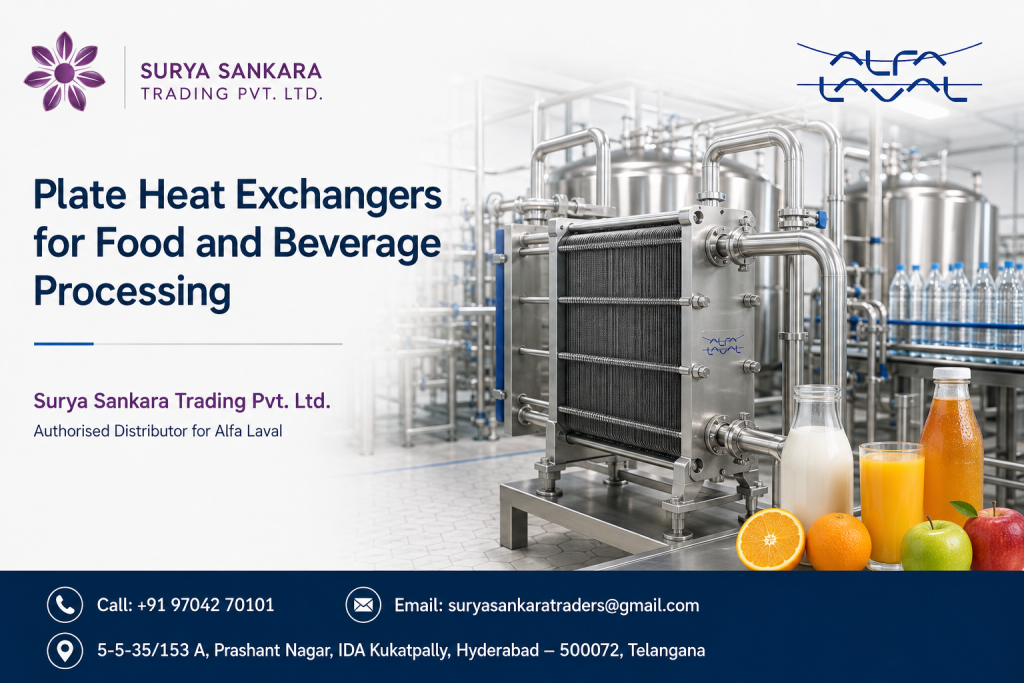
What Is a Food-Processing Plate Heat Exchanger? Plate Heat Exchangers for Food and Beverage Processing
A plate heat exchanger transfers thermal energy between separate hot and cold fluid streams through a series of thin metal plates.
The fluids normally flow through alternate channels without mixing. Heat passes through the plate material from the warmer stream to the cooler stream.
Corrugated plates create a large heat transfer surface and controlled flow pattern. This can enable efficient heating or cooling within a compact equipment footprint.
For hygienic food applications, the equipment may require:
- Food-compatible materials
- Hygienic plate geometry
- Suitable gasket materials
- Effective cleanability
- Controlled product distribution
- Appropriate surface finish
- Drainability
- Prevention of stagnant areas
- Suitable documentation
A standard industrial plate heat exchanger should not automatically be used for direct food-product contact. The design must match the hygiene and process requirements of the application.
Applications in Food and Beverage Processing – Plate Heat Exchangers for Food and Beverage Processing
Milk and Dairy Processing
Plate heat exchangers are widely associated with dairy processing because many products require precise and gentle temperature control.
Applications may include:
- Milk pasteurisation
- Milk cooling
- Yoghurt processing
- Cream heating and cooling
- Ice-cream mix treatment
- Whey processing
- Cleaning-solution heating
- Hot-water production
Multi-section designs may combine regeneration, heating and cooling duties within the same frame.
The actual configuration depends on the product, required temperature programme and applicable hygiene standards.
Beverage Production
Beverage manufacturers use heat exchangers to control temperatures during production, preservation and packaging.
Potential applications include:
- Juice pasteurisation
- Soft-drink processing
- Beverage cooling
- Syrup heating
- Brewing applications
- Process-water cooling
- Carbonated beverage duties
- Heat recovery
Products containing pulp, fibres or particles may require wider channels or another heat exchanger technology to reduce blockage and fouling.
Brewing
Temperature control is important throughout the brewing process.
Heat exchangers may be used for:
- Wort cooling
- Brewing-water heating
- Fermentation cooling
- Product temperature control
- Utility-water systems
- Heat recovery
Efficient wort cooling can help prepare the product for fermentation while recovering thermal energy for another process duty.
Edible Oil and Fat Processing
Heat exchangers may support heating, cooling and heat recovery during edible-oil and fat processing.
The correct design depends on viscosity, temperature, fouling behaviour and the possibility of crystallisation.
Some high-viscosity or phase-changing products may require scraped-surface or other specialised heat exchanger technologies instead of a conventional plate heat exchanger.
Process-Water and Utility Systems
Not every plate heat exchanger in a food factory handles the product directly. Many units perform utility duties such as:
- Chilled-water isolation
- Cooling-tower separation
- Boiler-water circuits
- Hot-water generation
- Refrigeration systems
- Heat-pump integration
- Cleaning-water heating
- Waste-heat recovery
Utility heat exchangers can improve plant efficiency while protecting sensitive systems from contamination or unsuitable water quality.
Pasteurisation and Temperature Control
Pasteurisation requires a controlled relationship between temperature and holding time. The objective is to achieve the required heat treatment while protecting product quality as far as possible.
A hygienic plate heat exchanger can support:
- Rapid heating
- Accurate temperature control
- Product regeneration
- Controlled holding
- Rapid cooling
- Efficient energy recovery
Equipment design and operating parameters must be established by qualified process specialists according to the product and applicable food-safety requirements.
Energy Recovery
Food and beverage factories often require simultaneous heating and cooling. Heat rejected from one product or utility stream may be reused to preheat another compatible stream.
Heat recovery can potentially reduce:
- Steam consumption
- Hot-water demand
- Cooling-water consumption
- Refrigeration load
- Electricity usage
- Operating costs
The achievable savings depend on flow rates, temperatures, operating hours and the compatibility of the available streams.
A thermal-performance study is necessary before estimating savings or return on investment.
Hygienic Design and Product Safety
Food-processing equipment should support hygienic operation and reduce areas where product can accumulate.
Important design considerations include:
- Uniform flow distribution
- Suitable plate pattern
- Food-compatible gasket material
- Appropriate plate material
- Cleanable connections
- Drainability
- Resistance to corrosion
- Prevention of cross-contamination
- Suitable leakage-detection strategy
- Access for inspection and servicing
For sensitive applications, double-wall plate arrangements may be considered to provide additional protection against cross-contamination.
Cleaning-in-Place
Cleaning-in-Place circulates suitable cleaning solutions through process equipment without dismantling the complete system.
An effective cleaning programme considers:
- Type of deposit
- Cleaning-agent concentration
- Temperature
- Flow velocity
- Contact time
- Rinsing requirements
- Gasket compatibility
- Applicable food-safety procedures
Incorrect chemicals or excessive temperatures can damage plates and gaskets. Always follow the equipment manufacturer’s instructions and the facility’s approved sanitation procedure.
Related Articles:
- What Is a Plate Heat Exchanger?
- Plate Heat Exchanger Applications
- How to Select a Plate Heat Exchanger
- Plate Heat Exchanger Cleaning Guide
- Energy Saving Using Plate Heat Exchangers
- Industrial Gasketed Plate Heat Exchangers
Advantages of Plate Heat Exchangers – Plate Heat Exchangers for Food and Beverage Processing
Efficient Heat Transfer
The plate arrangement can provide high heat transfer efficiency within a comparatively small area.
Compact Footprint
Compact construction is beneficial in production facilities where available floor space is limited.
Gentle Product Treatment
Suitable hygienic plate designs can provide uniform flow and controlled heating for temperature-sensitive products.
Flexible Capacity
Some gasketed designs can be adapted by adding or removing plates, subject to frame capacity and engineering evaluation.
Easier Inspection
A gasketed plate heat exchanger can be opened for inspection, mechanical cleaning and gasket replacement.
Heat-Recovery Potential
Regeneration and heat recovery can reduce utility consumption and improve process efficiency.
Selecting the Correct Heat Exchanger
Provide the following information when requesting equipment selection:
- Product or process fluid
- Composition and acidity
- Viscosity
- Particle or fibre content
- Flow rate
- Inlet and outlet temperatures
- Operating and design pressure
- Allowable pressure drop
- Cleaning method
- Hygiene requirements
- Required materials
- Operating hours
- Available utility conditions
- Installation space
- Future capacity plans
The lowest-priced unit may not provide the lowest lifecycle cost. Energy consumption, cleanability, downtime, spare availability and service support must also be considered.
Alfa Laval Food and Beverage Heat Exchangers
Alfa Laval offers hygienic heat transfer technologies for food, dairy and beverage processing. Available solutions include plate heat exchangers for gentle product treatment and specialised equipment for viscous, particulate or fouling products.
For example, Alfa Laval’s hygienic plate heat exchangers are designed around product safety, cleanability, flow distribution and thermal efficiency. The appropriate product range depends on the actual process duty.
Surya Sankara Trading Pvt. Ltd. can assist with:
- Application review
- Equipment selection
- Genuine Alfa Laval heat exchangers
- Installation and commissioning support
- Genuine plates and gaskets
- Preventive maintenance
- Cleaning guidance
- Troubleshooting
- Performance evaluation
- Replacement and upgrade consultation
Supplier in Hyderabad – Plate Heat Exchangers for Food and Beverage Processing
Food, dairy, beverage and process industries in Hyderabad, Telangana and Andhra Pradesh require efficient heat transfer equipment backed by technical support.
Surya Sankara Trading Pvt. Ltd., based in Hyderabad, supports customers seeking Alfa Laval heating, cooling and heat recovery solutions.
Share the product characteristics, flow rate, temperatures, pressure, cleaning method and hygiene requirements for an appropriate technical evaluation.
Frequently Asked Questions – Plate Heat Exchangers for Food and Beverage Processing
Why are plate heat exchangers used in food processing?
They can provide efficient heating, cooling, pasteurisation and heat recovery within a compact footprint. Hygienic suitability depends on the equipment design and application.
Can one heat exchanger process every food product?
No. Viscous, particulate, fibrous, crystallising or highly fouling products may require wide-gap, tubular or scraped-surface technologies.
Can plate heat exchangers be cleaned using CIP?
Suitable hygienic units can be designed for Cleaning-in-Place. Cleaning parameters must follow the manufacturer’s recommendations and the plant’s approved sanitation programme.
How can a plate heat exchanger save energy?
It can recover heat from a hot product or utility stream and use it to preheat another compatible stream, reducing heating and cooling demand.
Who supplies Alfa Laval heat exchangers in Hyderabad?
Surya Sankara Trading Pvt. Ltd. is an Authorised Distributor for Alfa Laval products and provides equipment, genuine spares and technical support.
Discuss Your Food-Processing Application
Are you planning a new food or beverage production line, replacing an existing heat exchanger or seeking better energy efficiency?
Share your product, flow rate, temperature programme, pressure, hygiene requirements and cleaning method with Surya Sankara Trading Pvt. Ltd.
Phone: +91 97042 70101
Email: suryasankaratraders@gmail.com
Location: Hyderabad, Telangana
Request a technical consultation or quotation for an appropriate Alfa Laval heat transfer solution.
Further readings on Plate Heat exchangers
- What is plate heat exchanger
- Benefits of plate heat exchangers
- Plate heat exchanger maintenance guide
- How to select a plate heat exchanger
- Common plate heat exchanger problems
- Plate heat xchanger cleaning guide
- Energy saving using plate heat exchanger
- Plate heat exchanger buying guide
- Plate heat echanger or pharmaceutical industry
- Plate heat exchanger for food & beverage processing