
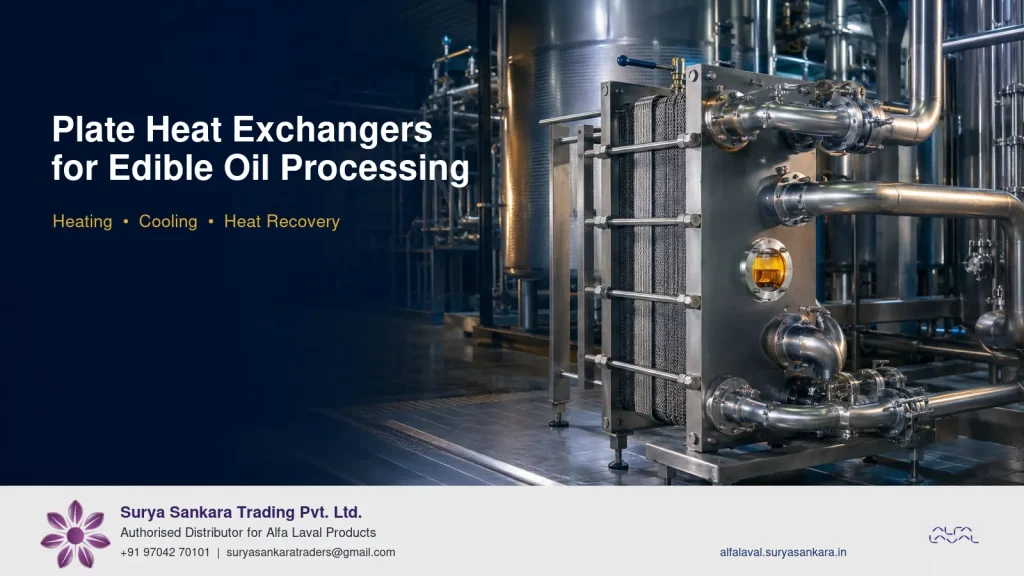
Plate Heat Exchangers for Edible Oil Processing: Heating, Cooling and Heat Recovery. Edible oil processing involves repeated heating, cooling and energy recovery. Crude-oil preparation, degumming, neutralization, washing, bleaching, winterization and deodorization all depend on controlled temperatures. Plate heat exchangers for edible oil processing can provide compact and efficient heat transfer for suitable duties, provided the oil properties, viscosity, fouling tendency, hygiene and cleaning requirements are correctly understood.
Vegetable oils behave differently from water. Viscosity changes significantly with temperature, some streams contain gums or suspended matter, and overheating may affect product quality or accelerate deposits. Heat-exchanger selection must therefore consider the complete refinery process rather than a nominal flow rate alone.
Surya Sankara Trading Pvt. Ltd. is an Authorised Distributor for Alfa Laval products. Based in Hyderabad, the company supports application discussions for edible-oil processors evaluating Alfa Laval heat-transfer equipment, genuine spares and after-sales support.
Why Temperature Control Matters in Edible Oil Refining
Refining removes or reduces gums, free fatty acids, pigments, trace metals, waxes, moisture, odours and other unwanted components. Each stage has a suitable operating-temperature window.
Accurate heat transfer can support:
- Stable viscosity for pumping and separation.
- Controlled conditioning before mixing or centrifugation.
- Effective heating before bleaching or deodorization.
- Product cooling before storage or packaging.
- Heat recovery between hot and cold oil streams.
- Reduced steam, hot-water or cooling-water demand.
- Consistent process control.
The required temperature and equipment type depend on the oil, refining route and plant design.
How a Plate Heat Exchanger Works with Edible Oil
In a gasketed plate-and-frame heat exchanger, hot and cold fluids pass through alternate channels separated by corrugated plates. The corrugations promote turbulence and support efficient heat transfer in a compact area.
For suitable oil duties, plate technology can provide:
- True counter-current flow.
- Close temperature approach.
- Compact footprint.
- Low liquid hold-up.
- Rapid response to temperature changes.
- Access for inspection and cleaning in gasketed designs.
- Flexible thermal area in selected configurations.
- Energy recovery between process streams.
However, high viscosity, large solids, gums, crystallizing components or severe fouling may require wider channels, another plate technology or a different exchanger design.
Edible Oil Applications
Crude-Oil Preheating
Crude vegetable oil may be heated to reduce viscosity and prepare it for conditioning, separation or refining. Feed contaminants and suspended matter must be considered during channel selection.
Degumming
Degumming involves controlled addition and mixing of water, acid or other conditioning agents to remove phospholipids. Temperature influences hydration, mixing and separation. A plate heat exchanger may be used to bring the oil to the required process temperature.
Neutralization and Washing
Chemical refining may require heating before alkali treatment, neutralization, washing or separator stages. Soapstock and emulsions can create fouling challenges if the exchanger is placed in an inappropriate location.
Bleaching-Oil Heating and Cooling
Oil is heated before contact with bleaching earth or activated carbon. After filtration, the oil may require heat exchange before the next stage. Fine solids carryover must be controlled to protect channels.
Deodorization Heat Recovery
Deodorization uses high temperature and vacuum to remove volatile compounds. Heat recovery between hot deodorized oil and incoming oil can reduce the external heating and cooling duty.
The exchanger for this service must be selected for temperature, pressure, vacuum-system integration, product quality and fouling. A standard gasketed exchanger is not automatically suitable for every deodorizer duty.
Winterization and Dewaxing
Some oils require controlled cooling to crystallize waxes before filtration or separation. Temperature approach and cooling rate can affect crystal formation. The exchanger must be designed as part of the complete winterization process.
Finished-Oil Cooling
Refined oil may be cooled before storage, blending or packaging. Cooling must be controlled to avoid unwanted crystallization or excessive viscosity.
Heat Recovery from Utility Streams
Hot condensate, process water or other clean utility streams may provide additional energy-recovery opportunities, subject to contamination risk and plant integration.
Oils Commonly Processed
Edible oil plants may handle:
- Soybean oil.
- Sunflower oil.
- Palm and palm-kernel oil.
- Rapeseed or canola oil.
- Rice-bran oil.
- Groundnut oil.
- Cottonseed oil.
- Sesame oil.
- Coconut oil.
- Corn oil.
- Other specialty oils and fats.
Each oil has different viscosity, wax content, gums, contaminants, cloud point and heat sensitivity. One plate configuration cannot be assumed suitable for every feedstock.
Viscosity and Pressure Drop
Oil viscosity generally decreases as temperature increases. At low temperature, a stream may become difficult to pump and create high pressure drop through narrow channels.
Design must consider:
- Viscosity at actual inlet and outlet temperatures.
- Minimum start-up temperature.
- Maximum and turndown flow.
- Allowable pressure drop.
- Pump capability.
- Channel gap and plate pattern.
- Risk of wax crystallization.
Using viscosity measured only at room temperature can produce an incorrect selection. Supply temperature-dependent physical-property data whenever possible.
Fouling Risks
Deposits in edible-oil duties may result from:
- Gums and phospholipids.
- Soapstock or emulsions.
- Bleaching-earth carryover.
- Filter-aid particles.
- Oxidized or polymerized oil.
- Waxes and crystals.
- Local overheating.
- Low channel velocity.
- Contaminated utility water.
Fouling reduces thermal performance and increases pressure drop. The design should balance channel velocity, shear, wall temperature, pressure loss and cleanability.
Upstream separation and filtration are often as important as exchanger geometry.
Hygienic and Product-Quality Considerations
Edible oil is a food product, so product-contact equipment must support the plant’s hygiene and food-safety programme.
Consider:
- Food-contact suitability of plates and gaskets.
- Drainability and product recovery.
- Absence of unsuitable dead zones.
- Cleanable piping and connections.
- Prevention of contamination from utility media.
- Product exposure to oxygen and excessive temperature.
- Cleaning validation.
- Traceability of replacement parts.
Where leakage between circuits would create significant risk, pressure relationships, monitoring and suitable double-wall or alternative construction may be evaluated.
Plate and Gasket Selection
Plate material must suit:
- The oil and refining chemicals.
- Chlorides and contaminants.
- Cleaning agents.
- Operating temperature.
- Corrosion conditions on the utility side.
Gasket material must be compatible with oil, chemicals, temperature and cleaning cycles. Some elastomers may swell, soften or harden when exposed to oils or solvents.
Do not choose a gasket merely because it is commonly used with water. Provide the complete process and cleaning chemistry for compatibility review.
Alfa Laval Heat Transfer in Edible Oil Systems
Alfa Laval supplies heat-transfer, separation and process-system technologies for vegetable-oil refining. Its official edible oil deodorization systems information identifies plate heat exchangers among the equipment used in refinery systems.
Depending on the duty, Alfa Laval technologies evaluated in an edible-oil plant may include:
- Gasketed plate-and-frame heat exchangers.
- Hygienic plate heat exchangers for suitable food duties.
- Wide-channel configurations for selected viscous or particle-containing streams.
- Welded plate technologies for demanding heat recovery.
- Specialized process-system equipment.
The appropriate model must be confirmed using current Alfa Laval data and the actual process conditions. Surya Sankara does not recommend a unit from oil type or plant capacity alone.
Alfa Laval official vegetable-oil order mentioning plate heat exchangers:
Heat Recovery and Energy Efficiency
Edible oil refineries can have simultaneous hot and cold process streams. A heat-integration study may identify opportunities to preheat incoming oil with hot outgoing oil.
Potential benefits include:
- Reduced steam or thermal-energy consumption.
- Lower cooling-water or refrigeration load.
- Smaller utility demand.
- Improved process-energy efficiency.
The study should examine:
- Stream availability and operating schedule.
- Temperature programme.
- Minimum approach temperature.
- Product pressure relationship.
- Allowable pressure drop.
- Fouling and cleaning.
- Leakage consequence.
- Bypass and control strategy.
- Payback based on actual utility cost.
Do not publish a universal heat-recovery percentage. Performance is specific to each thermal programme.
Information Needed for Selection
Product Information
- Oil type and refining stage.
- Crude, intermediate or refined condition.
- Composition and contaminants.
- Density, viscosity and specific heat versus temperature.
- Solids, gums, soaps, waxes or filtration carryover.
- Product-quality and hygiene requirements.
Thermal Duty
- Normal, minimum and maximum flow.
- Inlet and required outlet temperatures.
- Heating or cooling medium.
- Utility inlet and outlet temperatures.
- Batch or continuous operation.
- Heat load, if known.
Mechanical Data
- Operating and design pressure.
- Allowable pressure drop on both circuits.
- Design temperature.
- Connection size and standard.
- Installation space.
- Materials and plant-code requirements.
Cleaning Data
- Deposit type.
- Cleaning chemicals and concentration.
- Cleaning temperature and frequency.
- CIP or mechanical-cleaning preference.
- Required production run length.
Read How to Select a Plate Heat Exchanger for the broader selection process.
Cleaning Edible Oil Plate Heat Exchangers
Cleaning depends on the deposit and exchanger construction.
Product Recovery and Draining
Recover valuable oil before cleaning where the process design allows. Confirm safe isolation and drainage.
Pre-Rinse
A suitable warm pre-rinse may help remove residual product. Water introduction into an oil system must follow the plant procedure.
Chemical Cleaning
Cleaning chemistry must target the deposit while remaining compatible with plates, gaskets and piping. Verify concentration, temperature, circulation time and disposal method.
Mechanical Inspection
Gasketed units can be opened for inspection when required. Avoid tools that scratch or deform plates, and follow the specified tightening dimension during reassembly.
Verification
Evaluate pressure drop, heat duty, rinse condition and leakage before returning the exchanger to production.
Refer to the Plate Heat Exchanger Cleaning Guide.
Common Problems
High Oil-Side Pressure Drop
Possible causes include low oil temperature, increased viscosity, wax formation, blocked channels, solids carryover or excessive flow.
Reduced Heating or Cooling
Check fouling, flow, temperature, utility supply, bypassing, instrumentation and changes in oil properties.
Rapid Fouling
Review the exchanger’s location in the process, upstream filtration, wall temperature, velocity and cleaning procedure.
Gasket Deterioration
Check oil and chemical compatibility, temperature, cleaning conditions, storage, tightening and gasket age.
Leakage
Stop and inspect according to plant procedure. Possible causes include gasket damage, incorrect assembly, plate damage, corrosion or operating conditions outside the design.
Unwanted Crystallization
During cooling, a low wall temperature or unsuitable cooling profile may form wax crystals inside the exchanger. Review the complete winterization duty.
Maintenance Priorities
- Trend product and utility temperatures.
- Monitor flow and pressure drop.
- Inspect for external leakage.
- Record cleaning frequency.
- Verify frame tightening dimension.
- Inspect plates for fouling, corrosion and deformation.
- Check gaskets for swelling, hardening and loss of elasticity.
- Confirm plate sequence after maintenance.
- Use genuine, compatible replacement parts.
- Test before returning to food duty.
Read the Plate Heat Exchanger Maintenance Guide.
Edible Oil Processing in Hyderabad and South India
South India processes a wide range of oils, including rice-bran, groundnut, sunflower, cottonseed, palm, coconut and sesame oils. Refining and oil-processing businesses operate across Telangana, Andhra Pradesh, Karnataka, Tamil Nadu and Kerala.
Surya Sankara Trading Pvt. Ltd. is based in Hyderabad and handles application discussions for customers seeking Alfa Laval plate heat exchangers for edible oil processing in South India. For enquiries related to an edible oil heat exchanger in Hyderabad, vegetable-oil refining equipment in Telangana or oil heating and cooling elsewhere in South India, share the actual oil properties and process-stage data.
Location keywords help customers find support, but viscosity, fouling, food safety and the thermal duty determine equipment selection.
Why Work With Surya Sankara Trading Pvt. Ltd.?
As an Authorised Distributor for Alfa Laval products, Surya Sankara can support:
- Application consultation.
- Equipment selection coordination.
- Genuine Alfa Laval equipment, plates, gaskets and spares.
- Installation and commissioning guidance.
- Cleaning and maintenance planning.
- Troubleshooting coordination.
- After-sales support.
Surya Sankara Trading Pvt. Ltd. is an independent authorised distributor. This microsite is operated by Surya Sankara and is not Alfa Laval’s corporate website.
Frequently Asked Questions
Why are plate heat exchangers used in edible oil plants?
They can provide compact heating, cooling and heat recovery for suitable oil streams. The correct configuration depends on viscosity, fouling, solids, temperature and hygiene.
Can one heat exchanger handle different vegetable oils?
Possibly, but each oil and refining stage has different properties. The unit must be checked against all planned oils, temperatures, flow rates and cleaning requirements.
How does viscosity affect plate heat exchanger sizing?
Higher viscosity generally increases pressure drop and may reduce heat-transfer performance. Viscosity at actual operating temperatures is required for selection.
Can plate heat exchangers be used for deodorization heat recovery?
Plate technologies may be used in edible-oil deodorization systems, but the model and construction must match the temperature, pressure, fouling and process integration.
What causes fouling in edible-oil heat exchangers?
Gums, soaps, bleaching-earth carryover, waxes, oxidized oil, suspended solids and local overheating are possible causes.
Which gasket is suitable for vegetable oil?
Compatibility depends on oil, refining chemicals, temperature and cleaning agents. The gasket must be selected from complete application data.
Where can edible oil plants obtain Alfa Laval PHE support in South India?
Contact Hyderabad-based Surya Sankara Trading Pvt. Ltd., an Authorised Distributor for Alfa Laval products, for application-based selection and support.
Request an Edible Oil Heat-Transfer Review
Share the oil type, refining stage, composition, viscosity, solids, flow rate, inlet and outlet temperatures, utility conditions, pressure, allowable pressure drop, fouling history, cleaning method and installation details.
Surya Sankara Trading Pvt. Ltd.
Authorised Distributor for Alfa Laval products
Office: 5-5-35/153 A, Prashant Nagar, IDA Kukatpally, Hyderabad – 500072, Telangana
Phone: +91 97042 70101
Email: suryasankaratraders@gmail.com
Website: https://suryasankara.in/
Further readings on Plate Heat exchangers
- What is plate heat exchanger
- Benefits of plate heat exchangers
- Plate heat exchanger maintenance guide
- How to select a plate heat exchanger
- Common plate heat exchanger problems
- Plate heat xchanger cleaning guide
- Energy saving using plate heat exchanger
- Plate heat exchanger buying guide
- Plate heat echanger or pharmaceutical industry
- Plate heat exchanger for food & beverage processing